
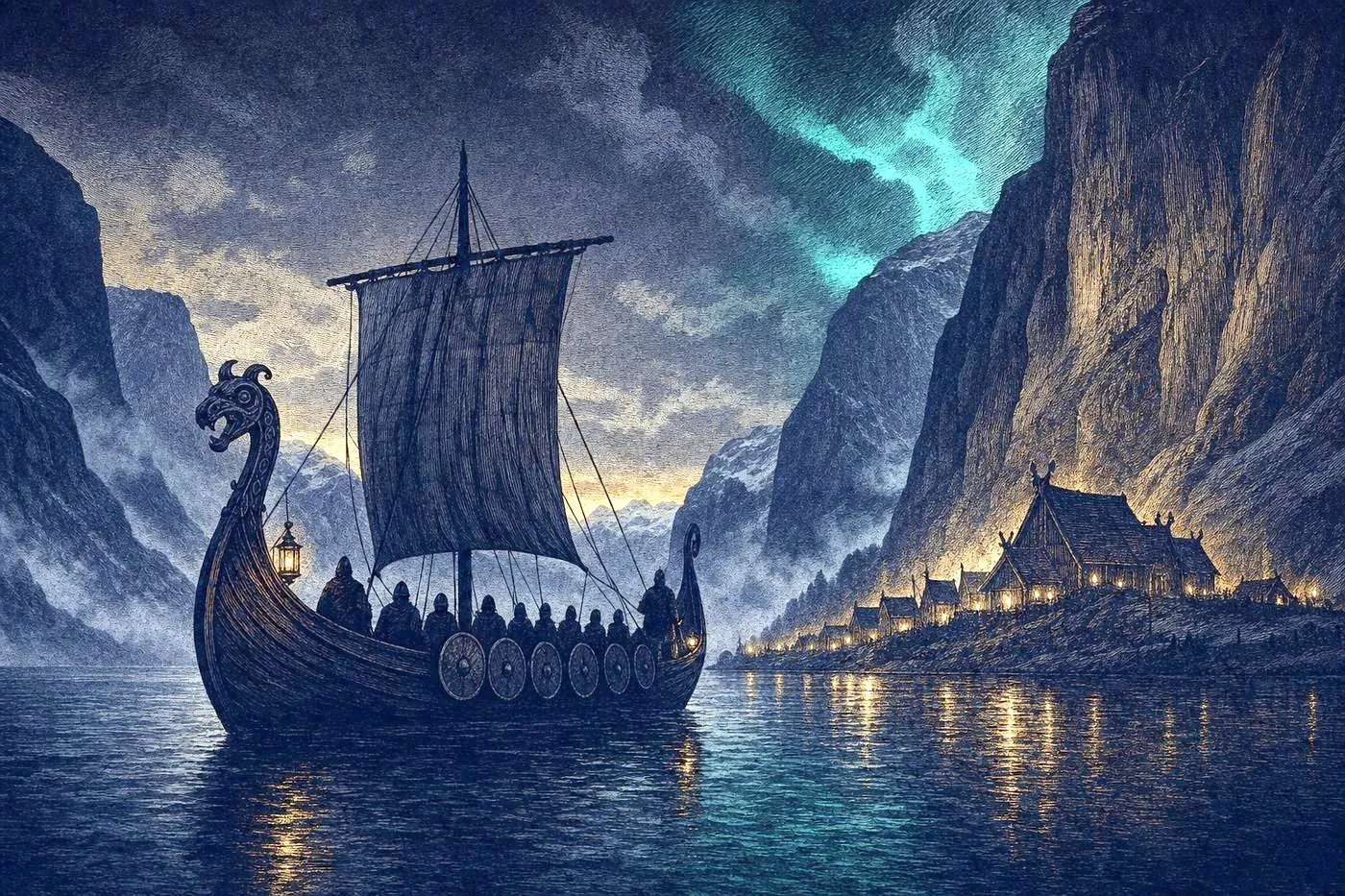
Raids and the Opening of the Viking Age
Historians conventionally date the start of the Viking Age to 793 AD, when Norse raiders attacked the monastery of Lindisfarne off the coast of Northumbria, an event recorded with shock by contemporary chroniclers as an assault on a sacred and previously untouched site. Over the following decades, seaborne raiders from Scandinavia, mostly from what is now Norway, Denmark, and Sweden, struck coastal and river settlements across the British Isles, Ireland, and continental Europe, exploiting fast, shallow-draft longships that could cross open sea and travel far up rivers alike. Raiding gradually gave way to more sustained campaigns and settlement. In 845 AD, a Viking fleet sailed up the Seine and sacked Paris, part of a wave of attacks on Frankish territory that forced Frankish rulers to pay tribute, known as Danegeld, in an effort to buy peace. By the mid-ninth century, Viking activity in Western Europe had shifted from opportunistic raiding toward more ambitious efforts at conquest and permanent settlement.

Conquest and Settlement Across Europe
In 865 AD, a large Scandinavian force remembered in English sources as the Great Heathen Army landed in East Anglia and began a sustained campaign of conquest across Anglo-Saxon England, eventually overrunning several of the kingdom’s independent territories. Resistance led chiefly by Alfred the Great of Wessex checked further Viking expansion in England and led to a rough territorial division, with Norse rule and law prevailing in a region later known as the Danelaw. On the continent, Norse settlement took a different form: in 911 AD, the Frankish king Charles the Simple granted the Viking leader Rollo territory around the mouth of the Seine under the Treaty of Saint-Clair-sur-Epte, in exchange for Rollo’s conversion to Christianity and nominal loyalty to the Frankish crown. This settlement became the Duchy of Normandy, whose Norse-descended rulers would, generations later, play a decisive role in English history. Viking voyagers also pushed further still, settling Iceland from the late ninth century, reaching Greenland under Erik the Red around 985 AD, and briefly establishing a settlement at L’Anse aux Meadows in what is now Newfoundland, the first confirmed European presence in North America, roughly five centuries before Columbus.
Danish Kings and the End of the Viking Age
Viking political ambition in England reached its peak in the early eleventh century. Sweyn Forkbeard of Denmark conquered England outright in 1013, and his son Cnut the Great ruled as king of England from 1016, eventually presiding over a North Sea empire that also included Denmark and Norway. Cnut’s death in 1035 fractured this union, and Anglo-Saxon rule was restored in England under Edward the Confessor. The Viking Age is conventionally treated as closing in 1066, a year that saw two decisive battles: at Stamford Bridge in September, King Harold II of England defeated an invading force led by the Norwegian king Harald Hardrada, ending Hardrada’s bid for the English throne and, by most traditional accounts, marking the last major Viking invasion of England. Weeks later, Harold’s own army, exhausted from that battle, was defeated by William of Normandy, himself a descendant of the Viking settler Rollo, at the Battle of Hastings, an event that closes the Viking Age in English history even as Scandinavian influence persisted in law, language, and settlement patterns for generations afterward.