
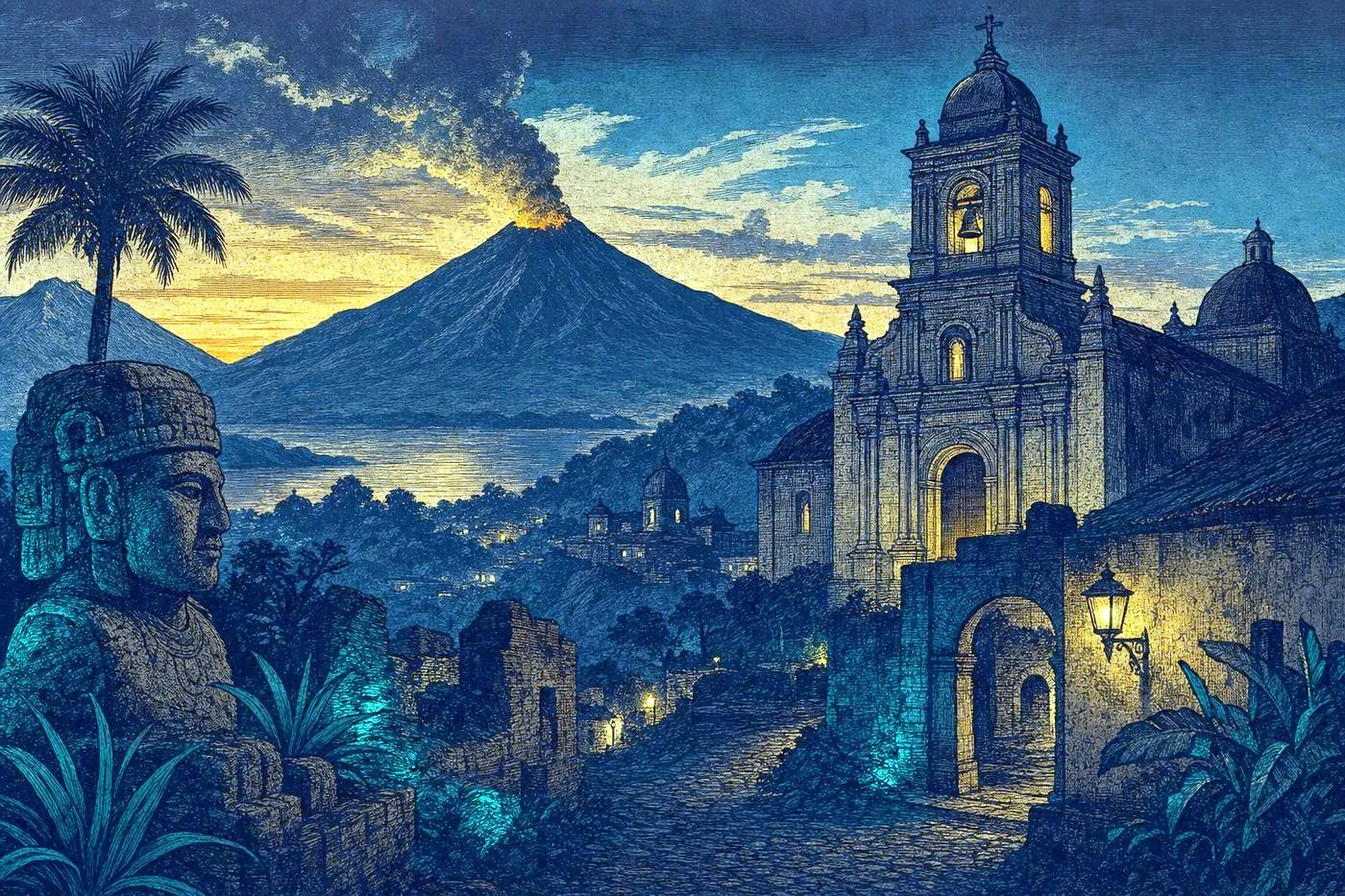
This El Salvador history timeline traces the country from its indigenous Pipil kingdom through Spanish colonization and independence to the civil war that dominated the late twentieth century.
Indigenous Cuzcatlán and Spanish Conquest
Before European contact, the territory of present-day El Salvador was home to the kingdom of Cuzcatlán, established by Nahua-speaking Pipil peoples who had migrated into the region, alongside other indigenous groups including the Lenca and Maya-descended communities in parts of the territory. Cuzcatlán was a significant regional power by the time Spanish conquistador Pedro de Alvarado, fresh from campaigns in Guatemala, led military expeditions into the area beginning in 1524. Alvarado’s initial force was repelled and wounded in early engagements, and it took repeated campaigns over the following years, led in part by his relatives, before Spanish colonial control was substantially consolidated by around 1528. Under Spanish rule, the territory was administered as part of the Captaincy General of Guatemala, its economy shaped over the following centuries by agricultural production, notably indigo, that relied heavily on indigenous and, to a lesser extent, enslaved labor.
Independence and the Path to Statehood
El Salvador, along with the rest of Central America, declared independence from Spain in 1821, initially as part of a short-lived union first with the Mexican Empire and then with the Federal Republic of Central America. That federation proved unstable and fractured amid recurring conflict among its member states, and El Salvador emerged as a fully sovereign republic in 1841. The following century brought a familiar pattern for the region: an economy increasingly dependent on a single export crop, coffee in El Salvador’s case, alongside deep social inequality and a political system dominated by a small landholding elite, sometimes referred to as the “fourteen families,” and, for long stretches, the military. That inequality erupted violently in 1932, when a peasant and indigenous uprising in western El Salvador was suppressed by the military government of Maximiliano Hernández Martínez in a massacre, remembered as La Matanza, that killed an estimated 10,000 to 30,000 people and durably weakened indigenous cultural identity in the region.
Civil War and Its Resolution
Rising social tension and repression culminated in the outbreak of civil war in 1979 between a series of military-led governments, heavily supported by the United States, and a coalition of leftist guerrilla groups that united as the Farabundo Martí National Liberation Front (FMLN). The conflict was marked by severe human rights abuses on multiple sides, including the assassination of Archbishop Óscar Romero in March 1980 while he was celebrating Mass, an act that drew international condemnation, and a death toll that a subsequent United Nations Truth Commission and other estimates place at roughly 75,000, with tens of thousands more displaced or disappeared. The war ended with the Chapultepec Peace Accords, signed in Mexico City in January 1992 under United Nations mediation, which demobilized the FMLN as an armed group, provided for reforms to the military and judiciary, and allowed the former guerrilla movement to compete as a political party. A UN-backed Truth Commission subsequently documented the scale of wartime atrocities, though a 1993 amnesty law shielded most perpetrators from prosecution for many years. The postwar transition has shaped El Salvador’s democratic politics in the decades since, alongside newer challenges including gang-related violence and large-scale emigration.