
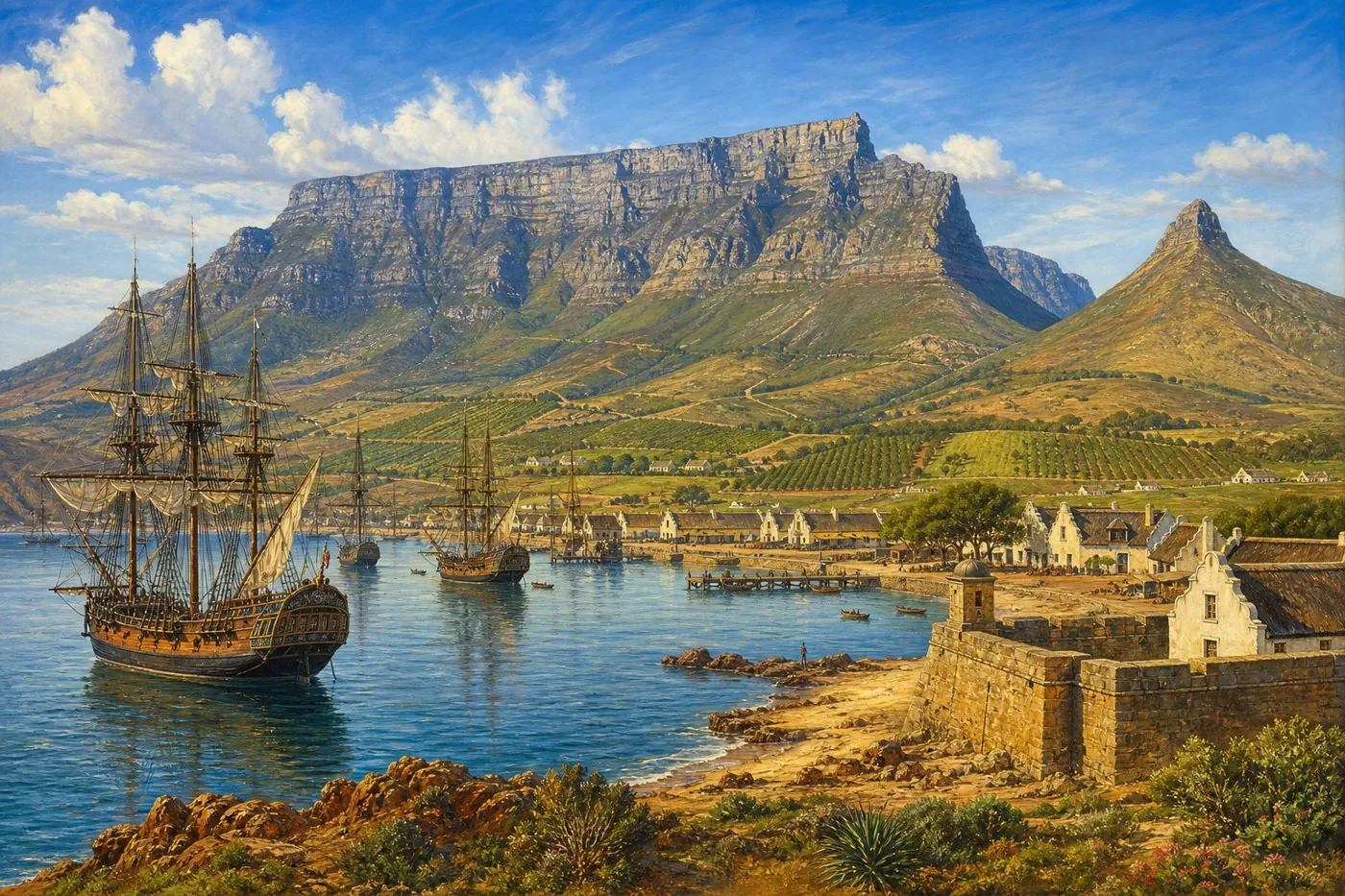
This south africa history timeline traces a story that runs from the region’s earliest Indigenous peoples through Dutch and British colonization, mineral-driven conflict, and one of the twentieth century’s defining struggles against institutionalized racism. It takes in the founding of Cape Colony in 1652, the formation of the Union of South Africa in 1910, and the apartheid era that ended with Nelson Mandela’s rise to the presidency in the 1990s.
South Africa History Timeline: Early Peoples and Colonial Settlement
Long before European contact, the region was home to San hunter-gatherers and Khoikhoi herders, collectively known as Khoisan peoples, whose ancestors are thought to descend from some of the earliest anatomically modern humans in southern Africa. From roughly the early centuries CE, Bantu-speaking farming and iron-working communities migrated south and east across the continent, reaching present-day KwaZulu-Natal by around 300 CE according to archaeological evidence, and gradually settling much of the eastern region over the following centuries, at times intermixing with existing Khoisan communities.
European contact began in earnest in 1652, when the Dutch East India Company sent Jan van Riebeeck to build a supply station at the Cape of Good Hope, meant only to resupply ships sailing between Europe and Asia. That outpost grew into a permanent settler colony, and Britain seized control of the Cape during the Napoleonic Wars, holding it permanently from 1814. Resenting British rule, particularly the abolition of slavery in the empire in the 1830s, thousands of Dutch-descended farmers known as Voortrekkers left the Cape in the Great Trek of the 1830s and 1840s, pushing inland to found independent Boer republics, chiefly the South African Republic (Transvaal) and the Orange Free State.
South Africa History Timeline: War, Union, and the Road to Apartheid
The discovery of diamonds near Kimberley in 1867 and gold on the Witwatersrand in 1886 transformed the region’s economy almost overnight, drawing prospectors, migrant laborers, and foreign capital, and sharpening British ambitions to control the mineral-rich Boer republics. Tensions over land, taxation, and political rights for non-Boer settlers erupted into the Second Boer War of 1899 to 1902, a costly conflict in which Britain eventually prevailed only after adopting scorched-earth tactics and confining Boer civilians in concentration camps, where thousands died, mostly of disease.
In 1910, the Cape, Natal, Transvaal, and Orange River colonies were unified as the self-governing Union of South Africa within the British Empire, but political power remained overwhelmingly reserved for the white minority. That exclusion hardened dramatically in 1948, when the National Party won a narrow election victory and began systematically codifying racial segregation into law under the policy known as apartheid, extending earlier colonial-era restrictions into a comprehensive legal system controlling where Black South Africans could live, work, and move.
South Africa History Timeline: Apartheid and the Birth of Democracy
Under apartheid, millions of Black South Africans were forcibly relocated to designated “homelands,” denied the vote in national elections, and subjected to pass laws restricting their movement, while resistance organizations including the African National Congress faced banning and mounting repression. The ANC’s Nelson Mandela, whose fuller life story is told on our separate Nelson Mandela timeline, was among many activists imprisoned for decades as the movement continued underground and in exile, while international pressure, including trade sanctions and sporting boycotts, steadily isolated the apartheid government through the 1970s and 1980s.
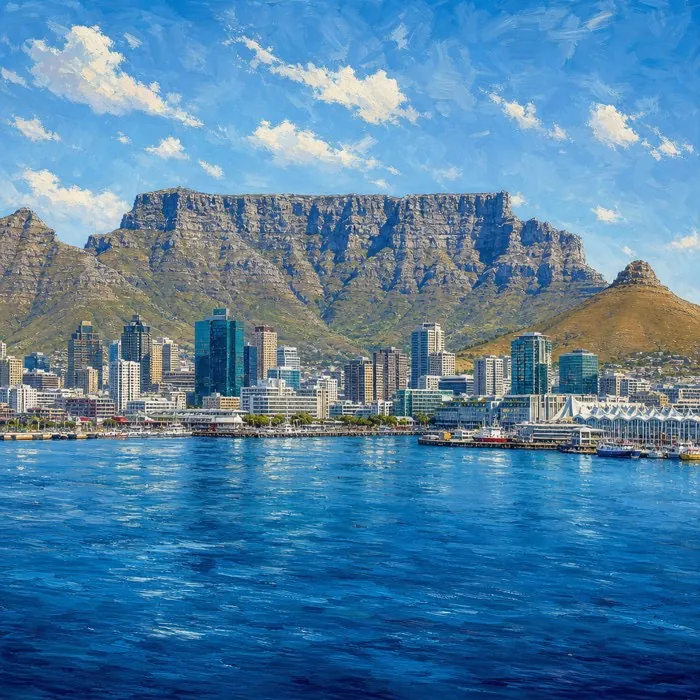
Facing sustained resistance and mounting external pressure, President F.W. de Klerk unbanned the ANC in February 1990, and Mandela was released from prison days later, on 11 February, after 27 years. Negotiation followed, culminating in South Africa’s first election open to voters of every race on 27 April 1994. More than twenty million South Africans voted, the ANC won decisively, and Mandela was inaugurated as the country’s first democratically elected president that May, formally closing the apartheid era. South Africa has remained a multiracial democracy since, under a constitution ranked among the world’s most progressive.
Frequently Asked Questions
When was South Africa first colonized by Europeans?
Dutch settlement began in 1652, when the Dutch East India Company established a resupply station at the Cape of Good Hope under Jan van Riebeeck; Britain later took control of the Cape, holding it permanently from 1814.
What was apartheid and when did it happen?
Apartheid was a system of legally enforced racial segregation and white minority rule, formally introduced after the National Party's 1948 election victory and dismantled through negotiations that led to South Africa's first multiracial election in 1994.
When was Nelson Mandela released from prison and elected president?
Mandela was released on 11 February 1990 after 27 years in prison, and was inaugurated as South Africa's first democratically elected president in May 1994 following the election of 27 April that year.
How many official languages does South Africa have?
South Africa's 1996 constitution originally recognized 11 official languages, and South African Sign Language was added as a 12th official language in 2023, reflecting the country's exceptional linguistic diversity.