
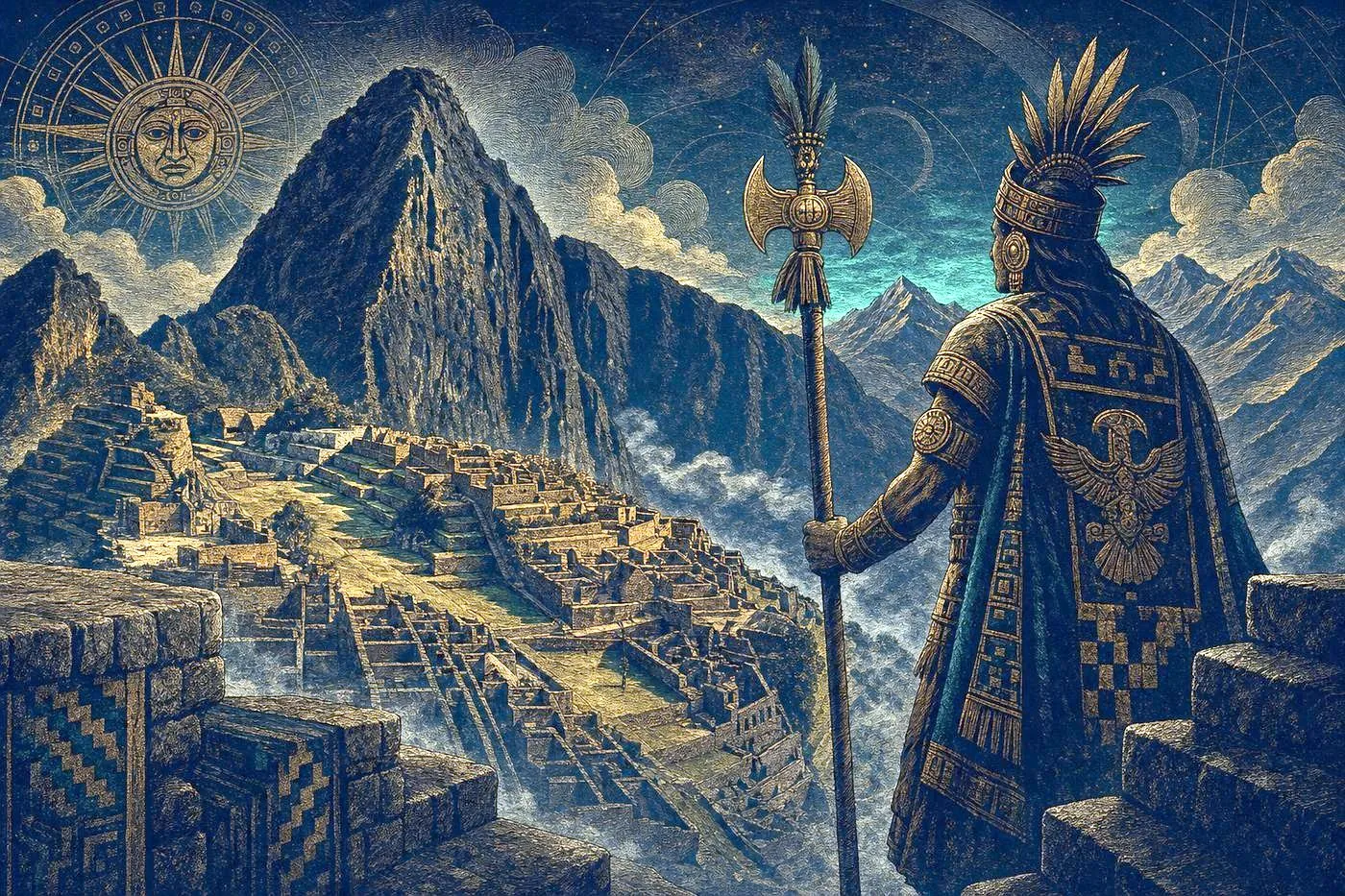
This Inca Empire timeline of events traces its growth from a small Andean kingdom centered on Cusco to South America’s largest pre-Columbian empire, and its rapid collapse following the arrival of Spanish forces under Francisco Pizarro.
The Inca Empire Timeline: From Cusco to Rapid Expansion
Inca tradition holds that the city of Cusco, high in the Peruvian Andes, was founded around 1200 by Manco Cápac, the legendary first Inca ruler; as with many origin accounts preserved through oral tradition rather than written record, the precise date should be treated as approximate. For roughly two centuries, the Inca remained one among several regional Andean powers, controlling little beyond the Cusco valley. That changed dramatically in 1438, when Pachacuti took power after leading a successful defense of Cusco against a rival group’s invasion and began a rapid campaign of territorial conquest. Pachacuti is generally credited with transforming the kingdom into an expansive empire the Inca called Tawantinsuyu, meaning roughly “the four regions together.” Under Pachacuti and his immediate successors, Inca control rapidly extended along the Andes through further conquest, eventually stretching from present-day southern Colombia to central Chile, making it the largest empire in the pre-Columbian Americas.
Administration, Roads, and Inca Achievement
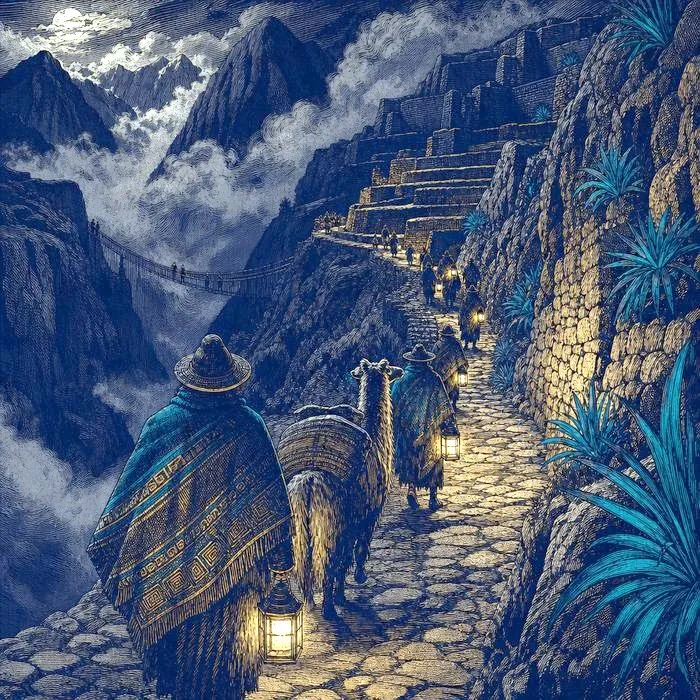
Governing such a vast and geographically difficult territory required sophisticated infrastructure. The Inca built the Qhapaq Ñan, an extensive network of roads and bridges connecting the empire across mountains, deserts, and rainforest, supporting the movement of soldiers, officials, and goods. Lacking a conventional writing system, Inca administrators instead relied on quipu, devices made of knotted cords, to record numerical and administrative information across the empire’s provinces; scholars continue to debate how much narrative, not just numerical, information quipu could encode. The empire imposed a common language, Quechua, and a labor-tax system known as mita, through which communities provided rotating labor for state projects, in place of monetary taxation. This administrative structure allowed a relatively small ruling class to govern millions of subjects across enormously varied terrain.
Civil War, Conquest, and the History of the Empire’s Collapse
By the time Spanish forces reached the Andes in the early 1530s, the empire was already destabilized by a succession dispute between two half-brothers, Atahualpa and Huáscar, whose rivalry had escalated into open civil war after their father’s death, reportedly from a European-introduced disease that had spread ahead of the Spanish themselves. Francisco Pizarro exploited this division, ambushing and capturing Atahualpa at Cajamarca in 1532 despite being vastly outnumbered. Although the Inca supplied an enormous ransom in gold and silver for his release, Spanish forces executed Atahualpa in 1533 and occupied Cusco later that year. Resistance did not end immediately: a rump Inca state survived in the remote mountain region of Vilcabamba for decades, but this final holdout fell in 1572, when Spanish forces captured Vilcabamba and executed its ruler, Túpac Amaru, extinguishing organized Inca political resistance roughly forty years after Pizarro’s first landing. Told as a history of the Inca Empire timeline, this final Spanish conquest closes an Inca Empire timeline of events that began with Pachacuti’s fifteenth-century expansion. Barely a century separates the empire’s greatest extent from its complete collapse, a fact any honest history of the Inca Empire timeline has to reckon with.
Frequently Asked Questions
What topics does this timeline of the Inca Empire cover?
This timeline covers the traditional founding of Cusco around 1200, Pachacuti's rise and rapid imperial expansion from 1438, the empire's road and administrative systems, the civil war between Atahualpa and Huáscar, Pizarro's capture of Atahualpa in 1532, and the final fall of Inca resistance at Vilcabamba in 1572.
How big was the Inca Empire at its height?
At its greatest extent, the Inca Empire stretched along the Andes from present-day southern Colombia to central Chile, making it the largest empire in the pre-Columbian Americas, administered through a shared language, road network, and labor-tax system.
How did the Spanish conquer the Inca Empire so quickly?
Francisco Pizarro's small force benefited from an ongoing Inca civil war between Atahualpa and Huáscar, superior weapons and cavalry, and the disruptive effects of European diseases that had already spread through the population before the Spanish fully arrived.
When did Inca resistance to Spanish rule finally end?
Organized Inca resistance continued from a remote mountain stronghold at Vilcabamba until 1572, when Spanish forces captured it and executed its ruler, Túpac Amaru, roughly forty years after Atahualpa's capture at Cajamarca.