
Unification and the Old Kingdom
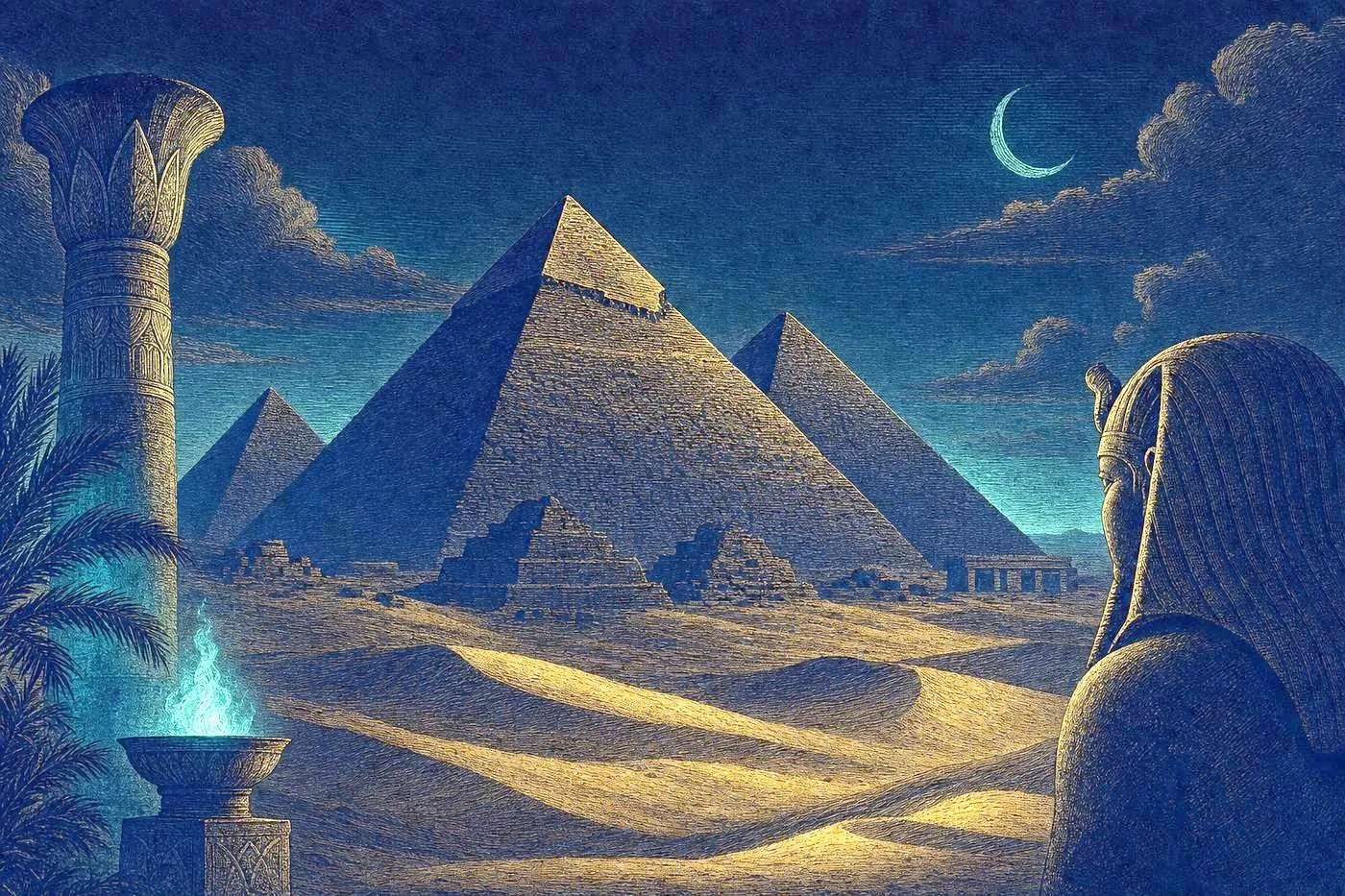
Ancient Egyptian civilization is conventionally dated from around 3100 BC, when Upper and Lower Egypt were unified into a single kingdom under a ruler traditionally identified as Narmer (sometimes equated with a legendary king called Menes in later king-lists). This unification established the First Dynasty and the pattern of centralized rule under a god-king, or pharaoh, that would define Egyptian civilization for the next three thousand years. The Old Kingdom, beginning around 2686 BC, is often called the age of the pyramids. Its most famous monument, the Great Pyramid of Giza, was built for the pharaoh Khufu around 2560 BC as part of a vast royal necropolis on the Giza plateau, alongside two other major pyramids and the Great Sphinx. These monuments required enormous organizational capacity: surveying, quarrying, transport, and the coordination of a large workforce. They reflect a highly centralized state built around the belief that the pharaoh’s afterlife secured order, or maat, for Egypt as a whole. Archaeological work at nearby workers’ villages has done much to correct an older popular assumption that the pyramids were built by enslaved labor; the evidence instead points to organized crews of paid laborers, likely supplemented by rotating agricultural workers during the Nile’s annual flood season. The Old Kingdom eventually fragmented into a period of decentralized rule known as the First Intermediate Period, though Egyptian civilization recovered and rebuilt central authority under the Middle Kingdom, beginning around 2055 BC, before fragmenting again and later reunifying as the New Kingdom.
The New Kingdom and Its Pharaohs
Egypt’s greatest territorial and cultural reach came during the New Kingdom, roughly 1550 to 1070 BC, when a series of powerful pharaohs expanded Egyptian influence into the Levant and Nubia. Hatshepsut, one of the few women to rule as pharaoh in her own right, oversaw a reign of approximately 1479 to 1458 BC noted for extensive building projects and trade expeditions, including a well-documented voyage to the land of Punt. Tutankhamun, who reigned roughly 1332 to 1323 BC and died young, is far better known today for the near-intact state of his tomb, discovered in 1922, than for any major achievement during his short rule. Ramesses II, who reigned from about 1279 to 1213 BC, is generally regarded as the New Kingdom’s most prominent pharaoh: his reign of over sixty years included the Battle of Kadesh against the Hittite Empire and one of the earliest surviving peace treaties in history, alongside an unmatched building program that included the temples at Abu Simbel.
Decline and the End of Pharaonic Egypt
After the New Kingdom, Egypt entered a long period of fluctuating fortunes, at times ruled by Libyan, Nubian, Assyrian, and Persian dynasties. Alexander the Great’s conquest in 332 BC ended Persian control and led to the establishment of the Ptolemaic dynasty, a Greek-speaking royal line founded by Alexander’s general Ptolemy, which ruled Egypt for nearly three centuries from the new city of Alexandria. The Ptolemaic period ended with its final and best-known ruler, Cleopatra VII, whose alliances with Julius Caesar and later Mark Antony placed Egypt at the center of Roman political conflict. Her death in 30 BC, following defeat at the Battle of Actium, marked the end of pharaonic rule; Egypt was absorbed as a province of the Roman Empire, closing more than three thousand years of continuous, if repeatedly interrupted, Egyptian civilization. Much of what is known about that civilization’s earlier periods still rests on inscriptions, tomb paintings, and administrative records that survive only in fragments, so specific dates and reign lengths (especially for the earliest dynasties) are frequently given by historians as approximate rather than exact.