This mexico history timeline traces the country from the fall of the Aztec Empire through three centuries of Spanish colonial rule to independence, revolution, and the modern republic that exists today. For the Mesoamerican civilization that preceded Spanish contact, see this site’s dedicated Aztec Empire timeline; this page picks up the story at the conquest and follows Mexico forward to the present.
Mexico History Timeline: Conquest and Colonial New Spain
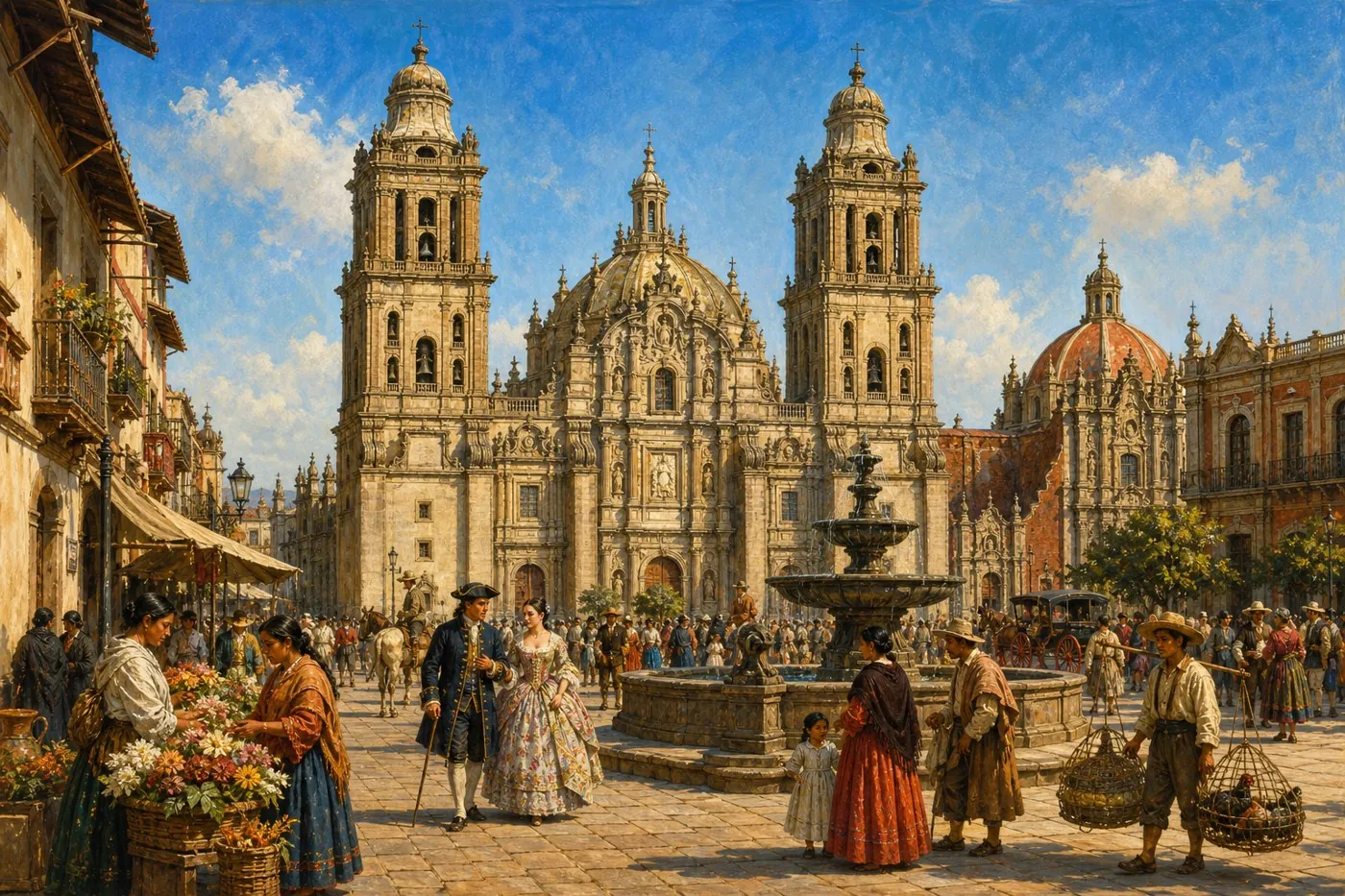
Spanish forces under Hernán Cortés, aided by Indigenous allies resentful of Aztec rule, captured the Aztec capital of Tenochtitlan in 1521, ending Mesoamerican imperial rule in the Valley of Mexico. Spain moved quickly to formalize its control, and by 1535 the crown had established the Viceroyalty of New Spain, with Antonio de Mendoza arriving as its first viceroy to govern from a rebuilt Mexico City. Over the following three centuries, New Spain became one of Spain’s wealthiest colonial holdings, its economy built substantially on silver mining, agriculture, and forced and coerced Indigenous labor. Catholic missionaries built churches and monasteries across the territory, and a complex colonial society emerged that mixed Spanish, Indigenous, and African populations, along with the racial hierarchies the colonial administration imposed to govern them. Mexico City grew into one of the largest and most important cities in the Americas, home to a viceregal court, a university founded in 1551, and a printing press that made it an early center of learning in the hemisphere. This colonial order, however, concentrated land and political power narrowly among Spanish-born and American-born elites, tensions that would eventually help drive the independence movement of the early nineteenth century.
Mexico History Timeline: Independence and a Turbulent Nineteenth Century
Mexican independence began on September 16, 1810, when the priest Miguel Hidalgo y Costilla issued his famous Grito de Dolores, calling for an end to Spanish rule. Hidalgo was captured and executed within a year, but other leaders, including José María Morelos and later Vicente Guerrero, carried the war forward until Spain formally recognized Mexican independence in the Treaty of Córdoba on August 24, 1821. The new nation’s early decades proved unstable, marked by a brief empire under Agustín de Iturbide, frequent changes of government, and the loss of Texas in the 1830s. Conflict with the United States culminated in the Mexican-American War of 1846 to 1848, after which Mexico ceded roughly half its territory, including present-day California, Texas, and the Southwest, under the Treaty of Guadalupe Hidalgo. Political struggles between liberal and conservative factions continued through the mid-century Reform era associated with President Benito Juárez and a brief French-imposed monarchy under Maximilian I, which Mexican republican forces defeated in 1867, restoring the republic before the long Díaz dictatorship that followed.
Mexico History Timeline: Revolution and the Modern Republic
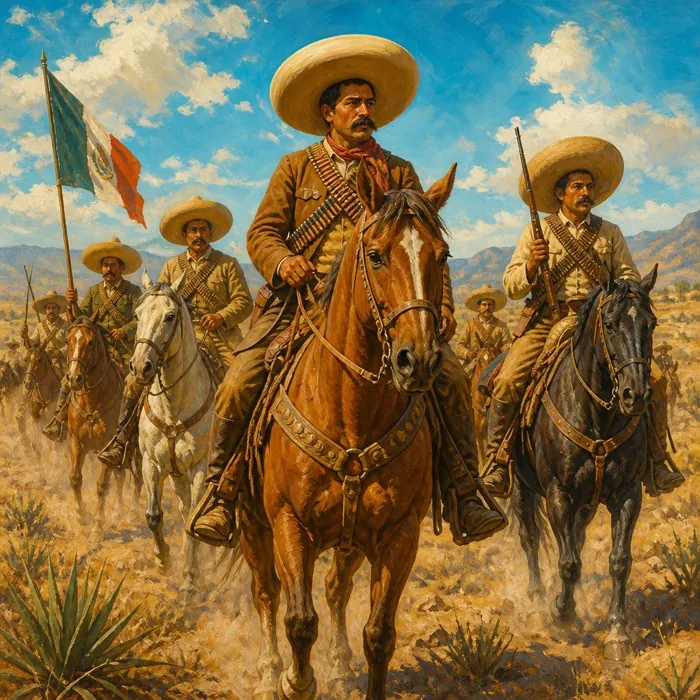
By 1910, decades of dictatorship under Porfirio Díaz had produced deep inequality alongside economic modernization, and discontent erupted into the Mexican Revolution, a decade of civil war involving leaders such as Francisco Madero, Emiliano Zapata, Pancho Villa, and Venustiano Carranza. The conflict, which claimed an estimated one million lives, produced the Constitution of 1917, drafted at Querétaro, which enshrined land reform, workers’ rights, and restrictions on the Catholic Church’s political role, and still forms the legal basis of the Mexican state today. Political stability returned gradually under a single dominant party, ultimately known as the Institutional Revolutionary Party (PRI), which governed continuously for 71 years. That era of one-party dominance ended in 2000, when opposition candidate Vicente Fox won the presidency in an election widely regarded as Mexico’s freest and fairest to that point, marking a landmark transition toward genuine multiparty democracy. In the decades since, Mexico has developed into one of the world’s larger economies, closely tied to the United States and Canada through trade, while continuing to navigate the challenges of drug-related violence, migration, and economic inequality that shape the country’s public life into the present day.
Frequently Asked Questions
When did Mexico become independent from Spain?
Mexico's war for independence began in 1810 and ended with Spain's recognition of independence through the Treaty of Córdoba, signed on August 24, 1821.
Who started the Mexican independence movement?
The priest Miguel Hidalgo y Costilla launched the movement with his Grito de Dolores on September 16, 1810, a date Mexico now celebrates as Independence Day.
What caused the Mexican Revolution?
Widespread discontent with the long dictatorship of Porfirio Díaz, including deep inequality in land ownership, triggered the Mexican Revolution in 1910, a decade-long conflict that reshaped Mexican politics and society.
How long did the PRI govern Mexico?
The Institutional Revolutionary Party and its predecessor governed Mexico continuously for 71 years, from the aftermath of the Revolution until Vicente Fox's opposition victory in the 2000 presidential election.