
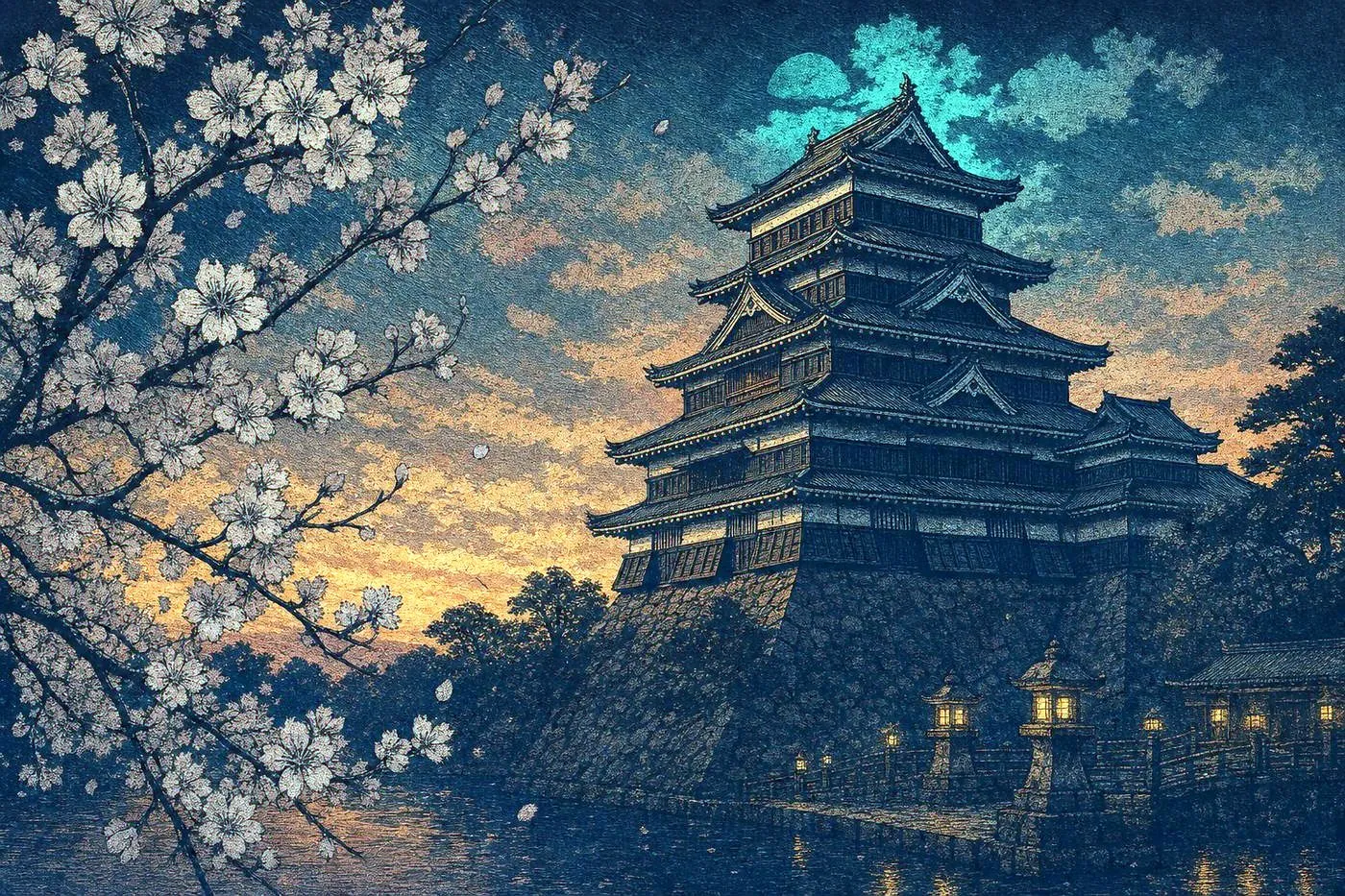
This timeline of ancient Japan traces the archipelago’s story from the earliest Jomon hunter-gatherers through the age of the shoguns to the 1868 Meiji Restoration.
Jomon and Yayoi Japan
Japan’s earliest identified culture, the Jomon period, spans an extraordinarily long stretch from roughly 14,000 BCE to around 300 BCE, though exact starting dates vary among researchers. Jomon communities were largely hunter-gatherers who nonetheless lived in relatively settled communities and produced some of the world’s earliest known pottery, decorated with cord-marked patterns that give the period its name. Around 300 BCE, the Yayoi period brought significant change, as wet-rice agriculture, bronze and iron metalworking, and new weaving techniques spread through the archipelago, likely introduced through contact and migration from the Korean peninsula and mainland Asia. These developments supported larger, more hierarchical communities organized around regional chiefdoms, and set the stage for the emergence of early states, one of which, described in Chinese historical records as the kingdom of Yamatai under a ruler named Himiko, is often cited as an early precursor of centralized Japanese political authority, though its exact location remains debated.
The Imperial Court and the Rise of the Shoguns
By the mid-1st millennium CE, a centralized imperial court had emerged, heavily influenced by Chinese Tang-dynasty models of government, law, and culture. In 710 CE, the court established its first permanent capital at Nara, and Buddhism, introduced earlier from Korea and China, became deeply embedded in Japanese religious and cultural life alongside native Shinto beliefs. The capital later moved to Heian-kyo (modern Kyoto) in 794, beginning the Heian period, celebrated for refined court culture and works such as “The Tale of Genji.” Real political power gradually shifted away from the imperial court toward regional warrior clans, and in 1192 Minamoto no Yoritomo was appointed shogun, establishing the Kamakura shogunate. This marked the beginning of nearly seven centuries in which Japan was effectively governed by successive military shogunates while the emperor retained largely ceremonial authority, an era that also saw Japan repel two attempted Mongol invasions in 1274 and 1281, storms later remembered as the “kamikaze,” or divine wind, that scattered the invading fleets. The Kamakura shogunate eventually gave way to the Ashikaga shogunate in the 14th century, a period that saw the flourishing of Noh theater and tea ceremony alongside prolonged civil conflict.
The Tokugawa Era and the Meiji Restoration
After a prolonged period of civil conflict known as the Sengoku (“Warring States”) era, Tokugawa Ieyasu unified the country and, in 1603, was appointed shogun, founding the Tokugawa shogunate based at Edo (present-day Tokyo). The Tokugawa era brought over two centuries of relative internal peace and strict social order, alongside a policy of national seclusion, or sakoku, that severely restricted contact with the outside world, though limited trade continued with the Dutch and others through the port of Nagasaki. This isolation ended in the 1850s under pressure from Western powers, most notably the arrival of American Commodore Matthew Perry’s fleet in 1853, which forced Japan to open to foreign trade. The resulting political crisis, combined with internal opposition to shogunal rule, culminated in the Meiji Restoration of 1868, when imperial rule was formally restored under the young Emperor Meiji. The shogunate and Japan’s feudal samurai class system were abolished, the capital moved from Kyoto to Edo, renamed Tokyo, and the new Meiji government pursued rapid modernization and industrialization, adopting Western legal, educational, and military models that transformed Japan within decades into a major world power.