
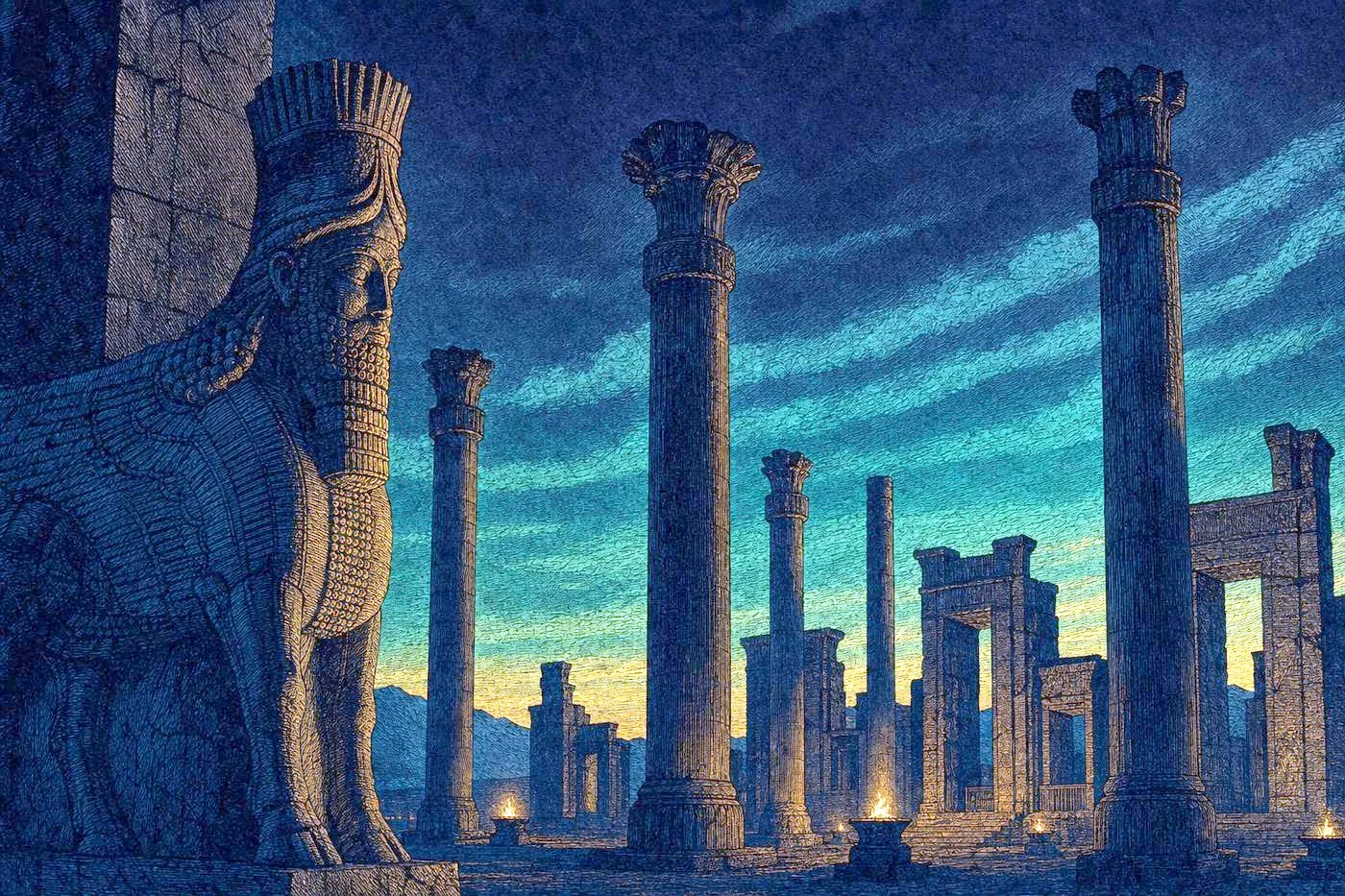
This Iran history timeline traces the country’s path from the ancient Achaemenid Persian Empire through the Islamic Revolution of 1979, tracking the dynasties, conquests, and religious shifts that shaped one of the world’s oldest continuous civilizations.
The Ancient Persian Empires
Iran’s recorded history begins with the rise of the Achaemenid Empire around 550 BCE, when Cyrus the Great united the Persian and Median peoples into a single state. Under Cyrus and his successors, the empire expanded into the largest the ancient world had yet seen, stretching from parts of the Balkans and Egypt to the Indus Valley, and developing an administrative system of provinces, roads, and communication that later empires would imitate. Achaemenid rule ended in 331 BCE, when Alexander the Great defeated the last Achaemenid king, Darius III, bringing Persia briefly under Hellenistic Greek influence. Persian statehood re-emerged under later dynasties, most notably the Sasanian Empire, founded in the early third century CE, which restored a distinctly Persian imperial identity and Zoroastrian religious tradition that endured for roughly four centuries.
That long era of Persian imperial continuity ended in 651 CE, when Arab Muslim armies completed the conquest of the weakened Sasanian state. The conquest introduced Islam to the Iranian plateau, and over the following centuries most of the population gradually converted, while Persian language, literature, and administrative traditions survived and blended with the new Islamic and Arabic influences arriving from the wider Muslim world.
The Safavid Empire and the Rise of Shia Iran
A pivotal turning point came in 1501, when Ismail I founded the Safavid Empire and declared Twelver Shia Islam the state religion, a decision that set Iran apart religiously from most of its Sunni Muslim neighbors and remains a defining feature of Iranian identity to this day. The Safavid period is often regarded as a golden age of Persian art, architecture, and statecraft, centered on the capital of Isfahan. Safavid rule eventually gave way to a succession of shorter-lived dynasties, and by the late eighteenth century the Qajar dynasty had established control, presiding over a period in which Iran increasingly found itself caught between the competing imperial interests of Russia and Britain, and lost considerable territory and sovereignty as a result.
From the Pahlavi Era to the Islamic Republic
In 1925, Reza Shah deposed the last Qajar ruler and founded the Pahlavi dynasty, pursuing an ambitious program of modernization, secularization, and centralized state-building modeled partly on contemporary Turkey. It was under Reza Shah, in 1935, that the country requested the international community use the name Iran rather than Persia. His son, Mohammad Reza Pahlavi, ruled through the mid-twentieth century, overseeing rapid economic development fueled by oil wealth alongside growing authoritarianism and widening opposition from religious, nationalist, and leftist groups alike.
That opposition culminated in the Islamic Revolution of 1979. Mass demonstrations and strikes forced the Shah into exile, and Ayatollah Ruhollah Khomeini, a cleric who had spent years in exile for opposing the monarchy, returned to Iran to lead the founding of the Islamic Republic. The revolution ended more than 2,500 years of Persian monarchy and replaced it with a system of governance combining elected institutions with clerical religious authority, reshaping Iran’s role in the region and its relationship with much of the Western world in ways that continue to define Iranian politics.
Frequently Asked Questions
What does this Iran history timeline cover?
This timeline covers Iran's history from the founding of the Achaemenid Persian Empire around 550 BCE through the Islamic Revolution of 1979 and the establishment of the Islamic Republic.
When did Persia become known as Iran?
The country was long known internationally as Persia. In 1935, under Reza Shah of the Pahlavi dynasty, the government requested that other nations use the name Iran, which Iranians had used for the country themselves for centuries.
Why is Shia Islam significant to Iranian history?
The Safavid dynasty made Twelver Shia Islam the state religion in 1501, a choice that distinguished Iran religiously from most neighboring Sunni Muslim states and remains central to Iranian religious and political identity.
What caused the 1979 Islamic Revolution?
Widespread opposition to the Shah's authoritarian rule, combined with religious, nationalist, and economic grievances, led to mass protests that forced Mohammad Reza Pahlavi into exile and brought Ayatollah Khomeini to power, ending the monarchy.