
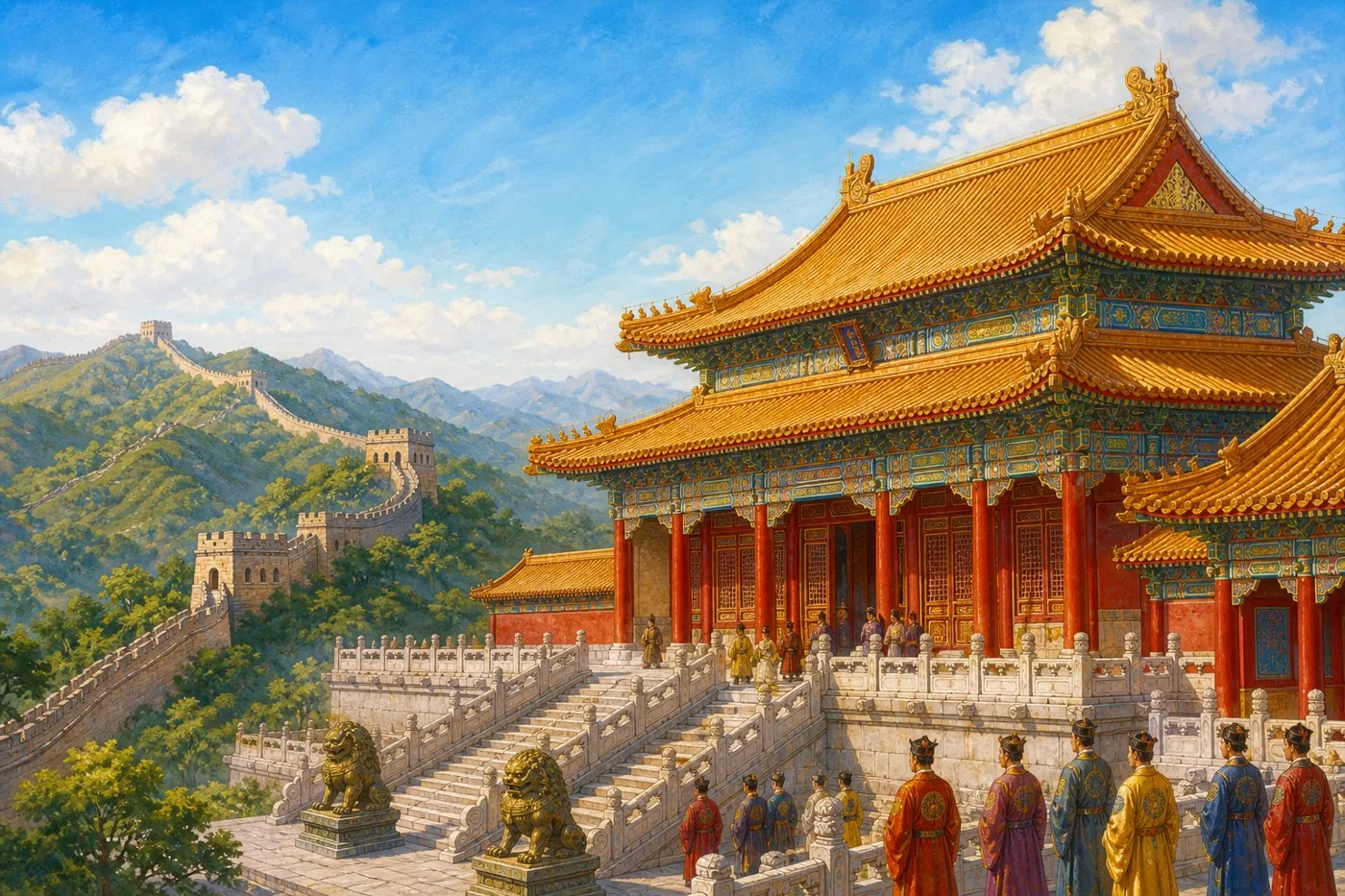
This china history timeline traces more than three thousand years of dynastic rule, from the Bronze Age Shang kings through the imperial unification of the Qin and the artistic golden ages of the Tang and Song, to the collapse of the imperial system in 1912 and the founding of the modern state in 1949.
China History Timeline: Early Dynasties and Unification
The earliest Chinese dynasty confirmed by both archaeology and written records is the Shang, conventionally dated to roughly 1600–1046 BCE, whose inscribed oracle bones provide the first evidence of a Chinese writing system. Around 1046 BCE a coalition led by the Zhou clan defeated the Shang in battle and founded the Zhou dynasty, China’s longest-ruling royal house, though its later centuries saw central authority weaken into a patchwork of competing feudal states. That long period of division ended in 221 BCE, when Ying Zheng, king of the western state of Qin, completed the conquest of his rivals and proclaimed himself Qin Shi Huang, or “First Sovereign Emperor.” His short-lived but transformative Qin dynasty imposed a standardized script, currency, and system of administration across the newly unified territory, and initiated construction efforts later incorporated into the Great Wall. Though the Qin dynasty itself collapsed within roughly fifteen years of his death, the principle of centralized imperial rule he established would shape Chinese governance for the next two millennia, surviving through repeated dynastic transitions even as individual ruling houses rose and fell.
China History Timeline: Imperial Dynasties and Golden Ages
The Han dynasty, founded by Liu Bang in 206 BCE after Qin’s collapse, consolidated and refined the imperial system, adopting Confucian principles of governance and opening long-distance trade routes across Central Asia that later became known as the Silk Road, connecting China with Persia, India, and eventually the Roman world. After a period of division following the Han’s fall, the Tang dynasty, founded in 618 CE, ushered in an era widely regarded, together with the subsequent Song dynasty (960–1279), as a golden age of Chinese civilization, marked by flourishing poetry, painting, Buddhist scholarship, and early innovations including gunpowder and advances in printing. The Ming dynasty, established in 1368 after the collapse of Mongol Yuan rule, rebuilt much of Beijing and commissioned the Forbidden City palace complex, completed in 1420, while also reconstructing large stretches of the stone Great Wall fortifications that survive today. Across these successive dynasties, China developed one of history’s most sophisticated bureaucratic states, administered through a civil service examination system that, with interruptions, endured for well over a thousand years.
China History Timeline: The Qing Dynasty and the Modern Era
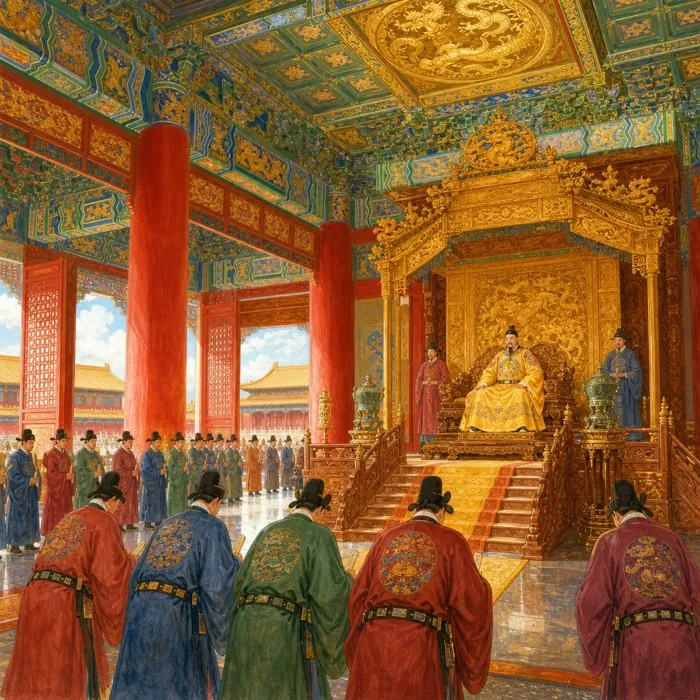
The Ming dynasty gave way in 1644 to the Qing, a dynasty founded by the Manchu people, who would rule China as its final imperial house. Qing China reached great territorial extent and, for much of its early history, considerable prosperity, but the nineteenth century brought internal rebellions and unequal treaties imposed by foreign powers following military defeats, weakening the dynasty’s authority. The Revolution of 1911–12 broke out after a mutiny among troops at Wuchang and spread rapidly across the country; on 12 February 1912, the boy emperor Puyi abdicated, ending more than two thousand years of dynastic rule and giving way to the Republic of China. Decades of political fragmentation, foreign invasion, and civil war followed. That civil war concluded in 1949 with victory for the Chinese Communist Party, and on 1 October 1949 Mao Zedong proclaimed the establishment of the People’s Republic of China in Beijing, founding the governing structure that has administered mainland China since. The transition from the last imperial dynasty to a modern republican and then communist state marks the closing chapter of this china history timeline, though the dynastic institutions of earlier centuries continue to shape the country’s culture, language, and historical identity today.
Frequently Asked Questions
What was the first dynasty in China?
The Shang dynasty, dated to roughly 1600–1046 BCE, is the earliest Chinese dynasty confirmed by both archaeological evidence and written records; an earlier Xia dynasty is described in later texts but remains harder to verify archaeologically.
Who first unified China?
Ying Zheng, king of the state of Qin, unified China in 221 BCE and took the title Qin Shi Huang, "First Sovereign Emperor," establishing centralized imperial rule that later dynasties would maintain.
When did China's imperial dynasties end?
Imperial rule ended on 12 February 1912, when the boy emperor Puyi abdicated following the Revolution of 1911–12, bringing over two thousand years of dynastic government to a close and establishing the Republic of China.
When was the People's Republic of China founded?
Mao Zedong proclaimed the People's Republic of China in Beijing on 1 October 1949, following the Chinese Communist Party's victory in the civil war that had followed the fall of the Qing dynasty.