
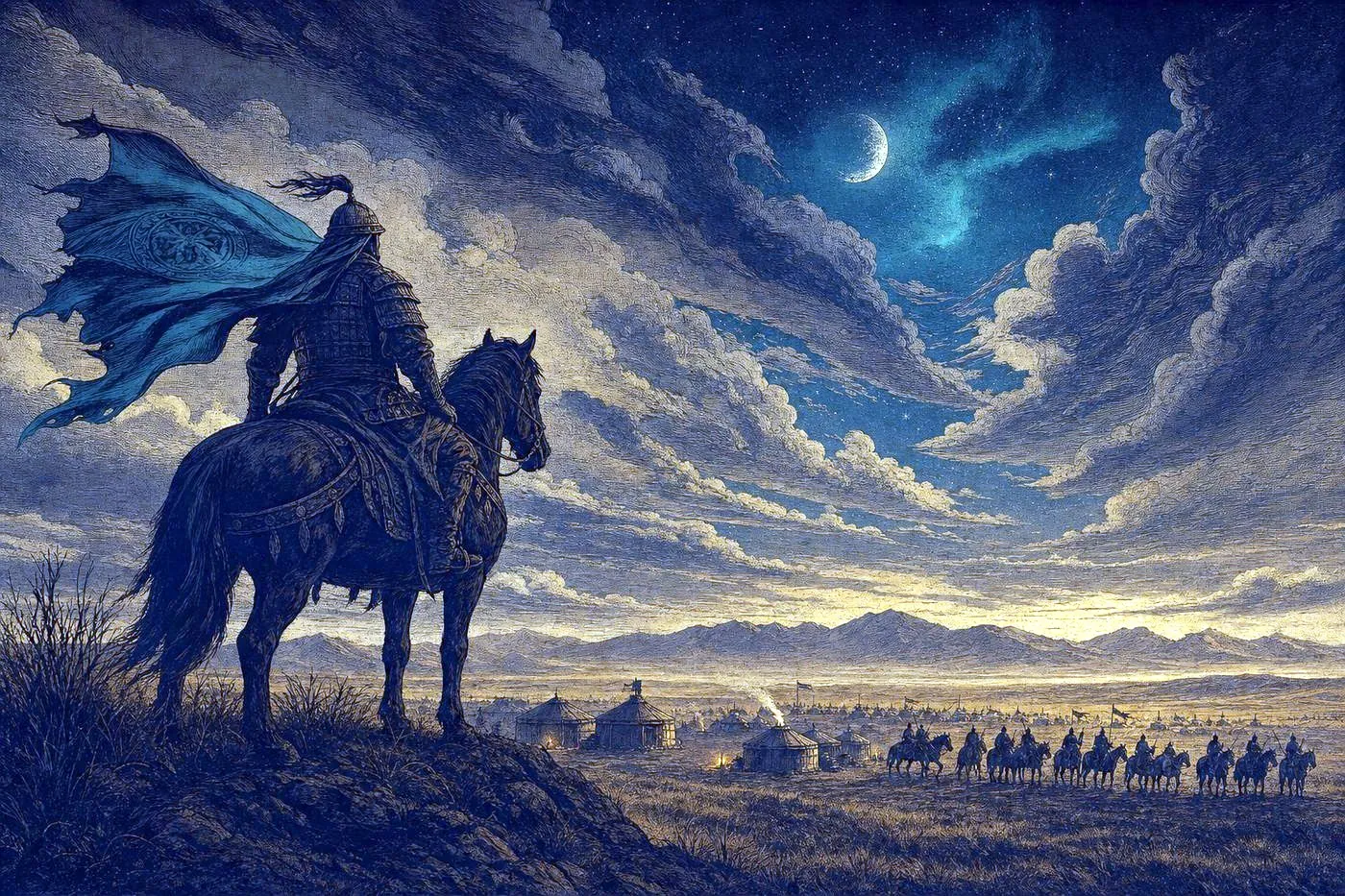
This Mongol Empire timeline of events traces its rise from a unification of steppe tribes in 1206 to the largest contiguous land empire in history, and its eventual division and decline over the following two centuries.
The Mongol Empire Timeline: Founding to Conquest
In 1206, a Mongol chieftain named Temüjin was proclaimed Genghis Khan at a kurultai, or grand assembly of tribal leaders, after years of warfare had brought the rival tribes of the Mongolian steppe under a single authority. Genghis Khan reorganized these tribes into a disciplined military structure, notably a highly mobile cavalry force built around composite bows and coordinated tactics, and turned outward almost immediately. Campaigns against neighboring states in northern China and Central Asia followed in quick succession. The conquest of the Khwarezmian Empire between 1219 and 1221 was especially brutal, with Mongol forces destroying major cities across present-day Uzbekistan, Turkmenistan, and Iran in reprisal for the killing of Mongol envoys. Genghis Khan died in 1227 during a campaign against the Western Xia kingdom, but the expansion he set in motion continued under his sons and grandsons. Read as a Mongol Empire timeline of events, this founding era of conquest set the pattern for everything that followed: rapid military conquest paired with an unusually fast consolidation of the territory it won.
Conquest, the Pax Mongolica, and Division of the Empire
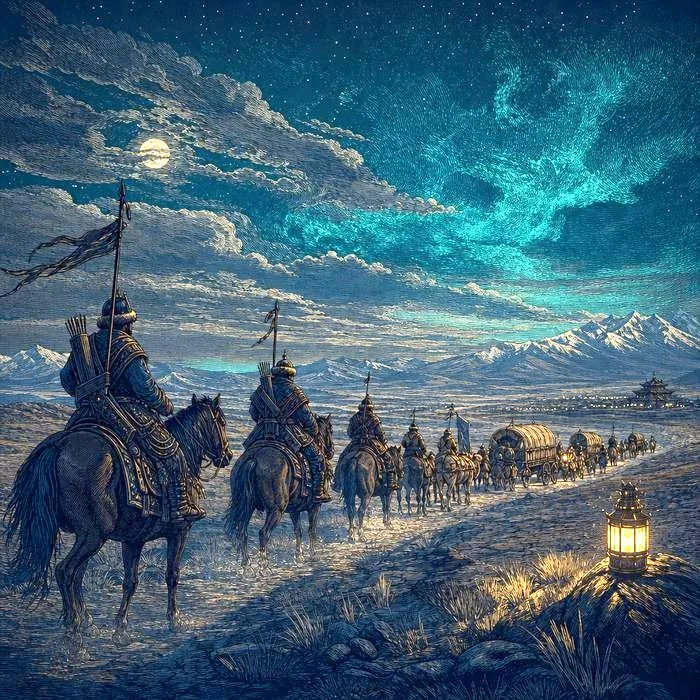
Mongol expansion reached its furthest extent into Europe between 1236 and 1242, when armies under Batu Khan overran the Rus’ principalities and defeated Hungarian and Polish forces, before withdrawing, reportedly prompted by the death of the Great Khan Ögedei, which required senior commanders to return east for a succession council. At its height, the empire stretched from Korea to Eastern Europe, and historians describe the relative stability this created across Eurasia as the Pax Mongolica, a period roughly spanning the mid-thirteenth to mid-fourteenth centuries in which overland trade routes, including those later associated with the Silk Road, became markedly safer for merchants and travelers. This sweeping conquest and the relative calm that followed it are central to any history of the Mongol Empire timeline, because they explain how trade, not only warfare, came to define much of the empire’s reach. This unity did not last. Following the death of the Great Khan Möngke in 1259, a succession dispute split the empire permanently. By the 1260s it had divided into four major khanates: the Yuan dynasty in China and Mongolia, the Golden Horde in Russia, the Chagatai Khanate in Central Asia, and the Ilkhanate in Persia and the Middle East, each ruled by a different branch of Genghis Khan’s descendants.
The Yuan Dynasty and the Later History of the Empire
Kublai Khan, a grandson of Genghis Khan, founded the Yuan dynasty and completed the conquest of Southern Song China by 1279, becoming the first Mongol emperor to rule all of China. The Yuan court adopted many Chinese administrative practices while retaining Mongol military and social structures. Mongol rule in China proved harder to sustain than its conquest: rebellion, economic strain, and internal Yuan court instability culminated in 1368, when the Ming dynasty drove the Mongol court back onto the steppe. The other khanates followed differing trajectories: the Ilkhanate collapsed by the mid-fourteenth century, while the Golden Horde and Chagatai successor states persisted, in weakened form, for well over a century afterward. Told as a history of the Mongol Empire timeline, the Yuan dynasty’s fall in 1368 did not end Mongol rule everywhere, only in China; the empire’s legacy endured in the trade networks, administrative practices, and cultural exchange it had helped set in motion across Asia and Europe.
Frequently Asked Questions
What does this Mongol Empire timeline cover?
This timeline covers the empire's founding under Genghis Khan in 1206, the conquest of the Khwarezmian Empire, the 1236–1242 invasion of Europe, the Pax Mongolica trade era, the empire's division into khanates in the 1260s, the founding of the Yuan dynasty, and its fall in 1368.
How large did the Mongol Empire become?
At its greatest extent, the Mongol Empire was the largest contiguous land empire in recorded history, stretching from the Korean peninsula and northern China across Central Asia into Russia and parts of Eastern Europe.
Why did the Mongol Empire split into khanates?
A succession dispute following the death of the Great Khan Möngke in 1259 could not be resolved peacefully, and by the 1260s the empire had permanently divided into four khanates ruled by different branches of Genghis Khan's family.
When did Mongol rule end in China?
The Mongol Yuan dynasty was driven out of China in 1368 by rebellion, giving way to the Ming dynasty, though Mongol-descended khanates continued to rule in Central Asia and Russia for longer afterward.