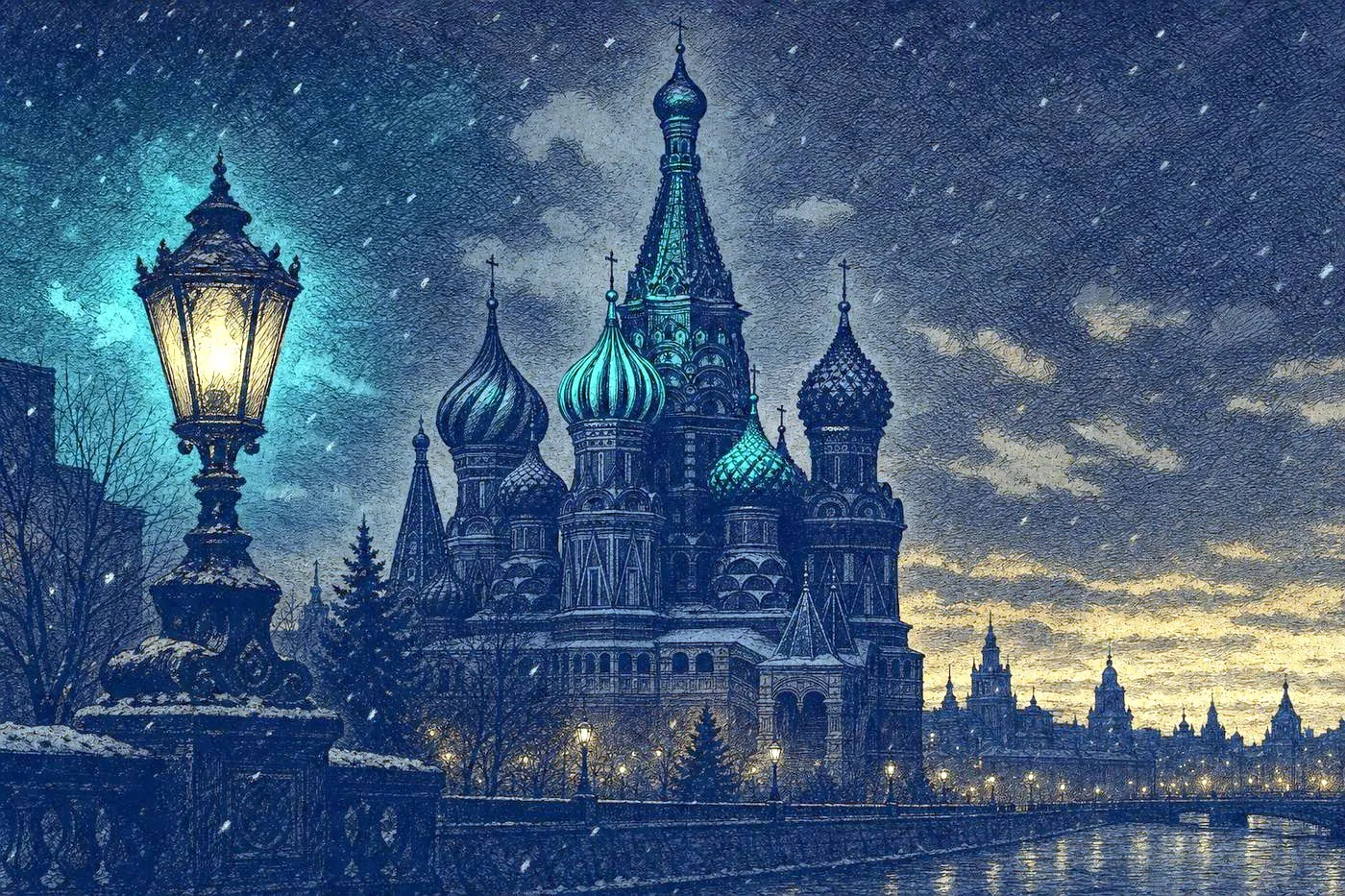
This Russian history timeline traces the story from the medieval state of Kievan Rus through the Tsarist empire to the Soviet Union and its 1991 dissolution.
Kievan Rus and the Rise of Moscow
Russian statehood is traditionally traced to Kievan Rus, a loose federation of East Slavic and Finnic tribes united, according to the semi-legendary account in the Primary Chronicle, under the Varangian prince Rurik and later consolidated by his successor Oleg, who joined Novgorod and Kiev around 882. Kievan Rus adopted Orthodox Christianity from the Byzantine Empire in 988 under Prince Vladimir the Great, a decision that shaped Russian religious and cultural identity for the next millennium. The state fragmented into competing principalities before Mongol forces under Batu Khan overran the region between 1237 and 1240, imposing more than two centuries of tributary rule often called the “Tatar Yoke.” During this period, the previously minor principality of Moscow gradually grew in influence, partly through its role as tax-collector for the Mongol khans, eventually leading the unification of Russian lands and throwing off Mongol overlordship by the late 15th century under Ivan III, who was the first Muscovite ruler to claim the title “Tsar” informally and style Moscow the “Third Rome.”
Tsarist Russia and Empire
In 1547, Ivan IV, known as Ivan the Terrible, was crowned the first Tsar of All Russia, centralizing authority and significantly expanding Muscovite territory, though his reign was also marked by repression and instability that contributed to the turbulent “Time of Troubles” after his death. The Romanov dynasty, established in 1613, ruled Russia for the following three centuries. Under Peter the Great, Russia modernized its military, administration, and culture along Western European lines, and after victory over Sweden in the Great Northern War, Peter proclaimed the Russian Empire in 1721. Catherine the Great further expanded imperial borders later in the 18th century, annexing much of present-day Ukraine and Poland-Lithuania’s eastern territories. Through the 19th century, the Russian Empire remained an autocratic, largely agrarian state even after the abolition of serfdom in 1861, and growing industrialization and social unrest culminated in the abortive 1905 Revolution, which forced Tsar Nicholas II to accept limited constitutional reforms, including an elected legislature, or Duma.
Revolution, the Soviet Union, and Its Collapse
The strains of the First World War, combined with long-standing social and economic grievances, precipitated the 1917 Russian Revolution. The February Revolution forced Tsar Nicholas II to abdicate, ending three centuries of Romanov rule, and a provisional government took power. That government was overthrown in the October Revolution by the Bolsheviks under Vladimir Lenin, who withdrew Russia from the war and, after a bloody civil war, established the Soviet Union in 1922. Under Lenin’s successor Joseph Stalin, the USSR underwent rapid, often brutal industrialization and collectivization before playing a decisive role in the Allied victory over Nazi Germany in the Second World War, after which it emerged as a global superpower locked in Cold War rivalry with the United States. Decades of economic stagnation following Stalin’s death in 1953, and the glasnost and perestroika reform policies of Mikhail Gorbachev in the 1980s, eventually led to the Soviet Union’s dissolution on 26 December 1991, with the Russian Federation, led by Boris Yeltsin, succeeding it as an independent state alongside fourteen other newly sovereign former Soviet republics.