
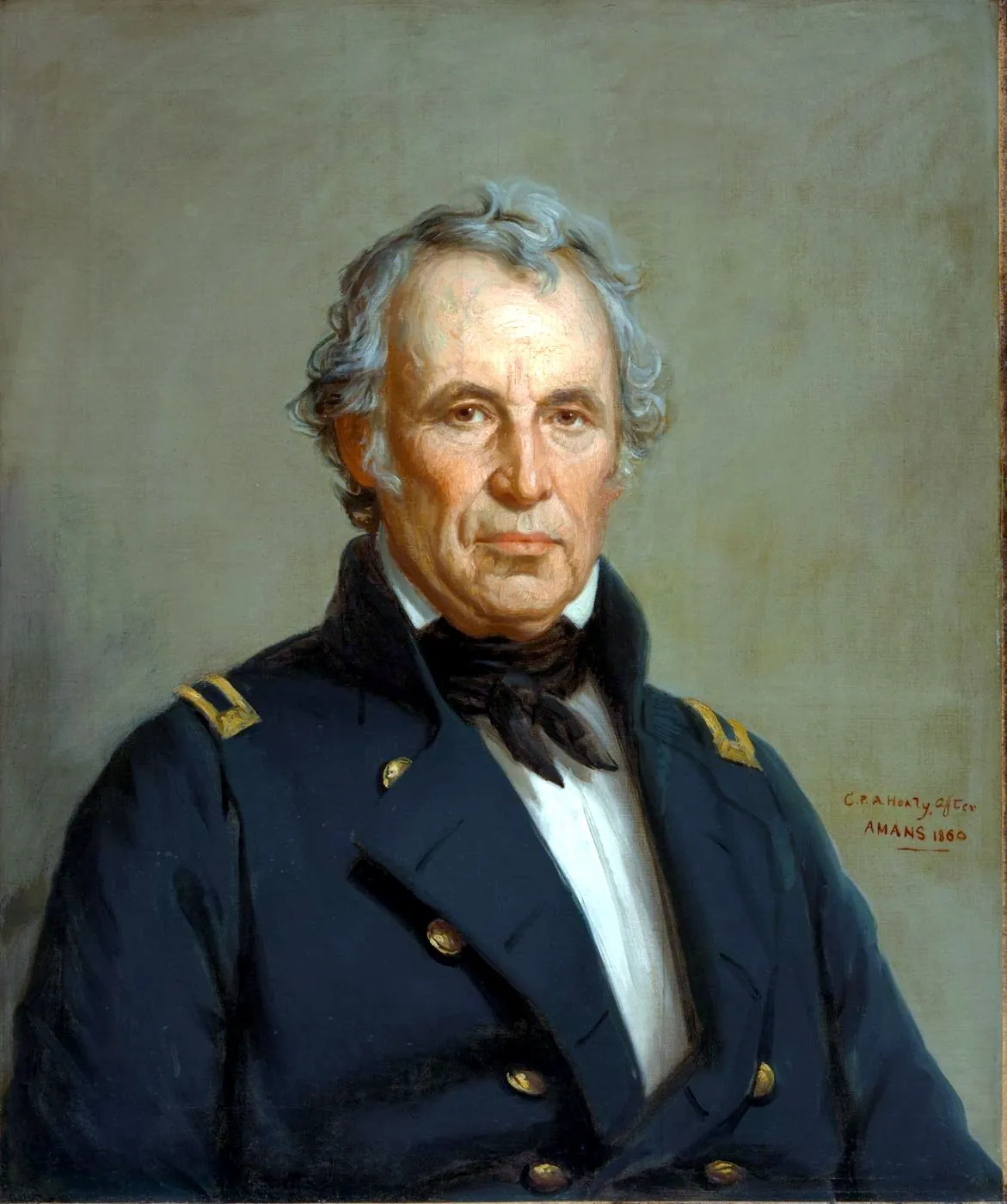
This Zachary Taylor timeline traces the twelfth president’s rise from a career army officer with no prior political experience to a presidency cut short by sudden illness after little more than a year.
Early Life and Decades in the Army
Zachary Taylor was born on November 24, 1784, in Orange County, Virginia, and raised on a Kentucky frontier plantation. He entered the U.S. Army in 1808 and spent nearly four decades in uniform, rising slowly through the ranks while serving in the War of 1812, the Black Hawk War, and the lengthy and difficult Second Seminole War in Florida. It was the Mexican-American War, however, that made him a national figure. Leading American troops to victories at Palo Alto, Resaca de la Palma, Monterrey, and, most famously, Buena Vista in 1847, Taylor earned enormous popular acclaim and the nickname “Old Rough and Ready” for his plain, unpolished manner and willingness to share hardship with his troops. That fame, rather than any political record, made him a natural presidential candidate; remarkably, Taylor had never held elected office and, by some accounts, had rarely if ever voted in a presidential election before running for the office himself.
Presidency: A Soldier Confronts a Political Crisis
Taylor was elected the twelfth president in 1848 as the Whig Party’s nominee, defeating Democrat Lewis Cass in an election shaped heavily by his war record and by the era’s still-unsettled disputes over the future of slavery. Although he was himself a Louisiana slaveholder, Taylor took a firmer stance against the expansion of slavery into newly acquired western territories than many expected, and he supported California’s application to join the Union as a free state. This position, along with his general resistance to Southern threats of secession over the territorial question, put him at odds with many fellow Southerners during the increasingly tense debates that would culminate in the Compromise of 1850. Taylor reportedly warned Southern leaders that he would personally lead an army against any state that attempted to secede, a striking stance for a slaveholding president to take. His presidency was brief and largely consumed by this sectional crisis; he did not live to see how it would ultimately be resolved by his successor.
Sudden Death and Legacy
On July 4, 1850, Taylor attended lengthy outdoor Independence Day ceremonies in Washington and reportedly consumed large quantities of raw fruit and iced drinks in the summer heat. He fell seriously ill with severe gastrointestinal illness in the days that followed and died on July 9, 1850, after only sixteen months in office: the second president, after William Henry Harrison, to die in office. The exact cause of his illness has long been debated, historically attributed to cholera morbus or a related gastrointestinal ailment linked to contaminated food or water, though some later speculation raised the possibility of poisoning; a 1991 exhumation and forensic analysis found no elevated arsenic levels, supporting the natural-illness explanation. His death was a genuine shock to the country, coming so soon after Harrison’s, and it briefly revived public unease about the vulnerability of the still-young office of the presidency. Taylor’s death elevated Vice President Millard Fillmore to the presidency and shifted the government’s approach to the sectional crisis, clearing the way for the Compromise of 1850 that Taylor himself had resisted in its original form.
Frequently Asked Questions
What does this Zachary Taylor timeline cover?
This timeline covers Taylor's biography from his 1784 birth in Virginia through his decades in the U.S. Army, his fame in the Mexican-American War, his 1848 election, his handling of the sectional slavery crisis, and his death in office in 1850.
How did Zachary Taylor die?
Taylor fell ill after Fourth of July festivities in 1850 with a severe gastrointestinal illness and died on July 9, 1850. Historians generally attribute this to natural illness; a 1991 forensic exhumation found no evidence supporting earlier poisoning theories.
Had Zachary Taylor held political office before becoming president?
No. Taylor had spent nearly forty years as a career army officer and had never held elected office before winning the presidency in 1848.
What was Taylor's position on the expansion of slavery?
Although a slaveholder himself, Taylor opposed the expansion of slavery into the newly acquired western territories and supported California's admission as a free state, a stance that put him at odds with many Southern political allies.