
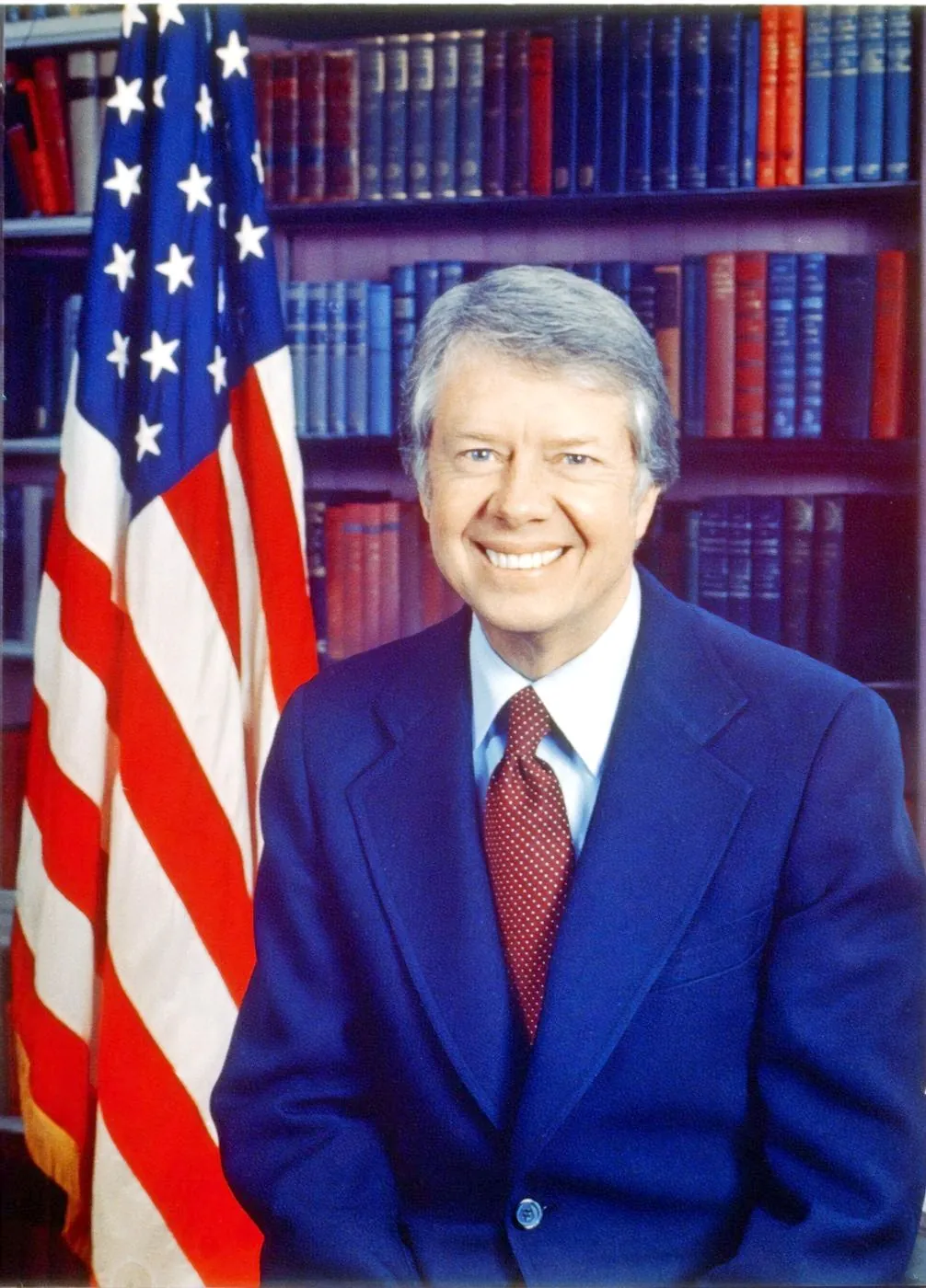
This Jimmy Carter timeline follows his path from a Georgia peanut farm and the U.S. Navy’s submarine service to the governorship, the presidency, and a Nobel Prize-winning post-presidency devoted to humanitarian work.
Early Life and Path to the Presidency
James Earl Carter Jr. was born on October 1, 1924, in Plains, Georgia, and grew up in the nearby community of Archery. He graduated from the U.S. Naval Academy in 1946 and served as a naval officer, including a stint in the nuclear submarine program under Admiral Hyman Rickover, before resigning his commission in 1953 to take over his family’s peanut farming and warehouse business after his father’s death. Carter entered Georgia politics in the 1960s, serving in the state senate before winning election as governor of Georgia in 1970, a term in which he pursued government reorganization, expanded environmental protections, and cultivated a reputation as a moderate, reform-minded Southern Democrat who broke with the region’s segregationist past. Running as a Washington outsider in the aftermath of Watergate and the Vietnam War, Carter won the 1976 presidential election against incumbent Gerald Ford in a close contest, positioning himself as a figure of personal honesty and moral clarity, exemplified by his frequently quoted campaign pledge, “I will never lie to you.”
The Presidency: Camp David and the Iran Hostage Crisis
Carter’s presidency is most closely associated with two foreign-policy episodes. In September 1978, he hosted Egyptian President Anwar Sadat and Israeli Prime Minister Menachem Begin at Camp David for thirteen days of negotiations that produced the Camp David Accords, a framework that led to the 1979 Egypt–Israel peace treaty and is generally regarded as one of the signature achievements of his term. His final year in office, however, was dominated by the Iran hostage crisis: in November 1979, militants loyal to Iran’s revolutionary government seized the U.S. embassy in Tehran and held American personnel hostage for 444 days, a crisis that included a failed 1980 rescue attempt and contributed heavily to Carter’s defeat in the 1980 election by Ronald Reagan. His administration also pursued the Panama Canal treaties, which committed the United States to transferring control of the canal to Panama by the end of the century, established full diplomatic relations with the People’s Republic of China, and created the U.S. Department of Energy and Department of Education against a backdrop of high inflation, gasoline shortages, and slow economic growth that voters increasingly blamed on his leadership.
Post-Presidency and Legacy
Carter’s decades out of office are widely considered among the most active and consequential of any former U.S. president. Through the Carter Center, which he and his wife Rosalynn founded in 1982, he worked on election monitoring, disease eradication efforts such as the campaign against Guinea worm disease, and international conflict mediation, while also becoming closely associated with Habitat for Humanity’s home-building projects. In 2002, he was awarded the Nobel Peace Prize in recognition of his decades of work toward peaceful resolutions of international conflicts and his advancement of democracy and human rights. He and Rosalynn Carter also remained visible volunteers with Habitat for Humanity well into their nineties, physically working on home-building projects alongside other volunteers. Carter lived longer than any U.S. president in history, entering hospice care at his home in Plains, Georgia, in February 2023 and dying there on December 29, 2024, at age 100; historians and commentators have widely noted that his post-presidential record is regarded by many as more consequential, and more positively remembered, than his single term in the White House.