
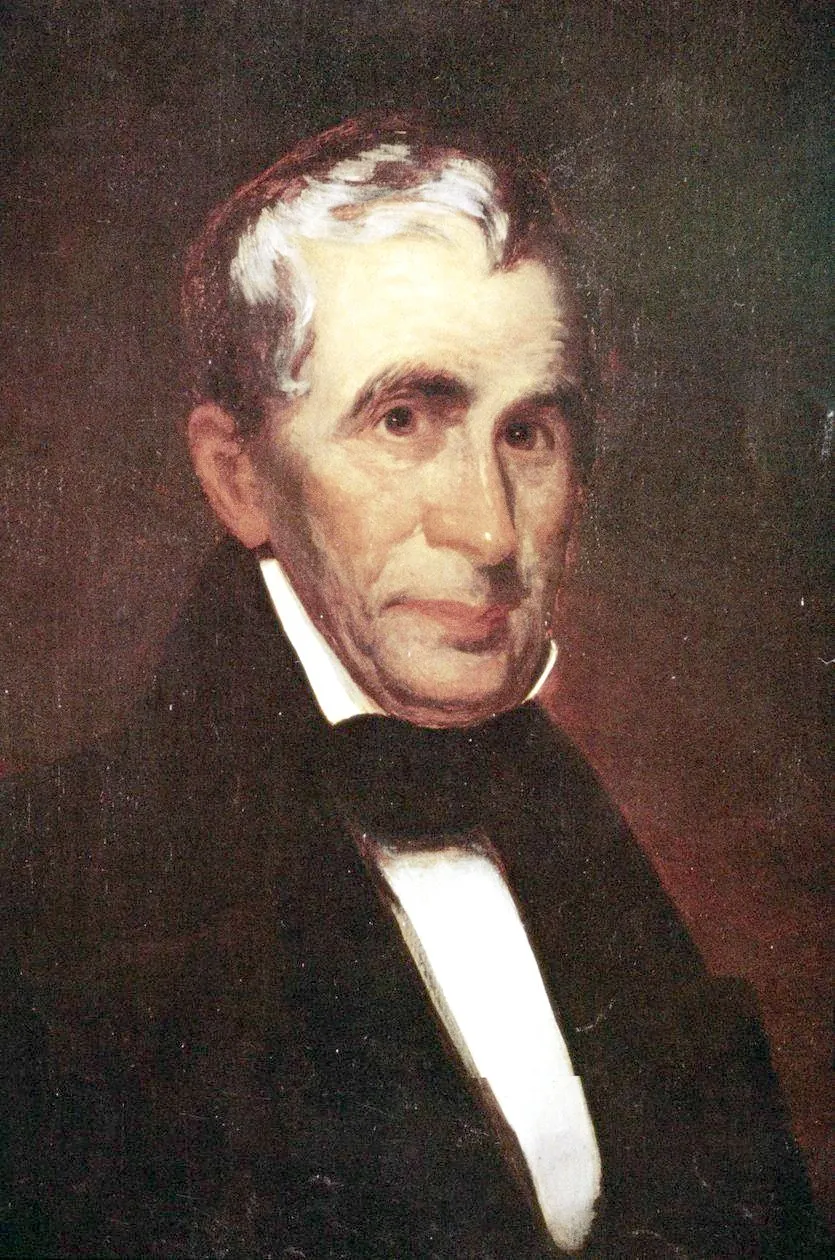
This William Henry Harrison timeline traces the ninth president’s long military and political career, his famous 1840 campaign, and the single month in office that made his term the shortest in American history.
Early Life and the Battle of Tippecanoe
William Henry Harrison was born on February 9, 1773, in Charles City County, Virginia, into a prominent planter family; his father, Benjamin Harrison V, had signed the Declaration of Independence. He joined the U.S. Army as a young officer and spent much of his early career on the western frontier, eventually becoming governor of the Indiana Territory in 1801. In that role, he negotiated numerous land treaties with Native American nations and, in 1811, led American forces against a confederacy organized by the Shawnee leader Tecumseh and his brother Tenskwatawa at the Battle of Tippecanoe. The battle’s outcome was militarily inconclusive by some accounts, but it was widely celebrated in the press as a decisive American victory and became the foundation of Harrison’s later political reputation as “Old Tippecanoe.” He went on to serve as a general in the War of 1812, notably at the Battle of the Thames in 1813, a battle in which Tecumseh himself was killed, effectively ending large-scale organized Native American resistance in the Old Northwest. He later represented Ohio in the U.S. House and Senate, and, decades afterward, his grandson Benjamin Harrison would also become president, making them the only grandfather-and-grandson pair to hold the office.
The 1840 Campaign and a Historic Inauguration
By 1840, Harrison had become the Whig Party’s presidential nominee, running alongside John Tyler behind the slogan “Tippecanoe and Tyler Too,” a campaign that leaned heavily on log-cabin, common-man imagery despite Harrison’s genteel upbringing. The campaign also leaned on log-cabin and hard-cider imagery, casting the patrician Harrison as a humble frontiersman in contrast to the supposedly aloof Van Buren, an approach later credited with pioneering the modern style of image-driven American political campaigning. Harrison defeated Van Buren decisively, becoming, at 68, the oldest man elected president up to that point in American history. On March 4, 1841, Harrison delivered his inaugural address in cold, wet weather without an overcoat or hat, reportedly to project an image of vigor; at roughly 8,400 words and nearly two hours, it remains the longest inaugural address ever delivered by an American president.

Sudden Death and a Constitutional Precedent
Harrison fell seriously ill within about three weeks of taking office. Tradition long attributed his illness to a cold contracted during the long inaugural exposure, though modern medical historians have suggested that contaminated water in the White House water supply, potentially causing typhoid or another enteric fever, may have been an equal or greater factor; the exact cause remains debated. He died on April 4, 1841, just 31 days into his term, the shortest presidency in American history and the first death of a sitting president. His death created a constitutional crisis of sorts, since the Constitution’s language on succession was ambiguous about whether the vice president became president outright or merely an acting president. Vice President John Tyler moved quickly to assert that he had become president in the fullest sense, a position that faced initial skepticism but became accepted precedent for decades before being formally confirmed by the 25th Amendment in 1967. Harrison is remembered today less for any policy achievement than for the brevity of his term and the succession precedent his sudden death forced into being.