
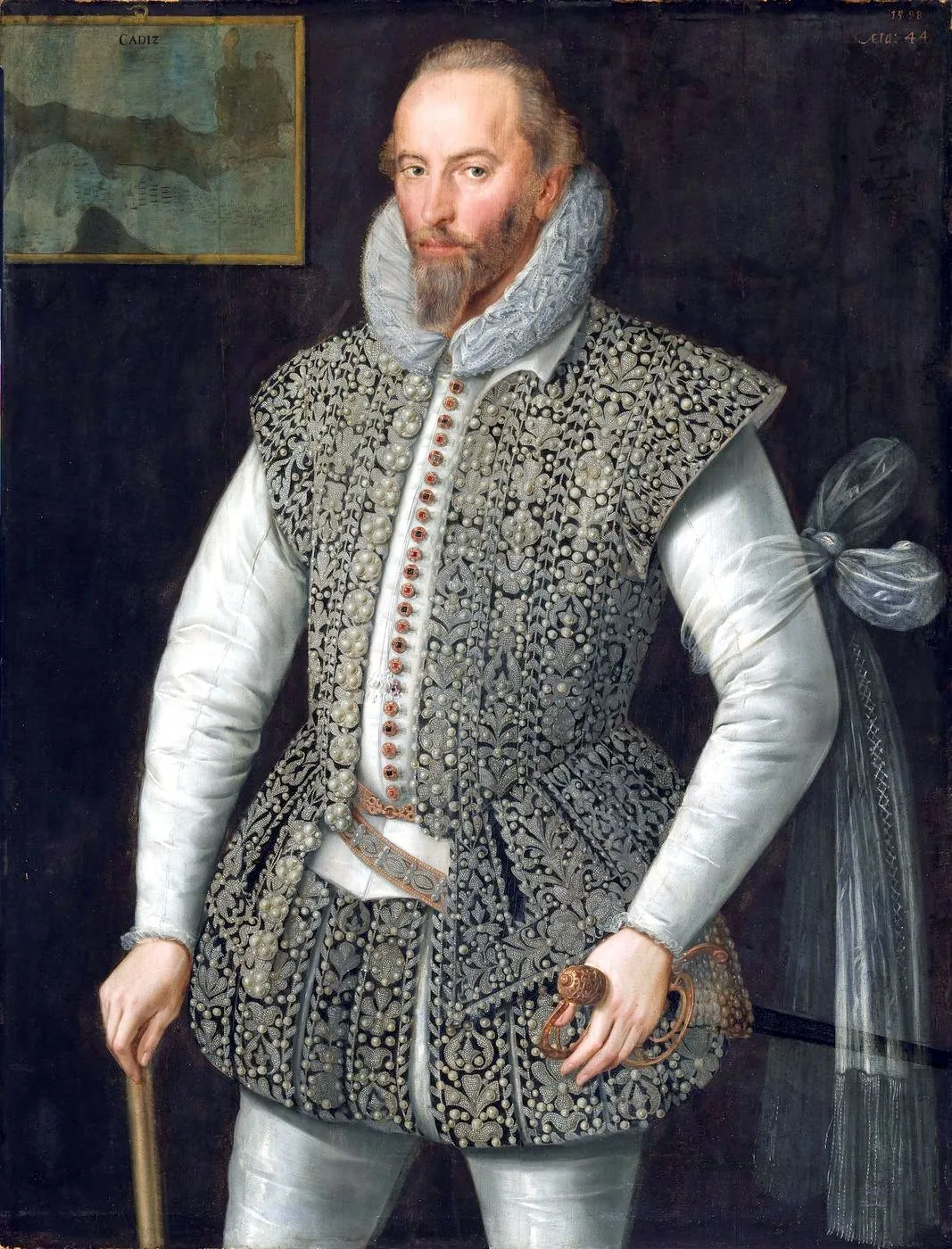

This Sir Walter Raleigh timeline traces his rise as an Elizabethan courtier and coloniser through to his fall and execution under James I, drawing on the documented record of his ventures in England, Ireland, and the Americas.
Courtier and Coloniser
Walter Raleigh was born around 1552 in Devon to a gentry family with strong Protestant sympathies, and he spent his early adulthood soldiering in France and Ireland before arriving at the English court. His service in suppressing rebellion in Ireland during the 1580s brought him land grants and closer contact with senior figures at court, laying the groundwork for his later rise. His wit, ambition, and reported physical presence won him the favour of Queen Elizabeth I during the 1580s, and he was knighted in 1585, receiving lucrative trade monopolies and estates that made him one of the wealthier men at court, though his fortunes there rose and fell with the queen’s shifting favour. With royal backing, Raleigh organised England’s earliest attempts at permanent colonisation in North America, funding voyages to a stretch of coast he named Virginia in the queen’s honour, though he never crossed the Atlantic himself. The first Roanoke Island settlement of 1585 struggled and was abandoned within a year after strained relations with nearby Indigenous communities and dwindling supplies, and a second colonising party sent in 1587 disappeared after resupply ships were delayed by the outbreak of war with Spain: the unresolved fate of that “Lost Colony” remains one of the most debated puzzles in early American history, and no confirmed account of what became of its settlers has ever been established, despite periodic archaeological efforts to locate physical traces of the group.

Writer, Soldier, and Explorer
Raleigh was as much a man of letters and ambition as a courtier. He held political office, sat in Parliament, and cultivated an interest in poetry and philosophy alongside his military and commercial pursuits; he is also credited, though the record is not always precise, with helping popularise both tobacco and the potato in England following contact with the Americas. In 1595 he led an expedition up the Orinoco River in present-day Venezuela and Guyana in search of the legendary golden city of El Dorado, an effort that failed to find riches but produced his widely read account, The Discoverie of Guiana, which helped sustain English interest in South American exploration. His fortunes at court declined sharply after Elizabeth’s death in 1603: the new king, James I, viewed him with suspicion, partly over rivalries with other courtiers, and Raleigh was convicted of treason on disputed evidence tied to an alleged plot against the king. He was imprisoned in the Tower of London, where he spent over a decade in relatively comfortable confinement, continuing scientific experiments and writing much of his unfinished History of the World, a sweeping work that was widely read in the years after his death.
Downfall and Execution
Released in 1616 to lead one final expedition to Guiana in search of gold, Raleigh was bound by strict royal conditions not to provoke conflict with Spanish territory, on pain of death should he fail to comply. The expedition failed to find gold, and a subordinate force under his command, acting without Raleigh present, clashed with a Spanish settlement along the Orinoco, a breach that proved politically disastrous given James I’s efforts to maintain peace with Spain through diplomacy and a proposed royal marriage alliance. On his return to England, Raleigh was arrested, and the original treason sentence from 1603 was revived to justify his execution, which took place at Whitehall in October 1618; contemporary accounts describe him meeting his death with notable composure. He is remembered as a defining, contradictory figure of the Elizabethan age: poet, soldier, and empire-builder whose colonial ventures anticipated England’s later expansion in the Americas even as his own life ended in judicial execution, a fate that has made him a lasting symbol of the era’s mix of ambition, exploration, and courtly peril.
Frequently Asked Questions
What does this Sir Walter Raleigh timeline cover?
This timeline covers his rise at the Elizabethan court, his sponsorship of the Roanoke colonisation attempts, his 1595 Guiana expedition, his imprisonment under James I, and his 1618 execution.
Did Sir Walter Raleigh actually sail to Roanoke?
No confirmed record shows Raleigh personally sailing to Roanoke Island; he financed and organised the expeditions under his royal patent but directed them from England.
What happened to the Roanoke 'Lost Colony'?
The fate of the settlers left on Roanoke Island in 1587 has never been conclusively established; when a resupply mission finally arrived in 1590, the colonists had vanished, leaving only limited physical clues behind.
Why was Sir Walter Raleigh executed?
He was executed in 1618 under a treason sentence originally issued in 1603, revived after his final Guiana expedition provoked a diplomatic crisis with Spain.