
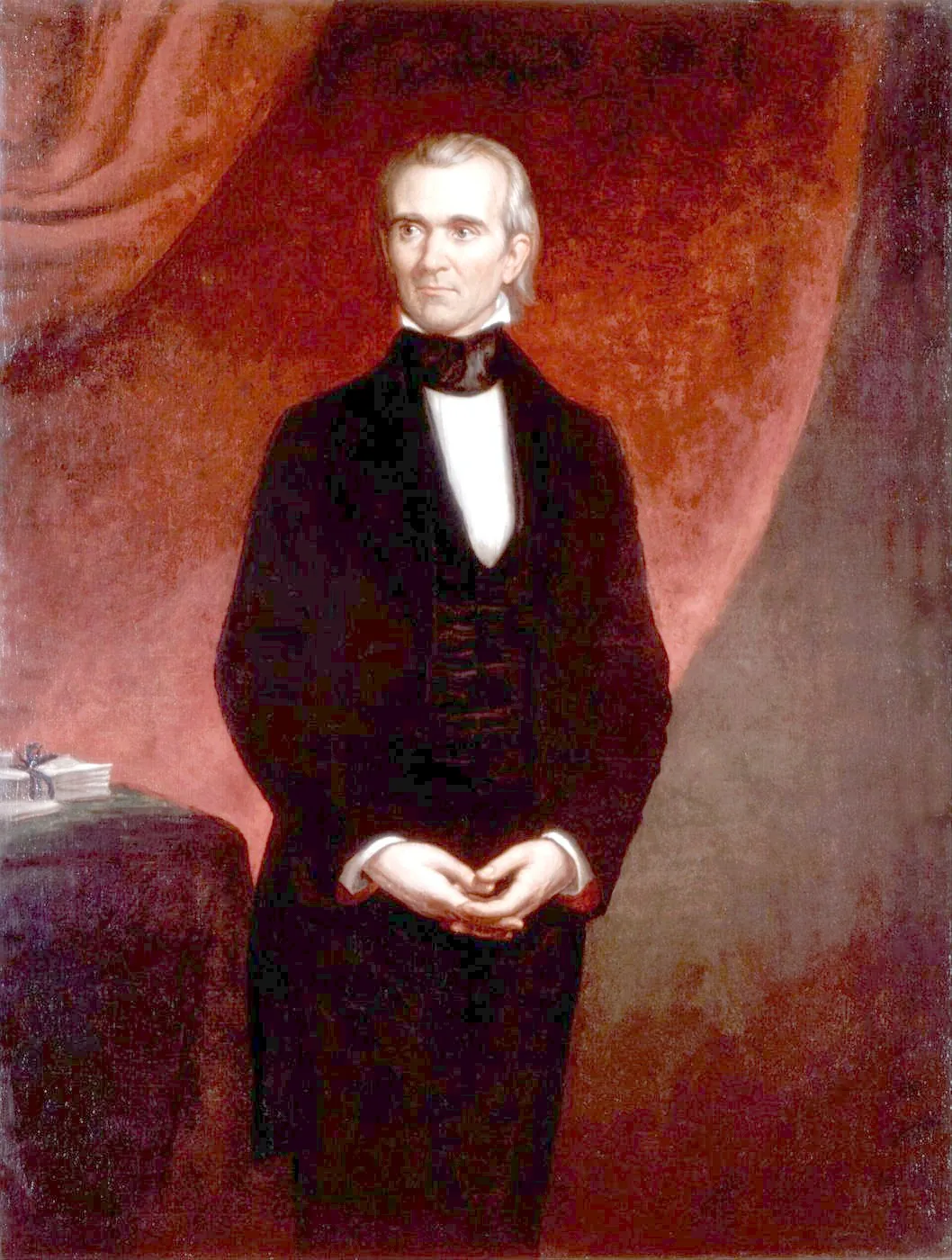
This James Knox Polk timeline traces the eleventh president’s rise from Tennessee lawyer to a single-term presidency that expanded the United States to the Pacific Ocean more than any administration before it.
Early Life and Rise in Tennessee Politics
James Knox Polk was born on November 2, 1795, in Mecklenburg County, North Carolina, and moved with his family to Tennessee as a child. After graduating from the University of North Carolina, he trained as a lawyer and entered Tennessee politics as a protégé of Andrew Jackson, earning the nickname “Young Hickory” for his close alliance with Jackson’s Democratic movement. Polk served in the U.S. House of Representatives for fourteen years, including a term as Speaker of the House from 1835 to 1839, before returning to Tennessee to serve as governor. By the mid-1840s his national ambitions had stalled, and he entered the 1844 Democratic convention as a long-shot contender.

Presidency: Westward Expansion and War with Mexico
Polk emerged from the 1844 Democratic convention as a compromise “dark horse” nominee and went on to win the presidency on a platform built around aggressive territorial expansion: annexing Texas and asserting a strong American claim to the Oregon Country, then jointly occupied with Britain. As president, Polk is generally credited with accomplishing nearly every major goal he set for his single term. He negotiated the 1846 Oregon Treaty with Great Britain, which established the 49th parallel as the border and secured the Pacific Northwest for the United States without armed conflict. Far more consequential, and more controversial, was the Mexican-American War. After the annexation of Texas inflamed an already disputed border, and after a clash between American and Mexican troops in the disputed zone, Polk asked Congress for a declaration of war in May 1846. The war, which some contemporaries and later historians have criticized as a war of expansion provoked by the United States, ended with the 1848 Treaty of Guadalupe Hidalgo, under which Mexico ceded a vast swath of territory covering much of the present-day American Southwest and California. Combined with the Oregon settlement, Polk’s presidency added more territory to the United States than any administration since the Louisiana Purchase, fulfilling the era’s expansionist push often summarized by the term “Manifest Destiny.”
Final Months and Legacy
Polk had pledged before his election to serve only a single term, and he kept that promise, declining to seek re-election in 1848. Beyond expansion, his administration also re-established an independent federal treasury system and lowered tariff rates, both long-standing Democratic policy goals. Exhausted by the workload of the presidency (he reportedly worked longer hours than almost any president before him and rarely left Washington during his term), he left office in March 1849 and returned to Tennessee, only to die of cholera in Nashville on June 15, 1849, just over three months after leaving the White House, making his post-presidential life one of the shortest of any American president. Polk is remembered by historians as one of the most effective single-term presidents, notable for setting a small number of concrete goals and achieving essentially all of them, even as the territorial expansion he oversaw intensified the sectional disputes over slavery that would erupt into civil war within a generation.
Frequently Asked Questions
What does this James Knox Polk timeline cover?
This timeline covers Polk's biography from his 1795 birth in North Carolina through his time as Speaker of the House, his 1844 election, the Oregon Treaty and Mexican-American War, and his death in 1849 shortly after leaving office.
Why did the United States go to war with Mexico under Polk?
After the United States annexed Texas, a dispute over the southern border escalated into conflict; Polk asked Congress for a declaration of war in 1846, and the war ended with Mexico ceding large territories to the United States.
Did James K. Polk serve more than one term?
No. Polk pledged to serve only a single term, kept that promise, and left office in March 1849.
How soon after leaving office did Polk die?
Polk died of cholera on June 15, 1849, just over three months after leaving the presidency, one of the shortest post-presidential periods of any U.S. president.