
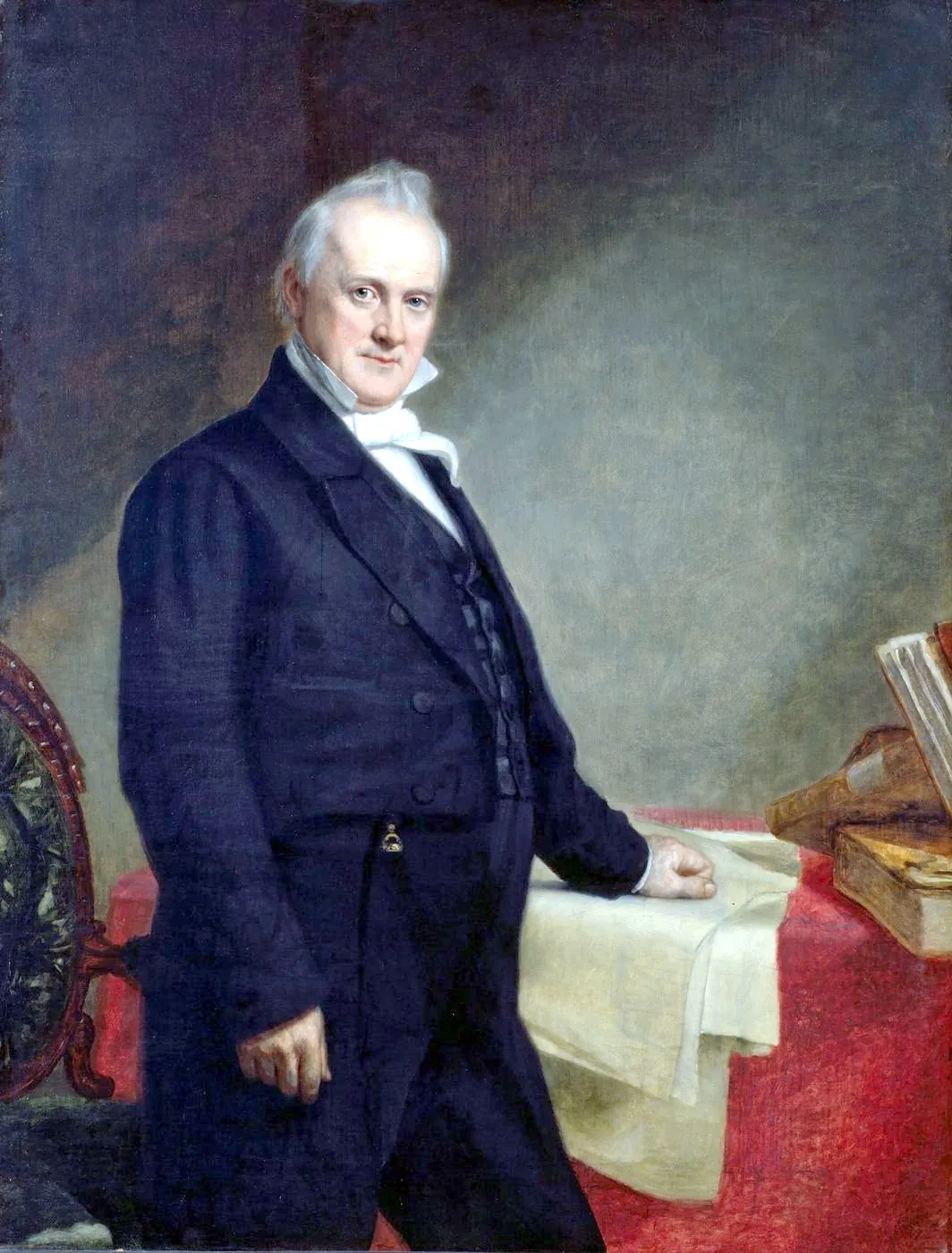
This James Buchanan timeline traces his path from a distinguished pre-Civil War diplomatic career to a presidency defined by paralysis in the face of Southern secession.
Early Life and a Career in Diplomacy
James Buchanan was born on April 23, 1791, in a log cabin at Cove Gap, near Mercersburg, Pennsylvania, the son of a prosperous Scots-Irish merchant. He trained as a lawyer, built a lucrative practice, and entered politics as a Federalist before eventually aligning with the Democratic Party. Over three decades he assembled one of the most extensive résumés of any pre-Civil War president: US Representative from Pennsylvania, Minister to Russia under Andrew Jackson, US Senator, and Secretary of State under President James K. Polk from 1845 to 1849, a role in which he helped negotiate the settlement of the Oregon boundary dispute with Britain. In the 1850s he served as Minister to the United Kingdom, where he was among the American diplomats who drafted the Ostend Manifesto, a controversial memorandum suggesting the United States might justify seizing Cuba from Spain. Buchanan never married and remains the only US president to have done so; earlier in life he had been engaged to Ann Coleman, whose sudden death in 1819, amid a broken engagement, is sometimes cited by biographers as a lasting influence on his private reserve. His years abroad through much of the 1850s meant he had taken few public positions on the deepening national argument over slavery’s expansion, an absence of a record that Democratic Party leaders saw as a political asset heading into the 1856 election, when the young Republican Party was mounting its first serious challenge for the presidency.

Presidency: Dred Scott and a Fracturing Union
Buchanan was elected the 15th president in 1856, defeating the new Republican Party’s first nominee, John C. Frémont, and former president Millard Fillmore, who ran that year as the candidate of the nativist American Party. Just two days after his inauguration in March 1857, the Supreme Court handed down its ruling in Dred Scott v. Sandford, denying citizenship to Black Americans and holding that Congress could not prohibit slavery in the territories; historians have since established that Buchanan improperly corresponded with a sympathetic justice beforehand, hoping the ruling would settle the slavery question politically. It did the opposite, inflaming sectional tensions further. His administration was also consumed by the fight over Kansas’s proposed Lecompton Constitution, a pro-slavery document Buchanan controversially supported despite evidence it did not reflect the territory’s actual popular will, a stance that split his own party. After Abraham Lincoln’s election in November 1860, South Carolina seceded from the Union that December, and six more Southern states followed within weeks. Buchanan maintained that secession was illegal but also argued, controversially, that the federal government had no constitutional authority to compel a state back into the Union by force, a position that left him largely passive as the crisis deepened, handing his successor a nation already coming apart. The country’s banking system was also still recovering through much of his term from the Panic of 1857, a sharp financial crisis that added economic strain to an already volatile political climate.
Retirement and Legacy
Buchanan left office in March 1861 and retired to Wheatland, his estate near Lancaster, Pennsylvania, where he spent much of his remaining years writing a defense of his presidency, published in 1866. He died at Wheatland on June 1, 1868. Buchanan is consistently ranked by historians among the least effective American presidents, largely because of his inaction during the secession winter of 1860–61, a period in which decisive federal leadership might have altered the course toward civil war. His presidency is generally remembered less for any specific policy achievement than as a case study in the costs of indecision at a moment of national crisis, and surveys of historians have repeatedly placed him at or near the bottom of presidential rankings for exactly that reason.