
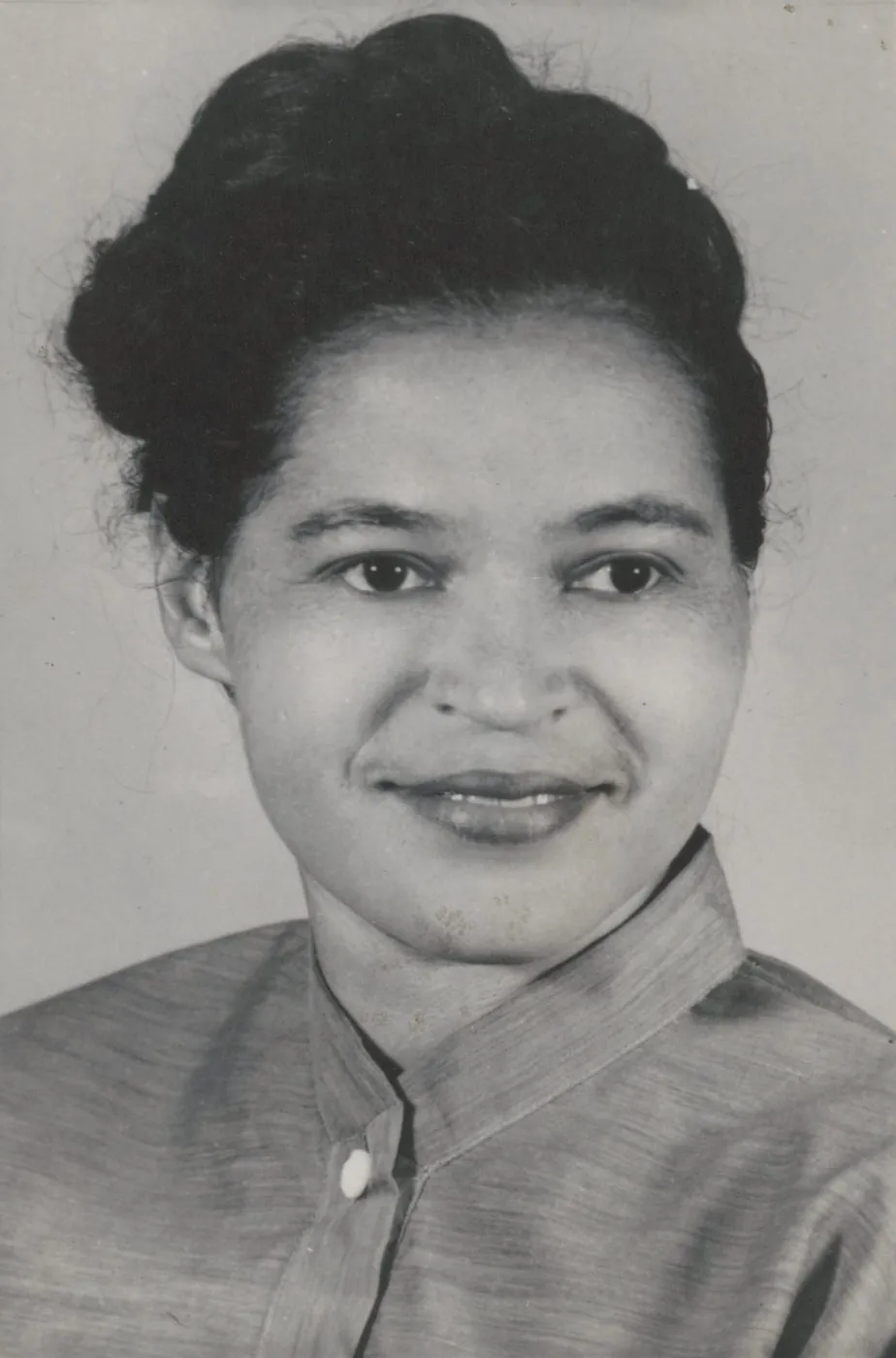
An Activist Before She Was Famous
Rosa Louise McCauley was born on February 4, 1913, in Tuskegee, Alabama, and spent much of her childhood on her grandparents’ farm outside Montgomery. She married Raymond Parks, a barber and NAACP activist, in 1932, and it was through this circle that she became formally involved in the organization herself. In 1943, she was elected secretary of the Montgomery chapter of the NAACP, working closely with chapter president E.D. Nixon on voter registration drives and the documentation of cases involving racial violence and injustice against Black Alabamians. This history matters: by the time of her arrest in 1955, Parks was not an ordinary passenger who happened to be tired at the end of a long day, as the story is sometimes simplified. She was an experienced, deliberate civil rights worker who understood the legal and political stakes of challenging segregation, and who had attended workshops on nonviolent resistance and desegregation strategy at the Highlander Folk School in Tennessee the summer before her arrest.
The Arrest and the Boycott
On December 1, 1955, Parks was riding a city bus home from her job as a seamstress at a Montgomery department store. When the driver ordered her to give up her seat in the section reserved for Black riders so that a white passenger could sit, she refused, and was arrested for violating the city’s segregation ordinance. Montgomery’s Black community, already organized through churches and civic groups, responded within days by launching a boycott of the city’s bus system. The boycott was coordinated by the newly formed Montgomery Improvement Association, led by a young Baptist minister, Martin Luther King Jr., whose role in the campaign helped establish him as a national figure in the civil rights movement (his fuller story is covered separately on this site). The boycott lasted 381 days, sustaining an alternative transportation network of carpools and walking routes while the city’s bus revenue collapsed and the case worked its way through the courts.

Legal Victory and Later Life
The boycott ended in December 1956, after the U.S. Supreme Court affirmed a federal district court ruling in Browder v. Gayle that Montgomery’s segregated bus seating violated the Fourteenth Amendment. The decision, combined with the sustained pressure of the boycott itself, marked one of the first major legal and organizational victories of the postwar civil rights movement and helped establish the model of mass nonviolent protest that would shape the following decade. Parks and her husband later relocated to Detroit, where she continued civil rights work, including several years on the staff of U.S. Representative John Conyers. She remained a visible figure in the movement for the rest of her life, and in 1996 received the Presidential Medal of Freedom, the nation’s highest civilian honor, followed in 1999 by the Congressional Gold Medal. Rosa Parks died in Detroit on October 24, 2005, at the age of 92. She subsequently lay in honor at the U.S. Capitol Rotunda, the first woman in American history to receive that distinction.