
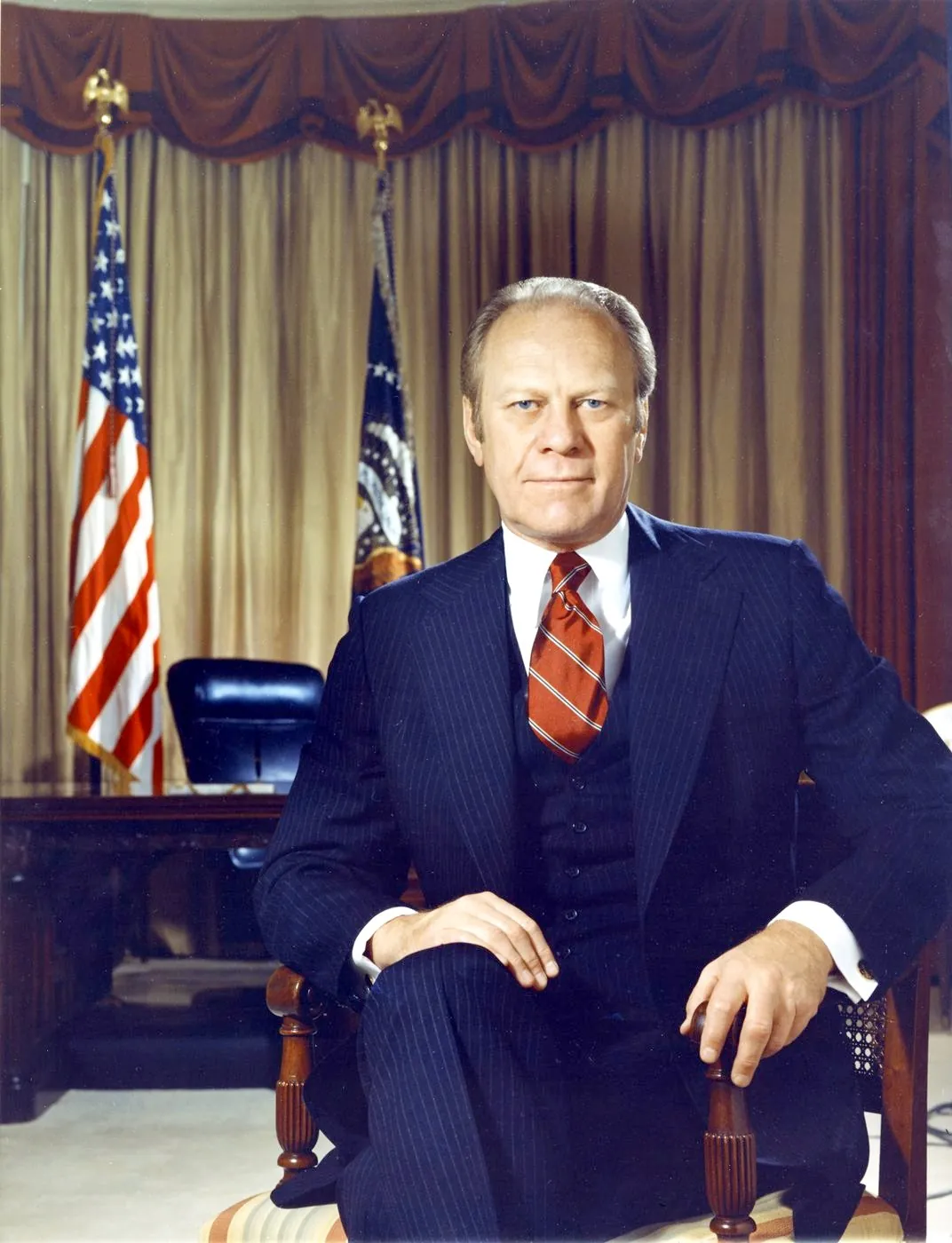
This Gerald Ford timeline traces his path from a Nebraska birth and a Michigan football field to twenty-five years in Congress, an unelected vice presidency and presidency, and the pardon that defined his brief White House tenure.
Early Life and Rise in Congress
Gerald Ford was born Leslie Lynch King Jr. in Omaha, Nebraska, on July 14, 1913. His parents separated soon after, and his mother relocated with him to Grand Rapids, Michigan, where she remarried Gerald Rudolff Ford; the boy was later renamed after his stepfather. He grew into a standout center on the University of Michigan football team, reportedly turning down professional offers to attend Yale Law School instead. During the Second World War he served as a U.S. Navy officer aboard the light aircraft carrier USS Monterey in the Pacific theater, an experience he later described as formative. Returning to Grand Rapids after the war, Ford practiced law and, in 1948, won election to the U.S. House of Representatives representing Michigan’s 5th congressional district; that same year he married Betty Bloomer, whom he had met after his return from the Navy. He held his House seat for a quarter-century, building a reputation as a steady, well-liked institutionalist rather than an ideological firebrand, and in 1965 his House Republican colleagues elected him Minority Leader, a position he held until 1973. Ford long harbored ambitions of becoming Speaker of the House rather than president, and reportedly planned to retire from politics after one more term when the events of the early 1970s intervened.
The Presidency: Succeeding Nixon and the Pardon
Ford’s rise to national office came through an unusual sequence of events. When Vice President Spiro Agnew resigned in 1973 amid an unrelated tax-evasion scandal, President Richard Nixon nominated Ford to fill the vacancy under the newly ratified 25th Amendment, and Congress confirmed him in December 1973. Less than a year later, on August 9, 1974, Nixon himself resigned over the Watergate scandal, and Ford was sworn in as the 38th president, making him the only person in American history to serve as both vice president and president without ever being elected to either office. A month into his presidency, on September 8, 1974, Ford granted Nixon a full and unconditional pardon for any crimes he may have committed as president, a decision that provoked immediate public backlash and is widely believed to have cost Ford political capital, though he maintained it was necessary to let the country move past Watergate. His presidency also grappled with high inflation and unemployment, the final evacuation of American personnel from Saigon in 1975 as the Vietnam War ended, the Mayaguez incident later that year, and the signing of the Helsinki Accords. He survived two separate assassination attempts in September 1975, both by women, in California within weeks of each other. Domestically, his administration launched the “Whip Inflation Now” (WIN) campaign in 1974, an effort to encourage voluntary anti-inflation measures that was widely mocked and produced little lasting economic effect.
Legacy and Later Years
Ford narrowly lost the 1976 presidential election to Jimmy Carter, a defeat many historians link in part to lingering resentment over the Nixon pardon. After leaving office he remained active in public life, serving on various boards, writing and speaking on policy issues, and receiving the Presidential Medal of Freedom in 1999 in recognition of his service. He died at his home in Rancho Mirage, California, on December 26, 2006, at age 93, at the time the longest-lived president in U.S. history. He is buried at the Gerald R. Ford Presidential Museum in Grand Rapids, Michigan, the city where he grew up. Historical assessments of Ford have grown more favorable with time, with many historians crediting his steady, low-key leadership style with helping restore public trust in the presidency after Watergate, even as the Nixon pardon remains the most debated decision of his career.