
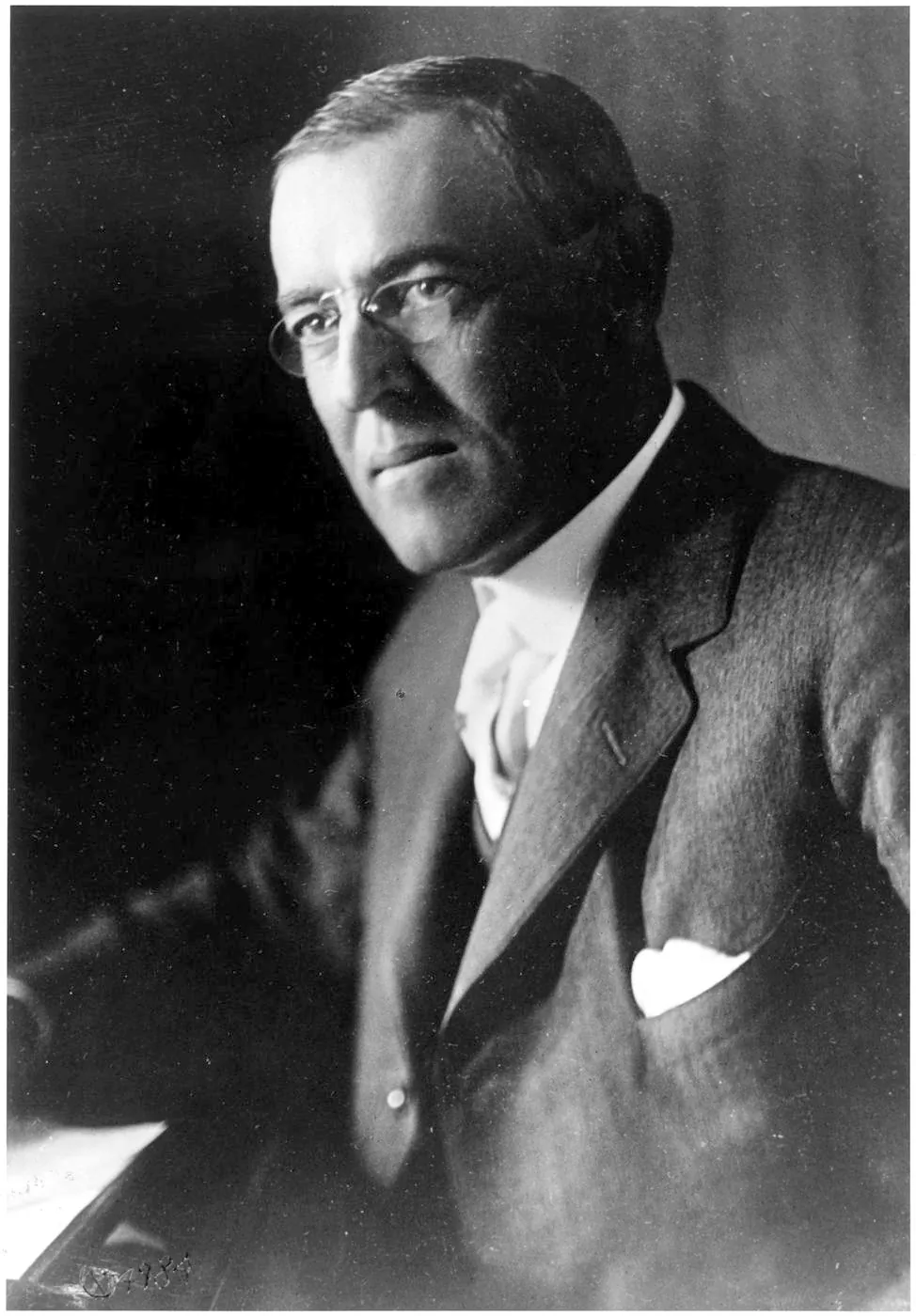
This Woodrow Wilson timeline traces his path from academic to president, through American entry into the First World War and the fight over the League of Nations, to the ratification of women’s suffrage during his second term.
Early Life and Academic Career
Thomas Woodrow Wilson was born on December 28, 1856, in Staunton, Virginia, and spent his childhood in the Reconstruction-era South. He pursued an academic path unusual for a future president, earning a doctorate in political science from Johns Hopkins University and building a scholarly career that culminated in his appointment as president of Princeton University in 1902, where he pushed for curricular and institutional reforms. His growing reputation as a reformer led New Jersey Democratic Party leaders to recruit him as a gubernatorial candidate in 1910, expecting a pliable figurehead; once elected, Wilson instead broke quickly with the party machine that had backed him, pushing through workers’ compensation, direct primary elections, and utility-regulation reforms that built the national profile carrying him toward the presidency just two years later.
Presidency: Reform, War, and the League of Nations
Wilson won the 1912 presidential election in a four-way race after Theodore Roosevelt’s third-party Progressive campaign split the Republican vote against incumbent William Taft. His first term centered on his “New Freedom” reform agenda, including the Federal Reserve Act of 1913, which created the modern U.S. central banking system, the Underwood Tariff Act, which lowered tariff rates and introduced a federal income tax under the newly ratified 16th Amendment, and the Federal Trade Commission and Clayton Antitrust Act of 1914, which strengthened federal oversight of corporate competition. Wilson won re-election in 1916 on the strength of having kept the United States out of the European war then raging, but within months of his second inaugural, German unrestricted submarine warfare and the intercepted Zimmermann Telegram (a proposal to Mexico for a wartime alliance against the U.S.) pushed him to ask Congress for a declaration of war in April 1917.

In January 1918, Wilson outlined his Fourteen Points as a blueprint for postwar peace, and after the armistice he became the first sitting U.S. president to travel to Europe, personally leading the American delegation at the Paris Peace Conference. The League of Nations, intended to prevent future wars through collective security, became the centerpiece of his diplomacy and earned him the 1919 Nobel Peace Prize, but the U.S. Senate, led by opponents such as Henry Cabot Lodge, ultimately refused to ratify the Treaty of Versailles or approve American membership in the League, in part because Wilson refused to accept the reservations Senate moderates had proposed as a compromise.
Suffrage, Decline, and Death
Wilson’s position on women’s suffrage evolved considerably during his presidency; after initially treating it as a matter for individual states, he came to publicly support a constitutional amendment, framing it in 1918 as a necessary war measure. The 19th Amendment was ratified in August 1920, guaranteeing women across the country the right to vote. By then, Wilson’s own capacities were severely diminished: a massive stroke in October 1919, suffered while campaigning for the League of Nations treaty, left him partially paralyzed, and for much of his remaining term, his wife, Edith Wilson, closely controlled access to him and his official duties, a period whose full details remain debated by historians. Wilson left office in March 1921 in poor health, retiring to a private home in Washington, D.C., where he lived quietly and rarely appeared in public before his death on February 3, 1924. He remains a historically consequential but sharply contested figure: credited by admirers with reshaping the modern federal government, advancing internationalism, and eventually backing women’s suffrage, while criticized by historians for re-segregating parts of the federal civil service and for a rigid, uncompromising style that arguably cost the League of Nations its chance at American membership.
Frequently Asked Questions
What does this Woodrow Wilson timeline cover?
This timeline covers Wilson's biography from his 1856 birth in Virginia through his academic career, his 1912 election as president, American entry into World War I in 1917, the Fourteen Points and League of Nations campaign, the 1920 ratification of women's suffrage, and his 1924 death.
Why did the United States enter World War I under Wilson?
Wilson asked Congress for a declaration of war in April 1917 after Germany resumed unrestricted submarine warfare against neutral shipping and after the interception of the Zimmermann Telegram, in which Germany proposed a military alliance with Mexico against the United States.
Did the United States join the League of Nations?
No. Although Wilson championed the League of Nations and won the 1919 Nobel Peace Prize for the effort, the U.S. Senate refused to ratify the Treaty of Versailles, and the United States never became a member.
What happened to Wilson's health in office?
Wilson suffered a severe stroke in October 1919 that left him partially incapacitated for the remainder of his second term, during which his wife, Edith Wilson, played a closely guarded and still-debated role in managing his official duties.