
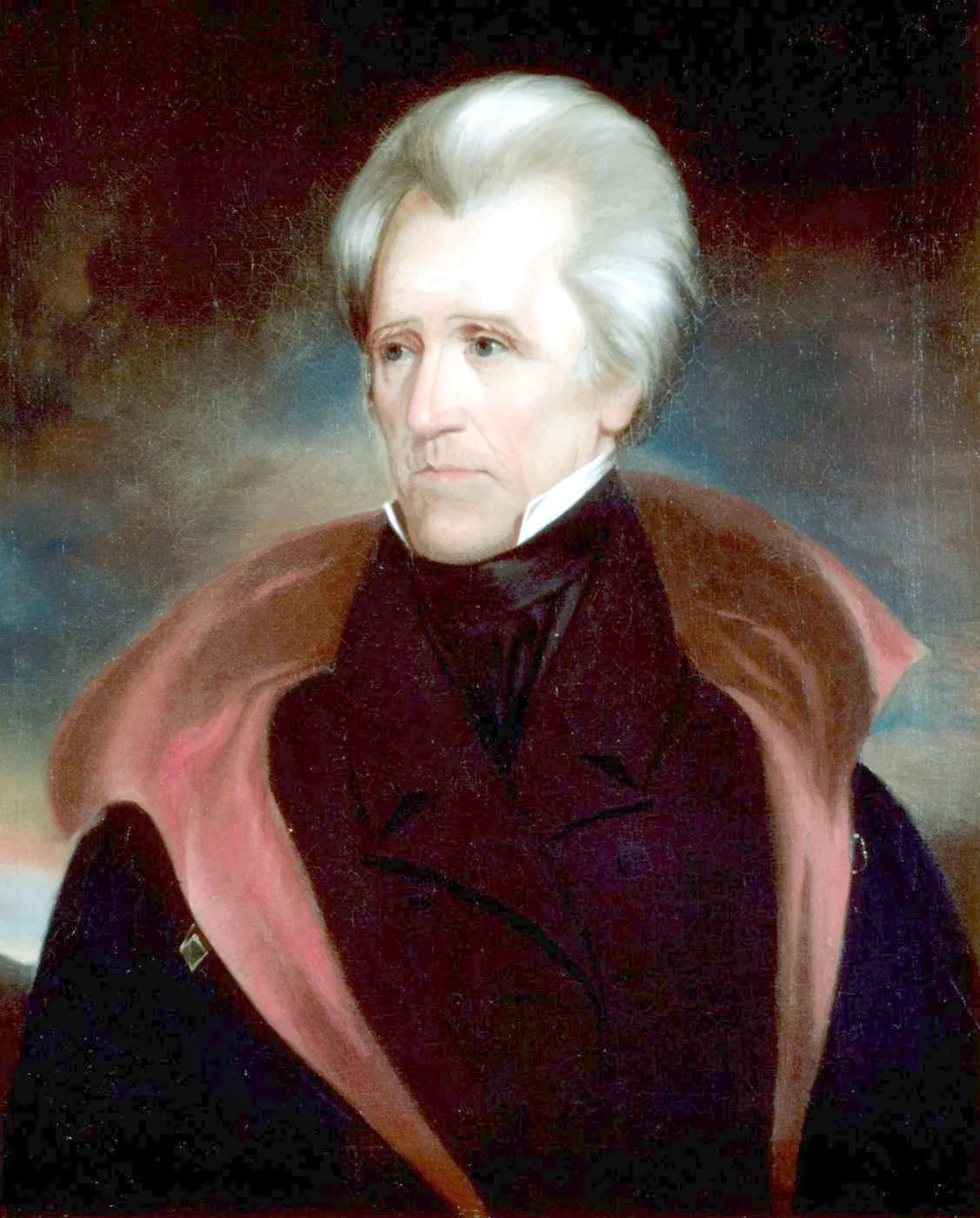
This Andrew Jackson timeline traces his path from an orphaned frontier child to the seventh President of the United States, including the achievements his supporters celebrated and the forced removal of Native peoples his administration carried out.
Early Life and Military Career
Andrew Jackson was born on March 15, 1767, in the Waxhaws, a backcountry region straddling the border of North and South Carolina; the exact town is disputed, and both states have claimed him. The Revolutionary War took his family from him early: his father died before his birth, and his mother and brothers died during or shortly after the war, leaving Jackson orphaned by the age of fourteen. He trained as a lawyer, moved to Tennessee, and built a career as a planter, enslaver, and militia officer before rising to national fame during the War of 1812. His decisive January 1815 victory over British forces at the Battle of New Orleans (fought, notably, after a peace treaty had already been signed in Europe, though news had not yet crossed the Atlantic) made him the most celebrated American general of his generation and gave him the political standing to run for president.

Presidency: Democratic Expansion and the Trail of Tears
Jackson was elected the seventh president in 1828, defeating incumbent John Quincy Adams in an election that benefited from the expansion of voting rights to a much larger share of white men and from popular hostility to the Washington political class. His presidency reshaped the office and the party system, giving rise to the modern Democratic Party and a more combative, populist style of executive leadership. But this Andrew Jackson presidential timeline cannot honestly separate that legacy from its gravest act: in 1830 he signed the Indian Removal Act, which authorized the federal government to force Native American nations in the Southeast, including the Cherokee, Creek, Choctaw, Chickasaw, and Seminole, from their ancestral lands. The removals carried out under this policy, most infamously the Cherokee removal along what became known as the Trail of Tears, caused enormous suffering and thousands of deaths from exposure, disease, and starvation. Historians and the federal government itself have since recognized this as one of the darkest chapters of nineteenth-century American policy, and it remains inseparable from any accurate account of Jackson’s presidency. In 1832, Jackson also vetoed the recharter of the Second Bank of the United States, framing the fight as a defense of ordinary citizens against concentrated financial power, and used the controversy to help secure re-election later that year.
Later Years and Legacy
After leaving office in 1837, Jackson retired to the Hermitage, his estate near Nashville, where he continued to wield significant influence over Democratic Party politics and his chosen successor, Martin Van Buren. He also remained a vocal supporter of preserving the Union during the 1832–33 Nullification Crisis, when South Carolina attempted to declare a federal tariff void, and he threatened military force to compel the state’s compliance, a stance later cited by unionists during the secession crisis of 1861. He died at the Hermitage on June 8, 1845. Jackson’s legacy remains sharply contested: celebrated by admirers as a champion of the “common man” and expanded democratic participation among white men, and condemned by historians and Native nations for the human catastrophe of Indian removal, a policy whose consequences are still commemorated and studied today. His image nonetheless appeared on U.S. currency for generations, a reminder of how contested his historical reputation continues to be.
Frequently Asked Questions
What does this Andrew Jackson timeline cover?
This timeline covers Andrew Jackson's biography from his 1767 birth in the Waxhaws through his military career, his 1828 election as the seventh president, the 1830 Indian Removal Act and Trail of Tears, his 1832 bank veto, and his 1845 death.
Why is the Indian Removal Act significant to Jackson's legacy?
The 1830 Indian Removal Act, signed by Jackson, authorized the forced relocation of southeastern Native American nations. The resulting removals, especially the Cherokee Trail of Tears, caused thousands of deaths and are regarded as one of the most serious injustices of the era.
How did Andrew Jackson become famous before his presidency?
Jackson became a national hero for leading American forces to victory at the Battle of New Orleans in January 1815 during the War of 1812.
When did Andrew Jackson die?
Jackson died on June 8, 1845, at the Hermitage, his estate near Nashville, Tennessee.