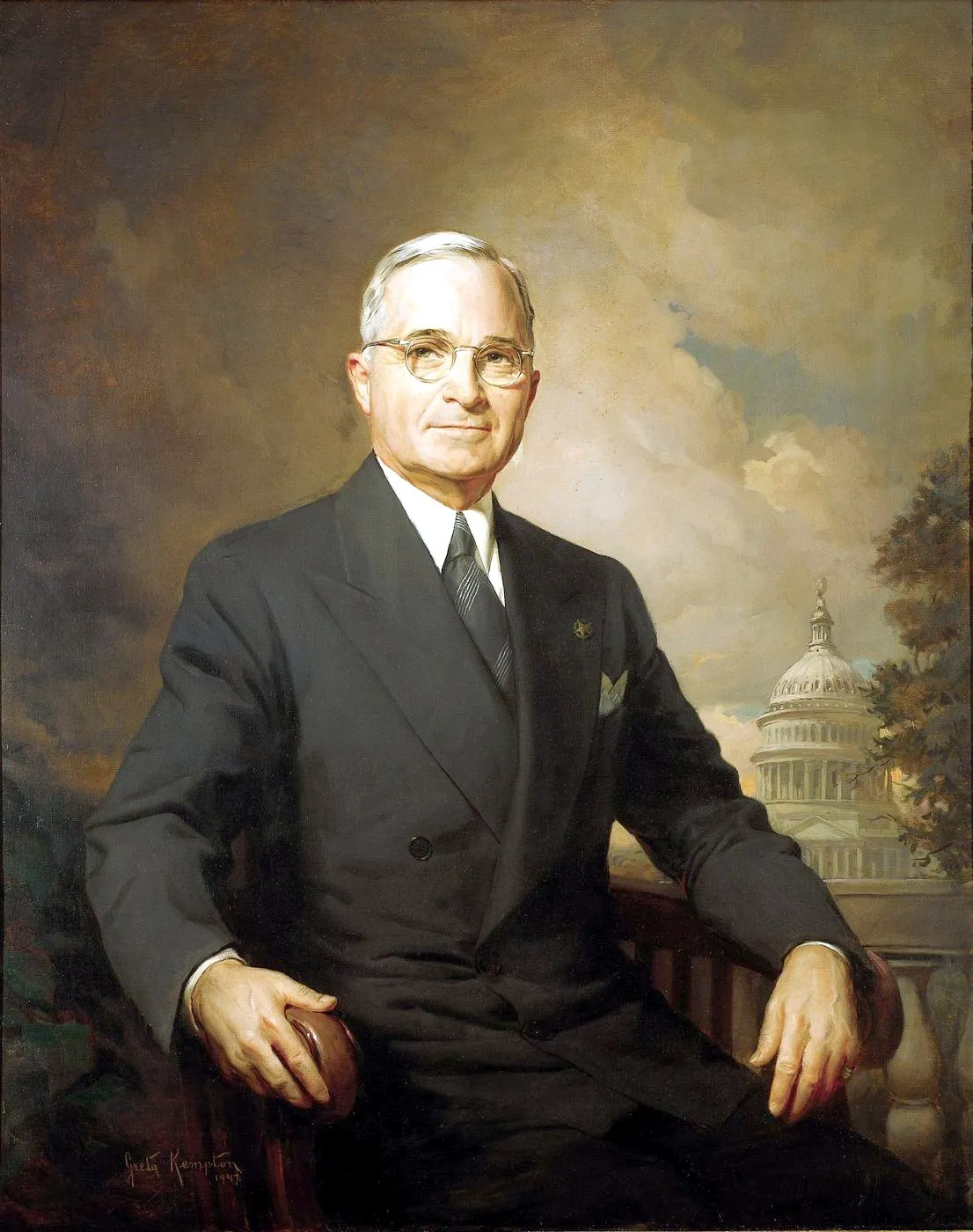
This Harry S. Truman timeline traces his path from a modest Missouri upbringing to the presidency he assumed without warning, and the decisions that shaped the end of the Second World War and the start of the Cold War.
Early Life and Path to the Vice Presidency
Harry S. Truman was born on May 8, 1884, in Lamar, Missouri, and grew up in and around Independence, Missouri, in a family of modest means; unlike most presidents, he never attended college. He served as an artillery officer in France during the First World War, an experience he later credited with shaping his leadership style. After the war, Truman ran a men’s clothing store that failed during the 1921 recession, then entered Missouri politics with the backing of the Kansas City Pendergast political machine, rising to preside over Jackson County government before winning election to the U.S. Senate in 1934. In the Senate, he gained national attention chairing a committee investigating waste and fraud in wartime defense spending. In 1944, Democratic Party leaders selected him as Franklin D. Roosevelt’s running mate, replacing Vice President Henry Wallace, and Truman was elected vice president that November. He had served in the role for less than three months, and had met privately with Roosevelt only a handful of times, when Roosevelt died on April 12, 1945, elevating Truman to the presidency with little preparation for the office. Truman later remarked that he felt as though the moon, the stars, and the planets had fallen on him upon hearing the news, reflecting how little he had been briefed on the administration’s wartime and diplomatic plans.
Ending the War and Shaping the Postwar Order
Truman inherited a nation still fighting the Second World War and, within his first months in office, learned of the secret Manhattan Project developing the atomic bomb. After Japan refused Allied surrender demands, Truman authorized the dropping of atomic bombs on Hiroshima on August 6, 1945, and Nagasaki on August 9, 1945 (the only use of nuclear weapons in warfare to date), decisions that hastened Japan’s surrender but that remain the subject of historical debate over their necessity and human cost. Truman also oversaw the drafting of the National Security Act of 1947, which reorganized the American military establishment and created the Department of Defense, the National Security Council, and the Central Intelligence Agency. As postwar tensions with the Soviet Union hardened into what became known as the Cold War, Truman articulated the Truman Doctrine of 1947, committing the United States to containing the spread of communism, and backed the Marshall Plan of 1948, a large-scale program of economic aid that helped rebuild Western European economies. In 1948, he also ordered the desegregation of the U.S. armed forces by executive order, and, defying pollsters who predicted defeat, won election to a full term that November over Republican Thomas Dewey, in an upset so widely unexpected that a newspaper famously printed the incorrect headline “Dewey Defeats Truman” on election night.
Korean War and Later Years
Truman’s second term was dominated by the outbreak of the Korean War in June 1950, when he committed American forces under a United Nations mandate to defend South Korea after invasion from the communist North, in a conflict that settled into a costly stalemate and remained unresolved when he left office. His decision in 1951 to relieve General Douglas MacArthur of command, after MacArthur publicly challenged administration policy on the war, proved deeply controversial but affirmed the principle of civilian control over the military. Truman chose not to seek re-election in 1952 and returned to Independence, Missouri, where he oversaw the building of his presidential library. He died on December 26, 1972. Historians have increasingly credited Truman with steering the United States through the difficult transition from world war to Cold War, laying institutional foundations, including NATO and the containment strategy, that shaped American foreign policy for decades.
Frequently Asked Questions
What does this Harry S. Truman timeline cover?
This timeline covers Truman's biography from his 1884 birth in Lamar, Missouri, through his 1945 succession to the presidency, the atomic bombings of Japan, the Marshall Plan, the Korean War, and his 1972 death.
How did Harry Truman become president?
Truman became president on April 12, 1945, when Franklin D. Roosevelt died in office. Truman had been vice president for less than three months at the time.
Why did Truman authorize the atomic bombings of Japan?
Truman authorized the bombings after Japan refused Allied surrender demands, aiming to end the war quickly. The decision remains debated by historians over its necessity and human cost.
When did the Korean War begin?
The Korean War began in June 1950 when North Korea invaded South Korea, prompting Truman to commit American forces under a United Nations mandate.