
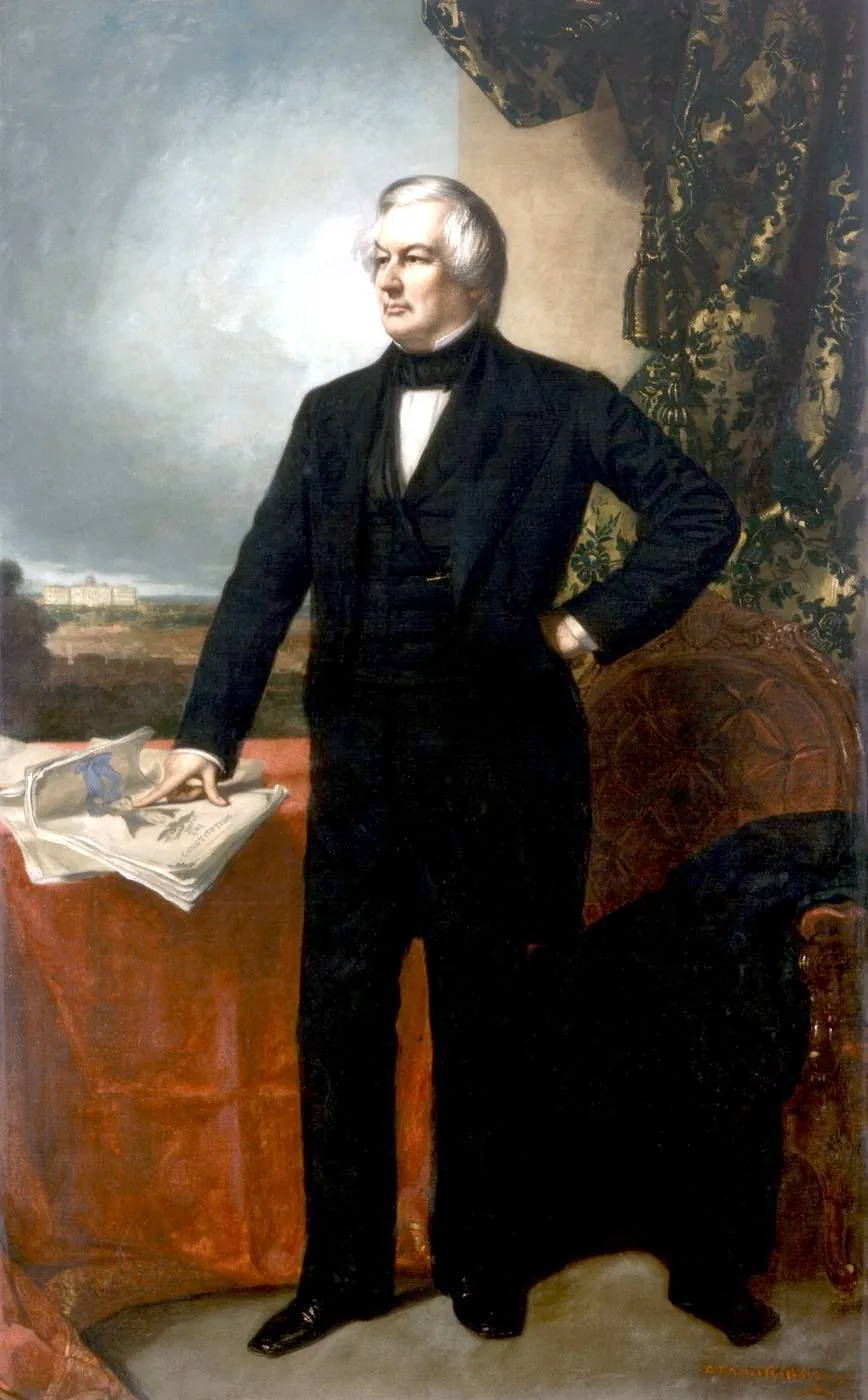
This Millard Fillmore timeline traces the thirteenth president’s rise from a self-taught rural New Yorker to a presidency defined by a fragile compromise intended to hold a divided nation together.
Early Life and Rise in New York Politics
Millard Fillmore was born on January 7, 1800, in a log cabin in Cayuga County, New York, into a poor farming family with little access to formal schooling. Largely self-educated, he apprenticed with a cloth-maker before studying law and eventually building a successful legal and political career in Buffalo. Fillmore was elected to the U.S. House of Representatives as a Whig in 1832, serving several terms and developing a reputation as a diligent legislator, particularly on tariff and financial matters, before losing a bid for governor of New York in 1844. His political fortunes revived when the Whig Party selected him as Zachary Taylor’s running mate in 1848, a ticket that balanced the war hero Taylor with a more moderate Northern political figure. Fillmore was inaugurated as vice president in March 1849, a position with little formal power that nonetheless placed him a heartbeat from the presidency.

Presidency: The Compromise of 1850
That heartbeat came on July 9, 1850, when Taylor died suddenly after a brief illness, making Fillmore the second vice president, after John Tyler, to assume the presidency following a sitting president’s death. Fillmore inherited an urgent and volatile crisis: the question of whether and how slavery would extend into the vast new territories won from Mexico, a dispute that had brought talk of secession to a fever pitch. Unlike Taylor, who had resisted a broad legislative deal, Fillmore supported and signed into law the package of measures known as the Compromise of 1850. These included the admission of California as a free state, the organization of Utah and New Mexico territories with the question of slavery left to be decided later by their residents, a ban on the slave trade (though not slavery itself) in Washington, D.C., and, most controversially, a strengthened Fugitive Slave Act that compelled citizens and officials in free states to assist in the capture and return of escaped enslaved people. Fillmore believed the compromise was necessary to preserve the Union, and it did postpone large-scale sectional conflict for roughly a decade, but the Fugitive Slave Act in particular provoked outrage in the North and hardened abolitionist sentiment, arguably deepening the divisions it was meant to ease.
Later Life and Legacy
Fillmore’s support for the compromise, and especially the Fugitive Slave Act, cost him support within his own party, and the Whigs declined to nominate him for a full term in 1852. He left the presidency in March 1853 and later ran again for president in 1856 as the candidate of the nativist American Party (commonly known as the “Know Nothing” party), finishing a distant third. He largely withdrew from national politics afterward, remaining active in civic life in Buffalo, New York, where he helped found institutions including the Buffalo history society and what became the University at Buffalo. Fillmore died in Buffalo on March 8, 1874. Historians generally regard his presidency as well-intentioned but ultimately unable to resolve the sectional crisis over slavery, a conflict that erupted into civil war within a decade of his signing the Compromise of 1850.
Frequently Asked Questions
What does this Millard Fillmore timeline cover?
This timeline covers Fillmore's biography from his 1800 birth in New York through his time in Congress, his vice presidency, his 1850 succession to the presidency after Zachary Taylor's death, the Compromise of 1850, and his death in 1874.
Why did Millard Fillmore become president?
Fillmore was vice president under Zachary Taylor and became president upon Taylor's sudden death in July 1850, making him the second vice president to succeed a president who died in office.
What was the Compromise of 1850?
It was a package of laws signed by Fillmore that admitted California as a free state, organized Utah and New Mexico territories, banned the slave trade in Washington, D.C., and enacted a strengthened Fugitive Slave Act, intended to defuse sectional conflict over slavery.
Did Millard Fillmore serve a second term?
No. His own Whig Party declined to renominate him in 1852 largely due to opposition to the Fugitive Slave Act, and he later lost a third-party bid for president in 1856.