
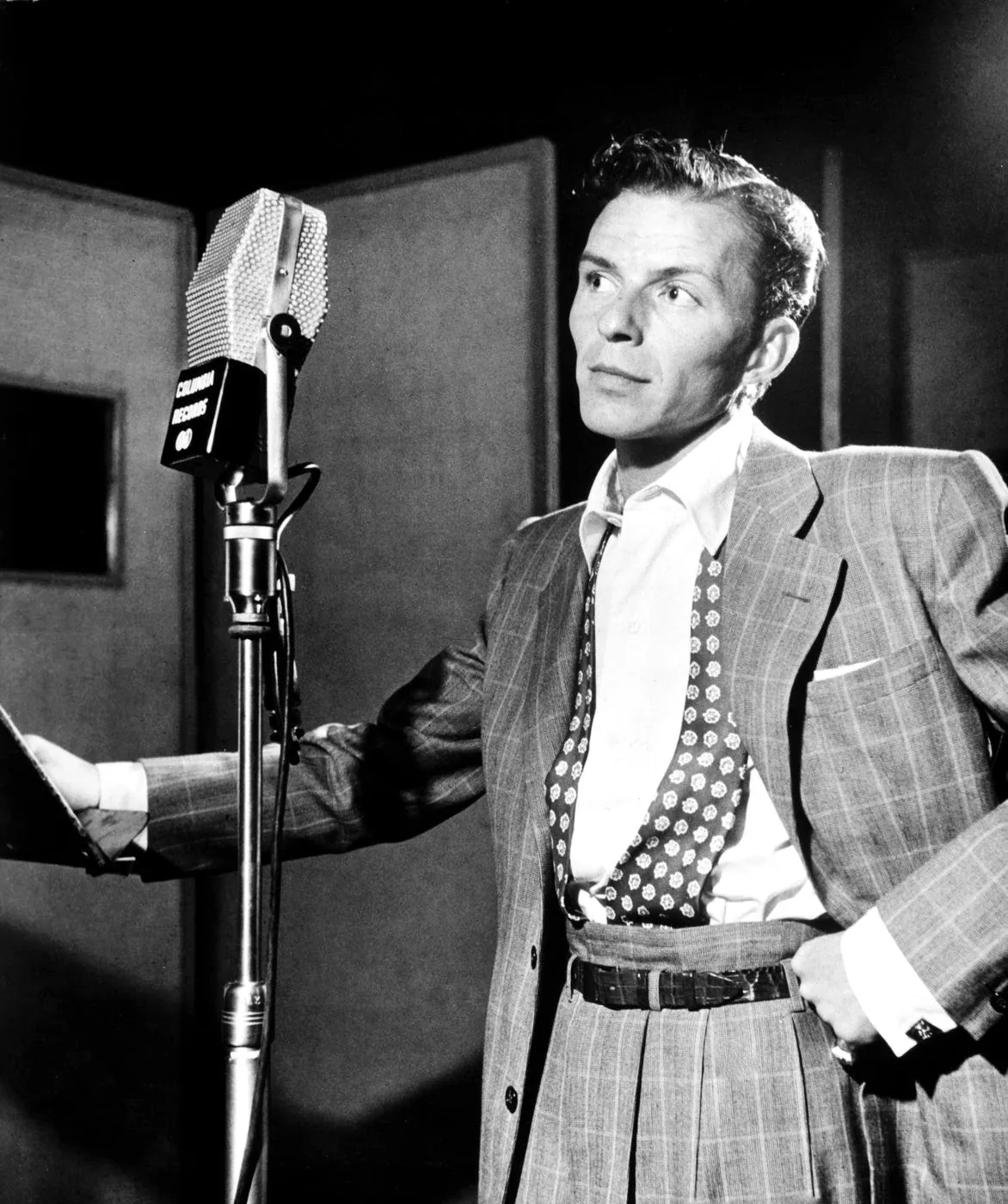
This Frank Sinatra timeline traces his career from a New Jersey childhood through the big-band years, a Hollywood comeback, and the Rat Pack era that made him one of the most recognizable entertainers of the twentieth century.
Early Life and the Big-Band Years
Francis Albert Sinatra was born on December 12, 1915, in Hoboken, New Jersey, the only child of Italian immigrant parents. He left school as a teenager to pursue singing, working small local venues before landing a job as featured vocalist with Harry James’s orchestra in 1939. The following year he moved to Tommy Dorsey’s much better-known band, where he learned breath control and phrasing techniques, reportedly studying Dorsey’s own trombone playing, that shaped his singing style for the rest of his career. By the early 1940s, Sinatra had left Dorsey to go solo, and his performances for young, largely female audiences made him one of the first modern teen idols in American popular music, well before the term existed. Contemporary accounts describe scenes of enthusiastic, sometimes chaotic fan response at his early solo appearances, comparable in tone to the reception later given to other popular music phenomena, and his radio and recording work through the 1940s established him as one of the best-known vocalists in the country while he was still in his twenties.

Career Slump, Comeback, and the Capitol Years
Sinatra’s popularity faded by the late 1940s as musical tastes shifted and his personal life drew heavy press attention, including a widely publicized divorce and remarriage. His fortunes changed in 1953, when he won the Academy Award for Best Supporting Actor for his dramatic role as Private Angelo Maggio in From Here to Eternity, a performance frequently cited as one of the more dramatic comebacks in American entertainment. That same period saw him sign with Capitol Records, where his partnership with arranger Nelson Riddle produced a string of concept albums, among them In the Wee Small Hours and Songs for Swingin’ Lovers!, that are still commonly regarded as high points of the American popular-song tradition. It was also during the Capitol years that Sinatra’s voice matured from the lighter crooning of his big-band days into the more world-weary, rhythmically confident style most associated with him today. His acting career also continued alongside his recording work; beyond From Here to Eternity, he appeared in dozens of films across the following decades, spanning dramatic roles and the light musical comedies more typical of the period.
Las Vegas, the Rat Pack, and Later Career
By 1960, Sinatra was headlining Las Vegas, performing alongside Dean Martin, Sammy Davis Jr., Peter Lawford, and Joey Bishop in shows that helped cement the informal group’s reputation as “the Rat Pack,” a label the performers themselves treated with some ambivalence. The same year, he founded his own label, Reprise Records, giving him greater control over his recorded output much as contemporaries in other fields were beginning to seek. Sinatra continued to record, tour, and act through the 1960s and 1970s, announcing a brief retirement in 1971 before returning to regular performing. In 1994, in recognition of a body of work spanning more than fifty years, he received the Grammy Lifetime Achievement Award. Sinatra died of a heart attack on May 14, 1998, in Los Angeles, at age 82. Across nightclub stages, film sets, and recording studios, his career is often described as having helped define what a modern American popular singer could be: equally at home fronting a big band, headlining a casino showroom, or carrying a dramatic film role.