
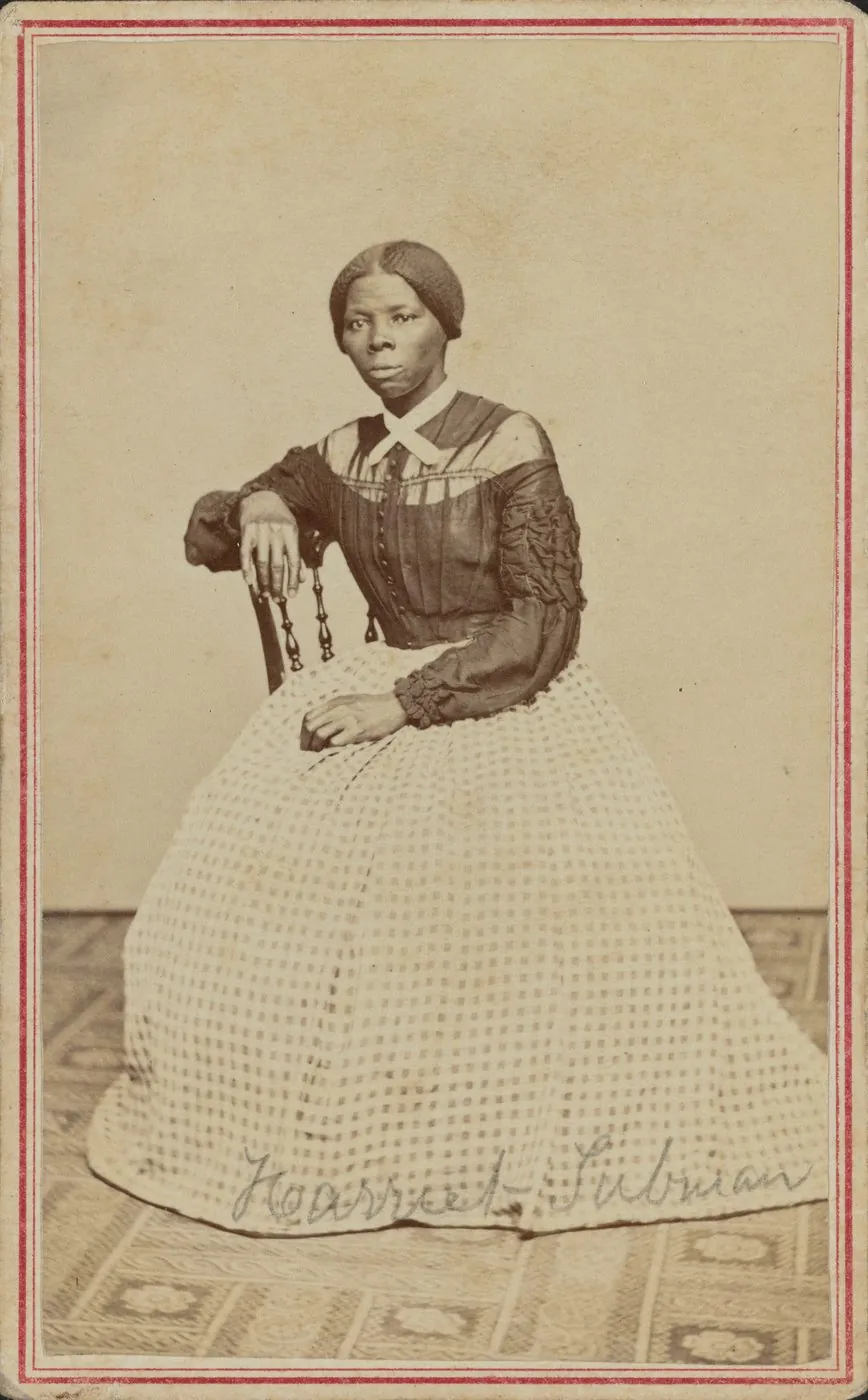
This Harriet Tubman timeline traces her path from enslavement in Maryland through her work on the Underground Railroad, her Civil War service, and her later activism for women’s suffrage.
Enslavement and Escape
Harriet Tubman was born Araminta Ross around 1822 into slavery on Maryland’s Eastern Shore, one of several children of enslaved parents; because enslaved births were often not formally recorded, her exact birth date is not known with certainty. As a child and young woman, she was hired out to different households and endured harsh treatment and physical labour, including agricultural work that gave her practical knowledge of the region’s terrain and waterways, skills that would later prove valuable. As a teenager, she suffered a severe head injury when an overseer, aiming a heavy weight at another enslaved person who was attempting to flee, struck her instead, an injury that caused recurring seizures, headaches, and other health effects for the rest of her life. She married a free Black man, John Tubman, in the early 1840s, though her own status as enslaved remained unchanged. In 1849, fearing she was about to be sold further south following the death of her enslaver, Tubman escaped slavery and travelled roughly 90 miles to Philadelphia, reaching free territory largely on her own, using the same informal networks of safe houses and sympathetic guides she would soon rely on to help others. Rather than remain safely in the North, she soon began returning to slaveholding Maryland to guide others to freedom, work that placed her at extreme personal risk under laws such as the Fugitive Slave Act, which criminalised assisting escaped enslaved people even in free states.
Conductor on the Underground Railroad
Through the 1850s, Tubman made a number of documented return trips into the South, leading enslaved people, including her elderly parents and several other family members, north along the informal network of routes, safe houses, and sympathetic guides known as the Underground Railroad. She became known by the epithet “Moses” for her role in these rescues, and accounts from the period describe her using careful planning, disguises, coded songs, and knowledge of terrain, rivers, and season to avoid capture, typically travelling during winter nights when the risk of detection was lower. She is also said to have carried a firearm on these missions, both for protection and, according to some accounts, to discourage any escapee from turning back. Estimates of the total number of people she personally guided to freedom vary between sources and cannot be stated with precision, since the operation depended on secrecy, but she was widely recognised in abolitionist circles during her own lifetime, including by figures such as Frederick Douglass, as one of the Underground Railroad’s most effective operatives, and a bounty was reportedly placed on her capture by slaveholders in the region.
Civil War Service and Later Activism
During the Civil War, Tubman served the Union Army in South Carolina as a scout, spy, cook, and nurse, treating soldiers suffering from disease and wounds while also gathering intelligence, drawing on her experience navigating hostile territory undetected. In 1863, she helped guide Union forces in the Combahee Ferry Raid, an operation that freed several hundred enslaved people along South Carolina’s Combahee River; the raid is often cited as making her the first woman known to have planned and led an armed military operation in U.S. history, though she received no military pay at the time and later had to fight for recognition of her wartime service. After the war, Tubman settled in Auburn, New York, on property she had purchased before the conflict, where she supported family and community members and later helped found a home for elderly Black Americans, despite ongoing financial hardship and years of delay before she received a government pension. In her later decades she became involved in the movement for women’s suffrage, appearing at meetings alongside other prominent activists and drawing on her own wartime record as evidence of women’s capability. She died in Auburn in 1913, and she is remembered today, including on U.S. currency proposals and in numerous memorials, as one of the defining figures of the fight against slavery and for civil rights in American history.
Frequently Asked Questions
What does this Harriet Tubman timeline cover?
This timeline covers her birth into slavery around 1822, her 1849 escape, her years leading rescue missions on the Underground Railroad, her 1863 Civil War service including the Combahee Ferry Raid, and her later suffrage activism before her death in 1913.
How many people did Harriet Tubman lead to freedom?
Historical estimates vary and cannot be stated with precision, since Underground Railroad activity was necessarily secretive, but she made numerous documented return trips into slaveholding territory over roughly a decade.
What was the Combahee Ferry Raid?
A Union Army operation in 1863 in which Tubman served as a guide, helping free several hundred enslaved people along South Carolina's Combahee River, an action often cited as making her the first woman in U.S. history known to have planned and led a military raid.
Was Harriet Tubman involved in women's suffrage?
Yes, in her later life she became active in the women's suffrage movement, speaking at events alongside other prominent activists in support of voting rights for women.