Early Life and Path to the Throne
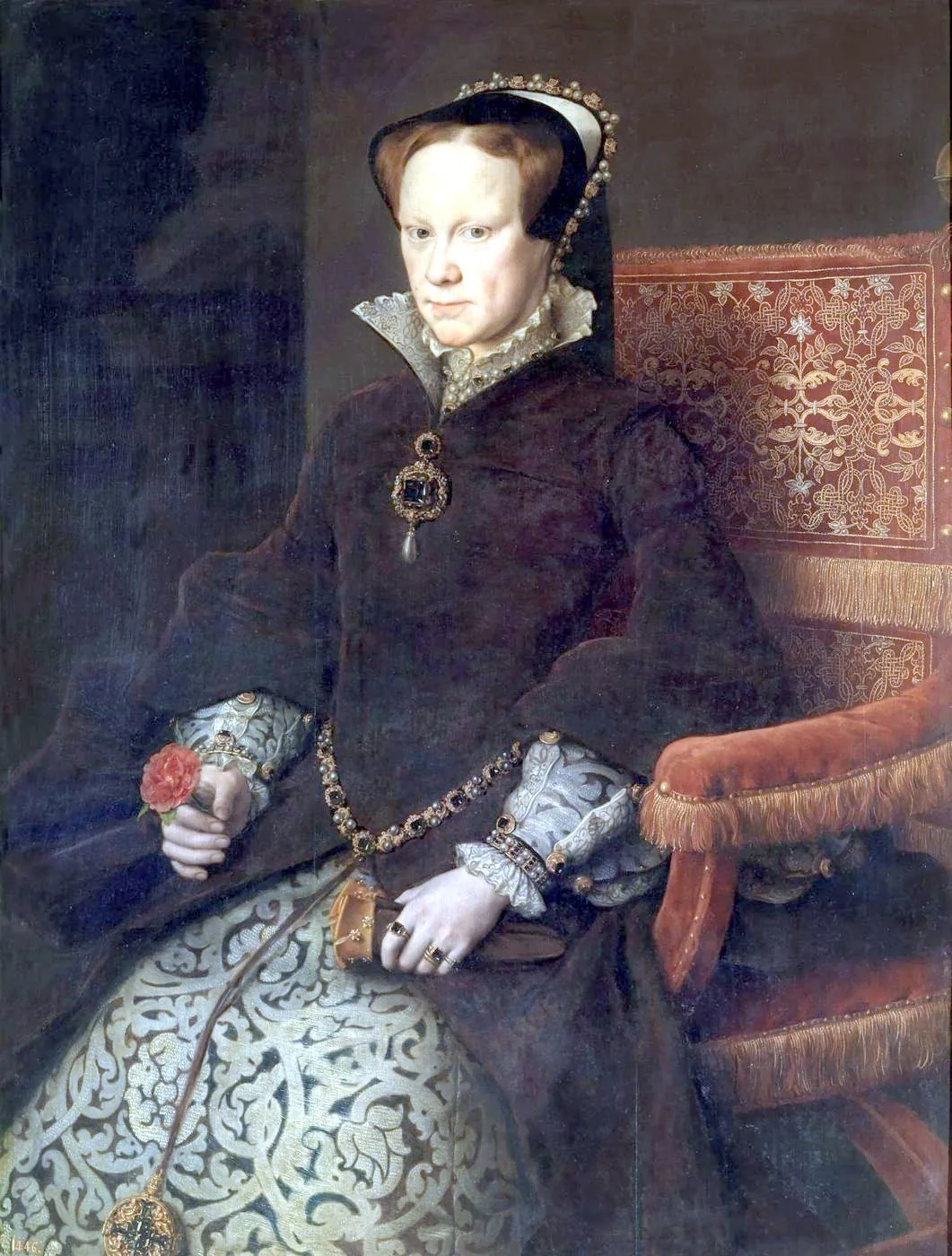
Mary was born on February 18, 1516, at Greenwich Palace, the only surviving child of King Henry VIII and his first wife, Catherine of Aragon. Her early life was disrupted by her parents’ divorce in the early 1530s, after which she was declared illegitimate, separated from her mother, and for a time excluded from the line of succession in favor of her half-sister Elizabeth. Under her half-brother Edward VI, a committed Protestant, Mary faced sustained pressure over her continued adherence to Catholicism. Shortly before his death in 1553, the terminally ill Edward attempted to alter the succession in a document known as the “Devise for the Succession,” bypassing both of his half-sisters in favor of his Protestant cousin Lady Jane Grey. Following Edward’s death, Jane was proclaimed queen but held power for only about nine days before Mary, backed by strong popular support across much of the country, asserted her claim and entered London to take the throne in July 1553, becoming the first woman to rule England in her own right.
Restoration of Catholicism and the Marian Persecutions
As queen, Mary moved quickly to reverse the Protestant reforms of her father’s and brother’s reigns, restoring papal authority over the Church of England and reinstating Catholic religious practice. In 1554, she married Philip II of Spain, a Catholic and heir to the Spanish throne, a union that proved unpopular with many of her subjects, who feared foreign domination; the marriage helped provoke Wyatt’s Rebellion earlier that same year.
From 1555, Mary’s government revived medieval heresy laws to prosecute Protestants who refused to recant their faith, and roughly 280 people, including the former Archbishop of Canterbury, Thomas Cranmer, were burned at the stake over the following years. These executions, concentrated largely in the southeast of England and recorded in detail by the later Protestant writer John Foxe, are the origin of the posthumous nickname “Bloody Mary,” though historians note that religious persecution of comparable severity occurred under other Tudor monarchs as well.
Later Reign, Death, and Legacy
Mary’s reign was also marked by setbacks beyond religious conflict: England’s long-held territory of Calais, its last continental possession, was lost to France in January 1558 after England was drawn into a war on Spain’s behalf, a loss Mary is said to have deeply regretted. She experienced at least two apparent false pregnancies, and the absence of an heir meant that, on her death, the throne would pass to Elizabeth, the Protestant half-sister she had long distrusted. Mary died on November 17, 1558, likely from illness, possibly uterine or ovarian in nature, though the precise cause is not certain; some historians have also suggested she may have died from influenza during an epidemic recorded in England that year. Her five-year reign has traditionally been overshadowed in historical memory by the religious persecutions carried out in her name, though modern historians have increasingly reassessed other aspects of her rule, including currency, financial, and naval administrative reforms that outlasted her and were later built upon during Elizabeth’s reign. The nickname “Bloody Mary” itself only became firmly attached to her reputation in the centuries after her death, propagated through Protestant historical writing that shaped English popular memory of the Tudor period for generations.