
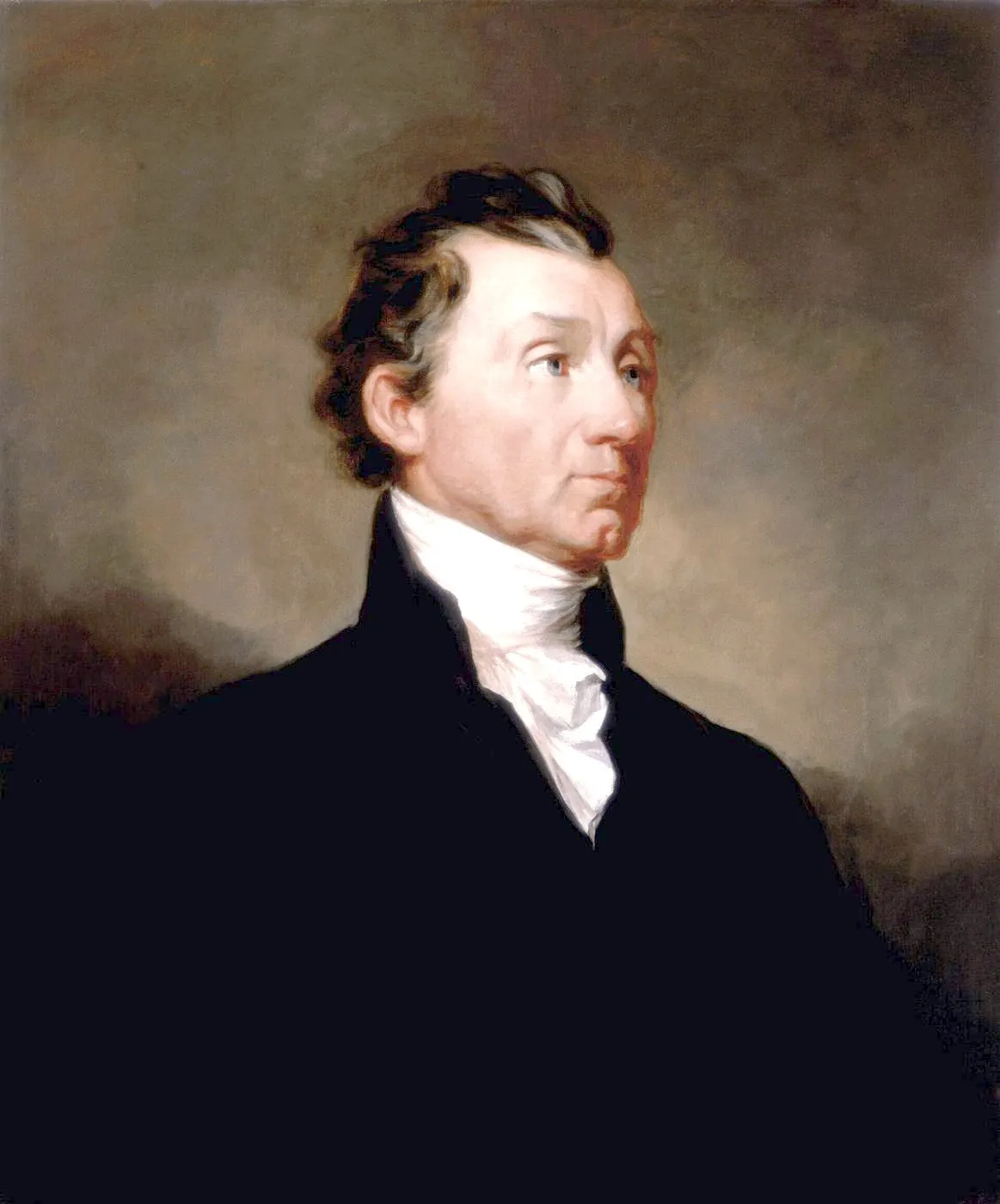
This James Monroe timeline follows his path from wounded Revolutionary War soldier to the presidency, covering his diplomatic career, the Era of Good Feelings, and the foreign-policy doctrine that still carries his name.
Soldier and Diplomat
James Monroe was born on April 28, 1758, in Westmoreland County, Virginia, and left the College of William & Mary to join the Continental Army during the Revolutionary War. He was seriously wounded at the Battle of Trenton in December 1776 during Washington’s crossing of the Delaware, an episode later commemorated in Emanuel Leutze’s famous painting, in which a flag-bearing officer is often identified as Monroe, and he carried the musket ball from that wound in his shoulder for the rest of his life. After the war, Monroe built a career in law and politics, serving in the Continental Congress, the U.S. Senate, and as governor of Virginia. His diplomatic experience deepened when President Jefferson sent him to France as a special envoy in 1803, where he assisted the American minister Robert Livingston in negotiating the Louisiana Purchase, and he later served as minister to Britain. Under President Madison, Monroe served as both secretary of state and, for a period during the War of 1812, secretary of war simultaneously, giving him an unusually broad view of the young nation’s foreign and military affairs at a moment when British forces had occupied and burned much of the capital itself.

The Era of Good Feelings
Monroe was elected president in 1816 and took office in March 1817, a period generally remembered as the Era of Good Feelings due to the relative decline of sharp partisan conflict following the collapse of the Federalist Party as a national political force. His administration made significant territorial gains: through the Adams-Onís Treaty of 1819, negotiated primarily by Secretary of State John Quincy Adams, Spain ceded Florida to the United States. The apparent calm of the period was tested domestically by the Missouri Compromise of 1820, which admitted Missouri as a slave state and Maine as a free state while restricting slavery’s expansion in much of the remaining Louisiana Territory, a temporary resolution to sectional tension over slavery that would resurface repeatedly in subsequent decades and that Jefferson, watching from retirement, reportedly described as an alarm bell in the night.
The Monroe Doctrine and Later Years
The most enduring legacy of Monroe’s presidency came in his December 1823 annual message to Congress, in which he articulated what became known as the Monroe Doctrine: a declaration that the Western Hemisphere was no longer open to European colonization and that the United States would view further European intervention in the Americas as a threat to its own peace and safety. Though largely unenforceable by American military power at the time and reportedly shaped substantially by Secretary of State Adams, the doctrine became a cornerstone of American foreign policy for generations. Monroe left office in 1825 and retired first to his Virginia estate before financial difficulties led him to move to New York City to live with his daughter. He died there on July 4, 1831, becoming the third president, after Adams and Jefferson, to die on the anniversary of American independence.
Frequently Asked Questions
What does this James Monroe timeline cover?
This timeline covers Monroe's 1758 birth in Virginia, his Revolutionary War service, his diplomatic career, his presidency from 1817 to 1825, and the 1823 Monroe Doctrine.
What is the Monroe Doctrine?
Announced in Monroe's 1823 message to Congress, it declared that European powers should not further colonize territory in the Americas or interfere with independent nations there, establishing a foreign-policy principle that influenced U.S. relations with the hemisphere for generations.
Why is Monroe's presidency called the 'Era of Good Feelings'?
The term reflects the relative decline of national partisan conflict during his administration, following the effective collapse of the Federalist Party, though sectional tensions over issues like slavery remained very much alive beneath the surface.