
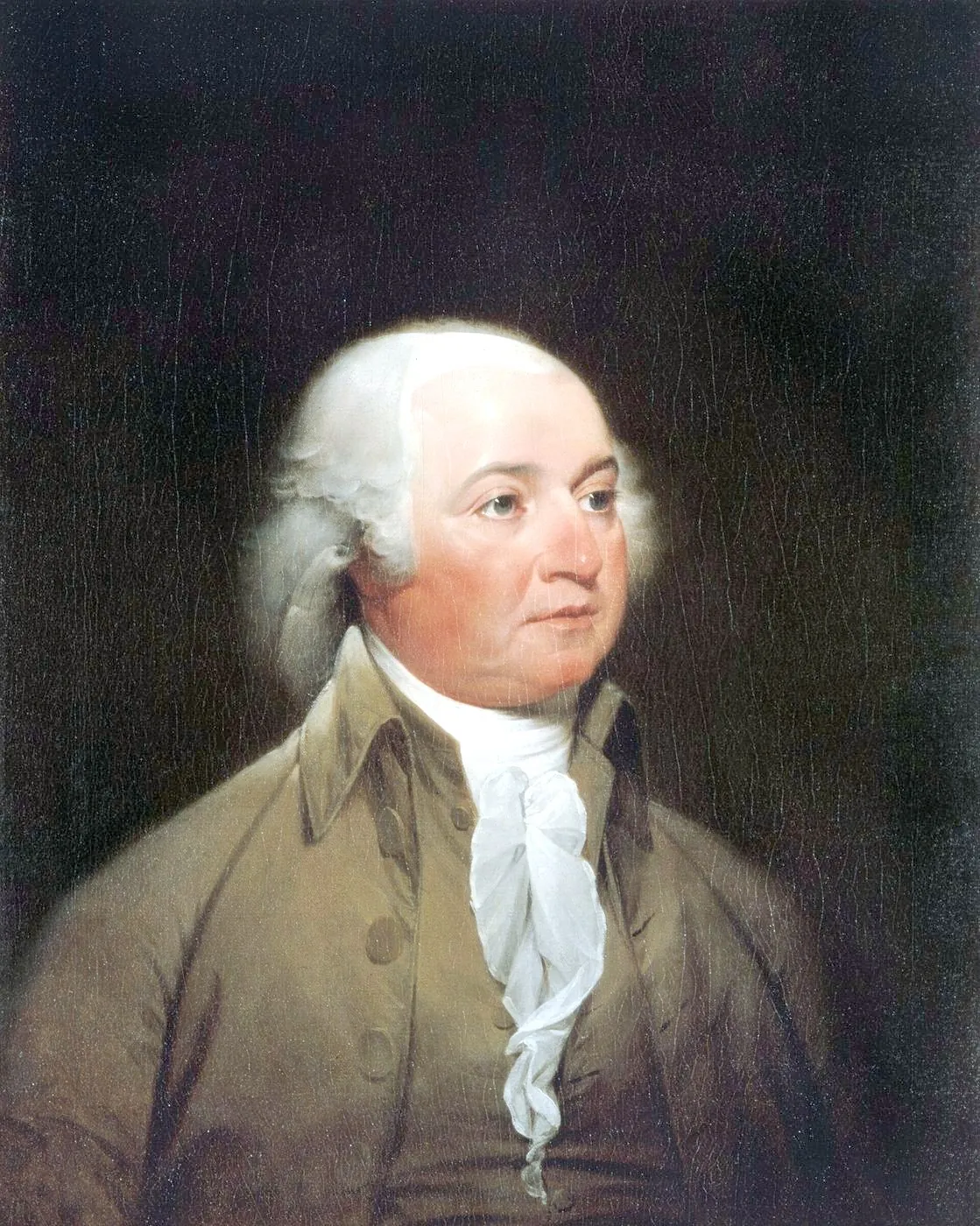
This John Adams timeline traces his path from a Massachusetts law office to the presidency, covering the revolutionary career, diplomatic missions, and contested single term that shaped the early republic.
Revolutionary Lawyer and Diplomat
John Adams was born on October 30, 1735, in Braintree, Massachusetts, and trained as a lawyer before the growing conflict with Britain pulled him into public life. In 1770, in a move that reportedly damaged his popularity in the short term, he agreed to defend the British soldiers charged in the Boston Massacre, arguing that a fair trial mattered even for deeply unpopular defendants; most of the soldiers were acquitted or convicted of lesser charges. As tensions escalated toward open rebellion, Adams became a leading voice for independence in the Continental Congress, served on the five-member committee that produced the Declaration of Independence in 1776, and later spent years in Europe as a diplomat, helping negotiate the Treaty of Paris that ended the Revolutionary War and later serving as the first American minister to Great Britain.
The Vice Presidency and a Contested Election
When the new federal government took shape under the Constitution, Adams was elected the nation’s first vice president, serving two terms under George Washington from 1789 to 1797. He found the office’s limited formal powers frustrating, reportedly describing it in private correspondence as an insignificant post, though it placed him next in line as Washington’s influence and the emerging Federalist Party positioned him for the presidency. Adams narrowly won the 1796 election over Thomas Jefferson, who as the runner-up became vice president under the electoral rules then in place, an awkward arrangement that put two rival political leaders in the executive branch together. Adams took office in March 1797 as the country’s second president, inheriting a government still working out how power would change hands peacefully between competing factions.

A Single Term Shaped by War and Division
Adams’s presidency was dominated by the Quasi-War, an undeclared naval conflict with France that followed the XYZ Affair, in which French agents demanded bribes from American diplomats before negotiations could proceed. Under pressure from within his own Federalist Party to seek a formal declaration of war, Adams instead pursued a peace mission that ultimately avoided full-scale war with France, a choice he came to regard as one of his most significant achievements even though it split his party and likely cost him a second term. In 1798, amid the crisis atmosphere, he signed the Alien and Sedition Acts, laws that restricted immigrants’ rights and criminalized certain criticism of the government; the Sedition Act in particular proved deeply controversial and is generally viewed by historians as a low point of his administration. In his final months in office, Adams also made a series of judicial appointments, including naming John Marshall as chief justice, a choice that would shape the Supreme Court’s role in American government for decades afterward. Adams lost the bitter 1800 election to Jefferson and, in one of the era’s more painful personal episodes, left Washington before the inauguration rather than attend. He and Jefferson later reconciled through an extensive correspondence in their retirement years. Adams died on July 4, 1826, the fiftieth anniversary of the Declaration of Independence, reportedly within hours of Jefferson’s own death the same day, a coincidence widely noted at the time. His son, John Quincy Adams, would become the nation’s sixth president.
Frequently Asked Questions
What does this John Adams timeline cover?
This timeline covers John Adams's 1735 birth in Braintree, Massachusetts, his legal and revolutionary career, his diplomatic service in Europe, his vice presidency under Washington, and his single term as president from 1797 to 1801.
Why did John Adams sign the Alien and Sedition Acts?
Adams signed the acts in 1798 amid the Quasi-War crisis with France, when Federalists in Congress pushed for measures against perceived foreign and domestic threats; the laws, especially the Sedition Act, proved highly controversial and are generally seen as damaging his popularity.
Did John Adams and Thomas Jefferson reconcile?
Yes. After leaving office as political rivals, the two men resumed a close friendship in retirement, exchanging an extensive and now-famous series of letters until both died on the same day, July 4, 1826.