
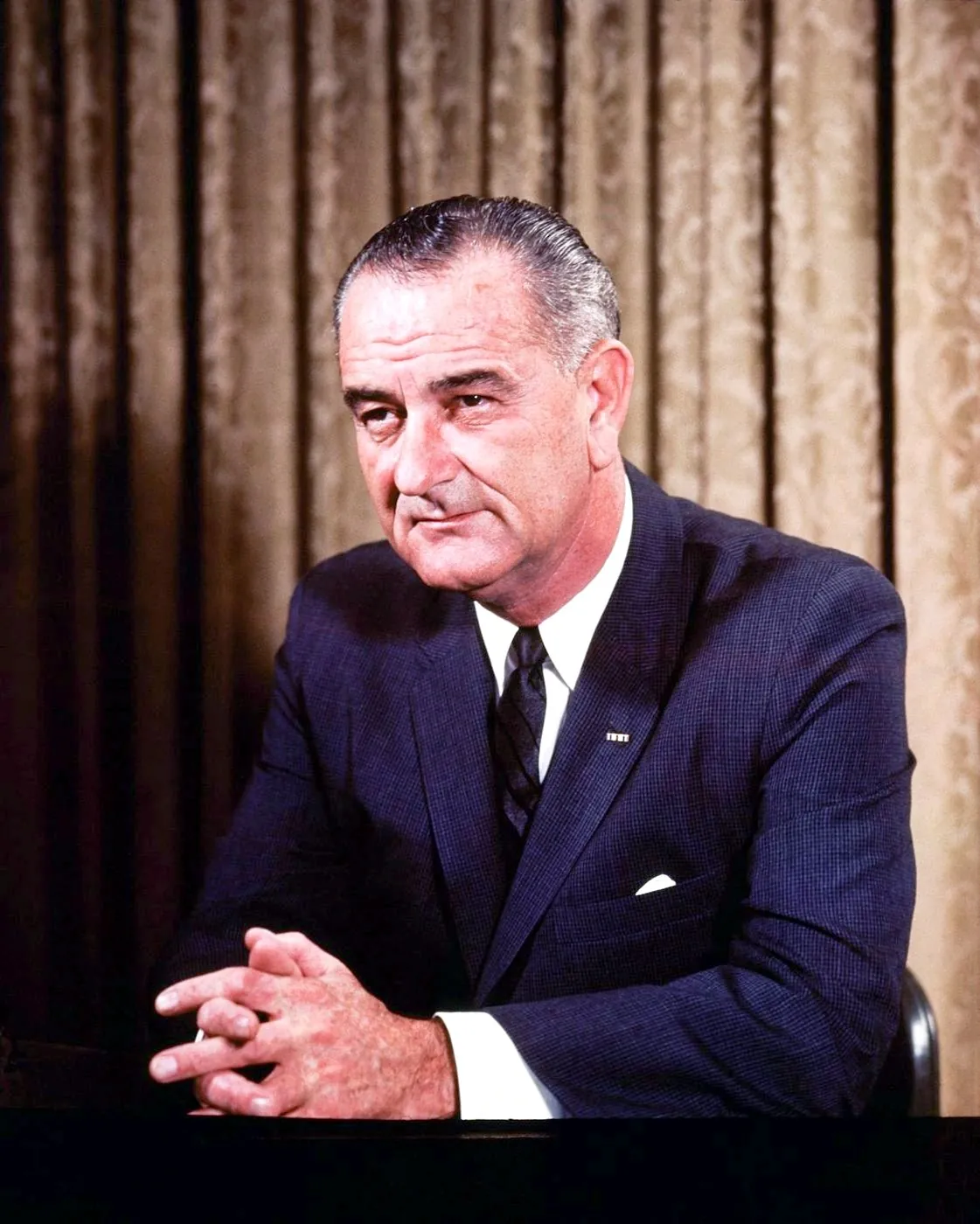
This Lyndon B. Johnson timeline traces his path from Texas Hill Country politics to a presidency that reshaped American civil rights and social policy while becoming consumed by the war in Vietnam.
Early Life and Rise to Power
Lyndon Baines Johnson was born on August 27, 1908, near Stonewall, Texas, in the Texas Hill Country, and worked briefly as a schoolteacher before entering politics as a congressional aide in Washington. He was elected to the U.S. House of Representatives in 1937 and, after an unsuccessful Senate bid in 1941, won election to the U.S. Senate in 1948. In the Senate, Johnson rose rapidly through the Democratic leadership, becoming Senate Majority Leader in 1955 and earning a reputation as an unusually forceful and effective legislative operator, adept at building the coalitions needed to pass difficult bills. After losing the 1960 Democratic presidential nomination to John F. Kennedy, Johnson accepted the vice-presidential nomination on Kennedy’s ticket, a choice widely credited with helping the ticket carry Texas and the broader South. He served as vice president with limited influence until November 22, 1963, when Kennedy was assassinated in Dallas and Johnson was sworn in as president aboard Air Force One that same day. His decades of Senate experience and deep familiarity with the levers of Congress proved central to how quickly his administration was able to move legislation in the months that followed.
Presidency: The Great Society and Civil Rights
Johnson used the national shock following Kennedy’s assassination, combined with his own legislative skill, to push through a substantial policy agenda. He signed the Civil Rights Act of 1964, outlawing major forms of discrimination, and the Voting Rights Act of 1965, dismantling many barriers to Black voter registration in the South: landmark laws covered in greater detail in this site’s dedicated article on the civil rights movement. After winning a landslide election in his own right in 1964 against Republican Barry Goldwater, Johnson launched the Great Society, an ambitious set of domestic programs including Medicare and Medicaid, providing federal health coverage for the elderly and low-income Americans, along with initiatives grouped under a broader “War on Poverty,” such as expanded federal aid to education and the Head Start early-childhood program. These programs represented one of the largest expansions of the American federal government’s social role since the New Deal. Johnson also signed the Immigration and Nationality Act of 1965, which ended a decades-old national-origins quota system and reshaped patterns of immigration to the United States in the decades that followed.
Vietnam War and Departure from Office
Johnson’s domestic achievements were increasingly overshadowed by the escalating war in Vietnam. Following the disputed Gulf of Tonkin incident in August 1964, Congress passed a resolution granting Johnson broad authority to expand U.S. military involvement, and he steadily increased American troop levels in Vietnam from the mid-1960s onward, eventually committing hundreds of thousands of soldiers to a conflict that grew deeply unpopular at home. Rising casualties, the January 1968 Tet Offensive, and mounting antiwar protest on college campuses and in the streets severely damaged Johnson’s public standing and exposed a widening credibility gap between official statements on the war’s progress and events on the ground. In March 1968, he announced he would not seek re-election, stepping aside to focus on efforts to negotiate an end to the war. He left office in January 1969 and retired to his Texas ranch, where he died on January 22, 1973. Johnson’s legacy remains divided between the lasting achievements of the Great Society and civil rights legislation and the human and political costs of the Vietnam War, which he himself acknowledged had overtaken much of his presidency.
Frequently Asked Questions
What does this Lyndon B. Johnson timeline cover?
This timeline covers Johnson's biography from his 1908 birth near Stonewall, Texas, through his 1963 succession to the presidency, the Civil Rights Act and Great Society, the Vietnam War's escalation, and his 1973 death.
How did Lyndon Johnson become president?
Johnson became president on November 22, 1963, when he was sworn in aboard Air Force One hours after President John F. Kennedy was assassinated in Dallas.
What was the Great Society?
The Great Society was Johnson's set of domestic programs launched from 1965, including Medicare, Medicaid, and anti-poverty and education initiatives, marking one of the largest expansions of federal social policy since the New Deal.
Why did Johnson decline to seek re-election in 1968?
Mounting casualties and public opposition to the Vietnam War had severely damaged his standing, and in March 1968 Johnson announced he would not run again in order to focus on ending the war.