
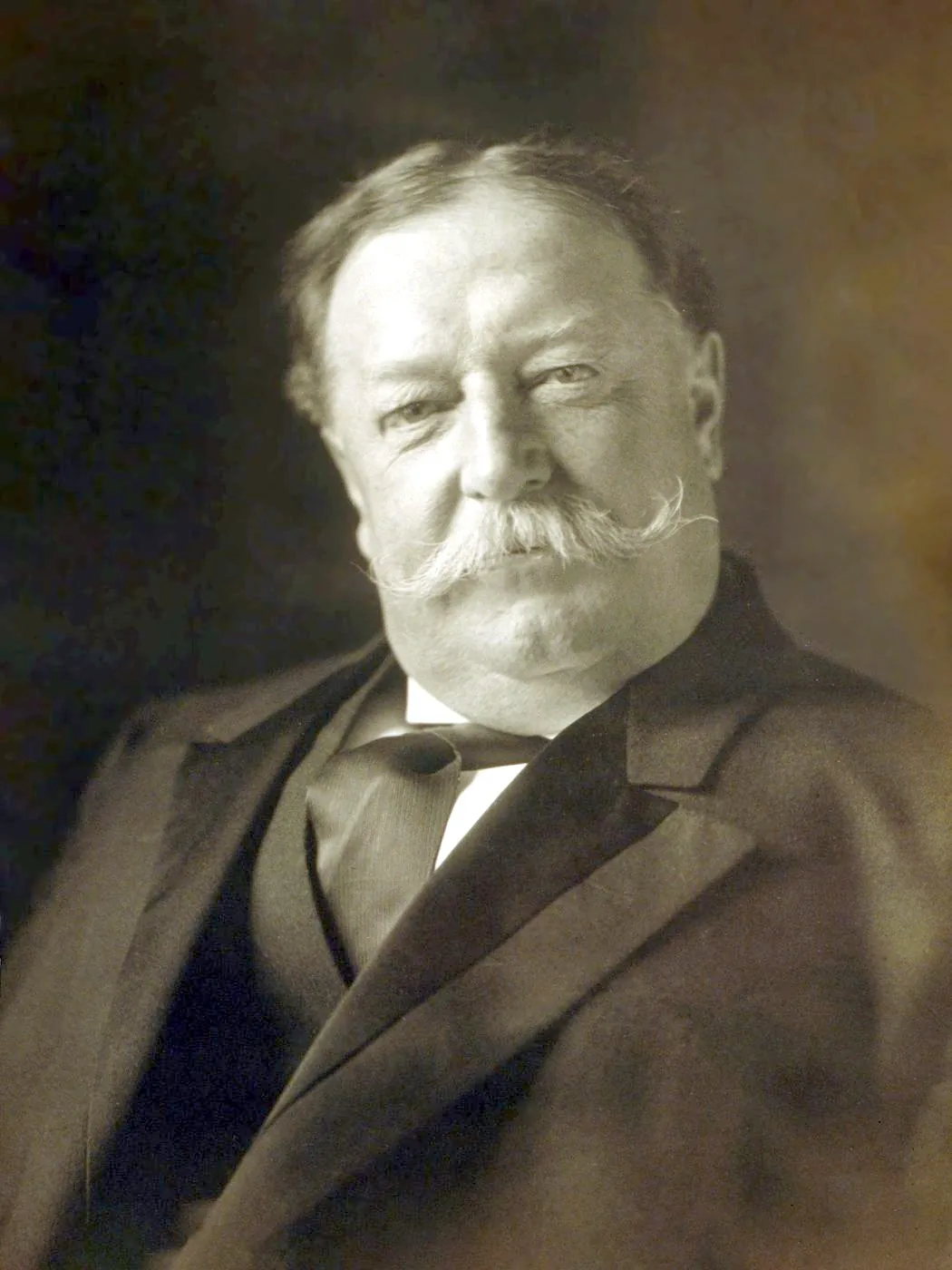
This William Taft timeline traces his path from colonial administrator to the presidency and, later, to the Supreme Court: the only American to hold both of the nation’s most powerful offices.
Early Life and Rise Through Public Administration
William Howard Taft was born on September 15, 1857, in Cincinnati, Ohio, to a family deeply engaged in law and Republican politics; his father had served as Secretary of War and Attorney General. Taft graduated from Yale and returned to Ohio to build a career as a lawyer and judge, developing an early preference for judicial work over elected office. President William McKinley appointed him to lead the civil government of the Philippines in 1901, following the Spanish-American War, and Taft reportedly turned down an offer of a Supreme Court seat to continue that work, which he found more personally rewarding; he worked to expand local self-government and infrastructure on the islands during his tenure. He went on to serve as Secretary of War under President Theodore Roosevelt, becoming one of Roosevelt’s most trusted troubleshooters on foreign and domestic matters, including a period overseeing the ongoing U.S. administration of the Panama Canal Zone, and was Roosevelt’s chosen successor for the 1908 Republican presidential nomination. Taft accepted the nomination somewhat reluctantly; he had long preferred judicial work to elected politics, and his wife, Helen Herron Taft, was widely credited with pushing him toward the presidency instead.
Presidency: Tariffs, Trust-Busting, and a Widening Party Split
Taft was elected the 27th president in 1908, defeating Democrat William Jennings Bryan with substantial help from Roosevelt’s endorsement. His administration in fact pursued more antitrust prosecutions than Roosevelt’s had, breaking up major trusts including Standard Oil, but Taft lacked Roosevelt’s flair for public leadership and struggled to satisfy the party’s progressive wing. The 1909 Payne-Aldrich Tariff Act, which fell well short of the tariff reductions many reformers had expected, became a lightning rod for progressive discontent, as did Taft’s dismissal of conservationist Gifford Pinchot amid a dispute over federal land policy. Abroad, his administration pursued what became known as “Dollar Diplomacy,” encouraging American financial investment in Latin America and East Asia as a tool of foreign policy in place of more direct military intervention. Taft also created the Bureau of Corporations’ successor arrangements and, in 1910, backed passage of the Mann-Elkins Act, which expanded federal regulation of the railroad and telecommunications industries.
By 1912, Roosevelt had broken decisively with his former protégé and ran against him for the Republican nomination; when the party organization held for Taft, Roosevelt launched a third-party Progressive campaign that split the Republican vote and handed the presidency to Woodrow Wilson, with Taft finishing a distant third.
Chief Justice and Final Years
After leaving the presidency, Taft taught law at Yale and remained active in public life, and in 1921 President Warren Harding appointed him Chief Justice of the United States: the role Taft had long considered his true calling, making him the only person in American history to have served as both president and Chief Justice. As Chief Justice, he successfully lobbied Congress for the Judiciary Act of 1925, which gave the Supreme Court greater control over which cases it heard, and pushed for a dedicated Supreme Court building, though it was not completed until after his death. On the bench, Taft generally favored a more restrained, business-friendly reading of federal regulatory power than some of his colleagues, and he took evident satisfaction in the role, reportedly remarking that he barely remembered being president. Failing health forced Taft to resign from the Court in February 1930, and he died a little over a month later, on March 8, 1930, in Washington, D.C. He is generally remembered as a capable, cautious administrator whose presidency was overshadowed by the more dramatic legacies of Roosevelt before him and Wilson after, but whose later judicial career reshaped the modern Supreme Court’s role.
Frequently Asked Questions
What does this William Taft timeline cover?
This timeline covers Taft's biography from his 1857 birth in Cincinnati through his administration of the Philippines, his 1908 election as president, the 1912 Republican split that cost him re-election, his 1921 appointment as Chief Justice, and his 1930 death.
Is William Taft the only president to also serve on the Supreme Court?
Yes. Taft is the only person in American history to have served as both President of the United States and Chief Justice of the Supreme Court, a role he held from 1921 until shortly before his death in 1930.
Why did Taft and Theodore Roosevelt become rivals?
Roosevelt, who had backed Taft as his successor, grew increasingly critical of Taft's more cautious approach to progressive reform. Their rift led Roosevelt to challenge Taft for the 1912 Republican nomination and then run as a third-party candidate, splitting the vote and costing Taft re-election.
What did Taft accomplish as Chief Justice?
Taft championed the Judiciary Act of 1925, which gave the Supreme Court greater discretion over its caseload, and pushed for the construction of a permanent, dedicated Supreme Court building.