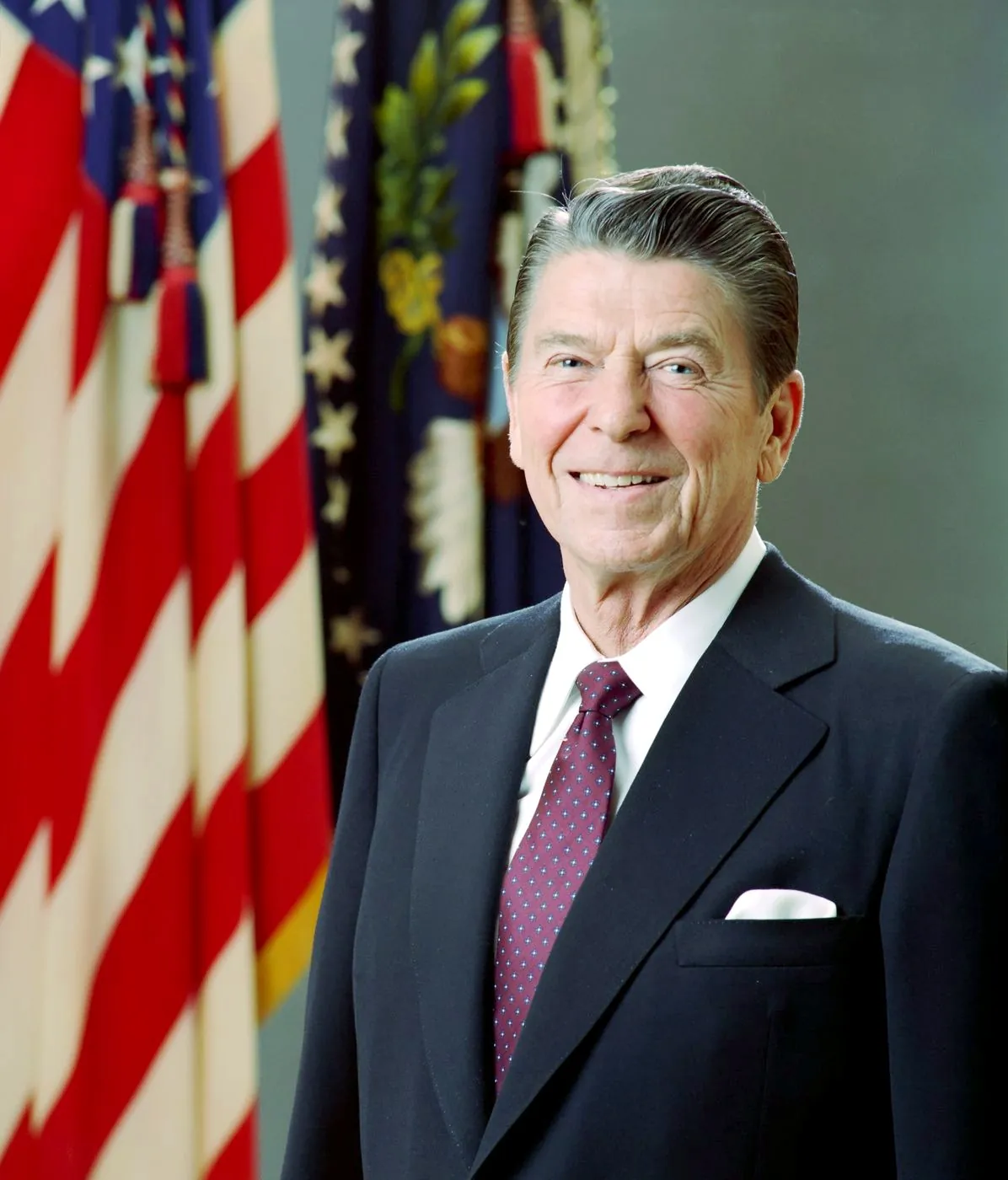

This Ronald Reagan timeline traces his path from a Hollywood screen career and the governorship of California to two terms as president during a pivotal stretch of the Cold War.
Early Life and the Road to the Governorship
Ronald Wilson Reagan was born on February 6, 1911, in Tampico, Illinois, and grew up in nearby Dixon. After working as a radio sports announcer, he moved to Hollywood in the mid-1930s and built a substantial acting career, appearing in dozens of films through the 1950s while also serving as president of the Screen Actors Guild, an experience that immersed him in labor negotiations and union politics. His political views shifted over these years from New Deal Democrat to conservative Republican, a transition often dated to his prominent 1964 televised speech supporting Barry Goldwater’s presidential campaign, widely known as “A Time for Choosing.” Reagan was elected governor of California in 1966 and served two terms, from 1967 to 1975, during which he built a reputation for fiscal conservatism, clashed repeatedly with student protest movements at Berkeley and other campuses, and worked with the Democratic-controlled legislature on welfare reform, positioning himself as a national figure on the American right well before his 1980 presidential run.
The Presidency: Reaganomics and the End of the Cold War
Reagan defeated incumbent Jimmy Carter in the 1980 presidential election. Weeks into his term, in March 1981, he survived an assassination attempt by John Hinckley Jr. and made a rapid recovery that reportedly boosted his public standing. His domestic agenda, often called “Reaganomics,” centered on large tax cuts, reduced domestic spending, deregulation, and a tight-money approach to fighting inflation, a combination that produced a sharp early-1980s recession followed by sustained economic growth. On foreign policy, Reagan pursued a major military buildup and the Strategic Defense Initiative while sharply escalating rhetoric against the Soviet Union, then in his second term pivoted toward direct summit diplomacy with Soviet leader Mikhail Gorbachev; his 1987 speech at the Berlin Wall, urging Gorbachev to “tear down this wall,” became one of the defining moments of the era, and the arms-reduction agreements reached in these years are widely credited with helping bring the Cold War toward its end. His second term was also marked by the Iran-Contra affair, in which senior administration officials secretly facilitated arms sales to Iran, partly intended to secure the release of American hostages held in Lebanon, and diverted the proceeds to Nicaraguan Contra rebels in violation of congressional restrictions, a scandal that damaged his administration’s credibility even though investigators found no conclusive evidence directly implicating Reagan himself. Reagan also survived a 1986 reelection-year controversy over the affair with a formal public apology, telling the nation his heart told him the arms-for-hostages description was untrue even as facts suggested otherwise.

Later Years and Legacy
Reagan left office in January 1989 as one of the most popular presidents of the modern era, and his approach to taxation, deregulation, and anti-communist foreign policy reshaped the Republican Party for decades afterward. In November 1994, he disclosed that he had been diagnosed with Alzheimer’s disease, and he largely withdrew from public life in the years that followed. He died at his home in Los Angeles on June 5, 2004, at age 93, and received a state funeral in Washington, D.C., before burial at his presidential library in Simi Valley, California. He remains one of the most influential, and among historians and the public one of the more contested, figures in modern American presidential history: credited by supporters with revitalizing the economy and helping end the Cold War, and criticized by others for the era’s rising income inequality, the response to the AIDS epidemic, and the fallout from Iran-Contra.