
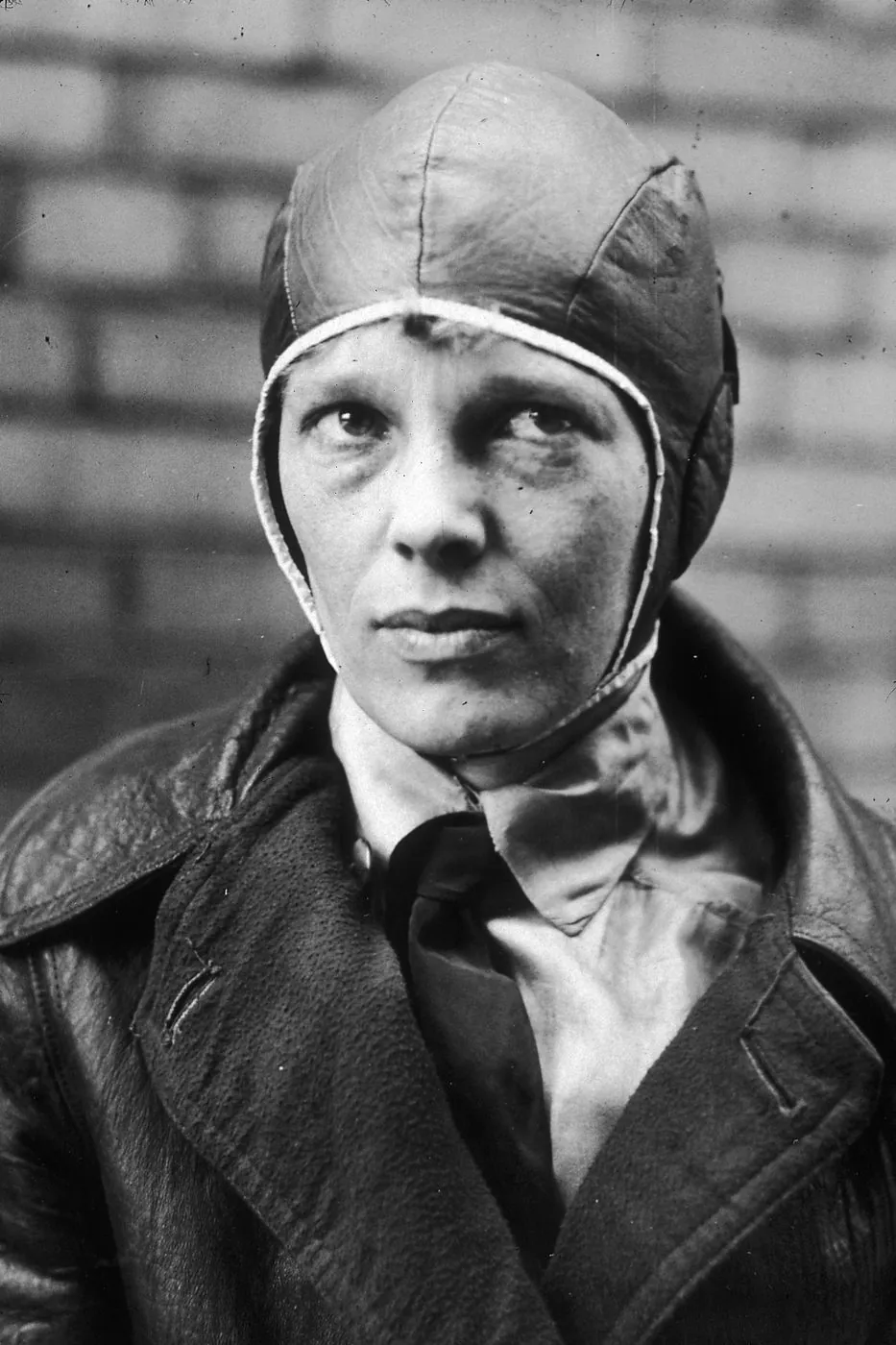
This Amelia Earhart timeline traces her path from a Kansas childhood to record-setting solo flights and her unresolved disappearance over the Pacific in 1937.
Early Life and Entry into Aviation
Amelia Mary Earhart was born on July 24, 1897, in Atchison, Kansas, and spent much of her childhood moving between relatives in Kansas and her parents’ households in Iowa and Minnesota. She first flew as a passenger at an air show in California in 1920, an experience she later described as the moment she resolved to learn to fly, and she took her first flying lesson within days. She earned her pilot’s license in 1923 and spent the following years building flying hours and a public profile, working at times as a social worker while pursuing aviation as both a passion and, increasingly, a career. Her national fame began in 1928, when she was recruited to fly as a passenger aboard the Fokker trimotor Friendship on a transatlantic crossing, becoming the first woman to cross the Atlantic by air. She was careful to note that she had not piloted the flight herself, and she resolved to make the crossing under her own control someday.
Record-Setting Solo Flights

Earhart made good on that ambition in May 1932, flying solo from Harbour Grace, Newfoundland, to a field near Londonderry, Northern Ireland, and becoming the first woman to fly solo nonstop across the Atlantic, only the second person to do so after Charles Lindbergh’s 1927 crossing. The flight cemented her status as the most prominent woman in American aviation and brought her closer to figures in government and industry who supported further record attempts. She continued setting distance and speed records through the mid-1930s, including becoming the first person to fly solo from Honolulu, Hawaii, to Oakland, California, in January 1935, a route considered especially hazardous given the distance over open ocean. Alongside her flying, Earhart worked as a visiting faculty member at Purdue University, promoted commercial aviation and women’s involvement in it, and helped found The Ninety-Nines, an organization for female pilots.
The Round-The-World Attempt and Disappearance
In 1937, Earhart set out to become the first woman to fly around the world along a demanding equatorial route of roughly 29,000 miles, piloting a twin-engine Lockheed Electra 10E with navigator Fred Noonan. After an aborted first attempt and a series of legs across South America, Africa, South Asia, and Southeast Asia, the pair departed Lae, New Guinea, on July 2, 1937, bound for Howland Island, an extremely small landmass in the central Pacific being used as a refueling stop. Radio transmissions from Earhart’s aircraft grew increasingly strained as the flight approached its estimated arrival time, and contact was lost before the plane reached the island. A large-scale search by the US Navy and Coast Guard failed to locate the aircraft or any confirmed wreckage, and Earhart and Noonan were officially declared dead in January 1939. Their disappearance remains one of aviation’s most enduring unsolved mysteries; several theories about the flight’s fate have been proposed over the decades, but none has been conclusively proven, and no confirmed wreckage of the Electra has been recovered. Proposed explanations range from a crash and sinking near Howland Island to a landing on a remote uninhabited atoll further south, and periodic search expeditions have continued into recent years without producing definitive physical evidence. Regardless of how the flight ended, Earhart’s earlier solo records were genuine and well documented, and she is remembered today as a defining figure in early aviation and in the broader history of women’s achievement in fields long dominated by men.