
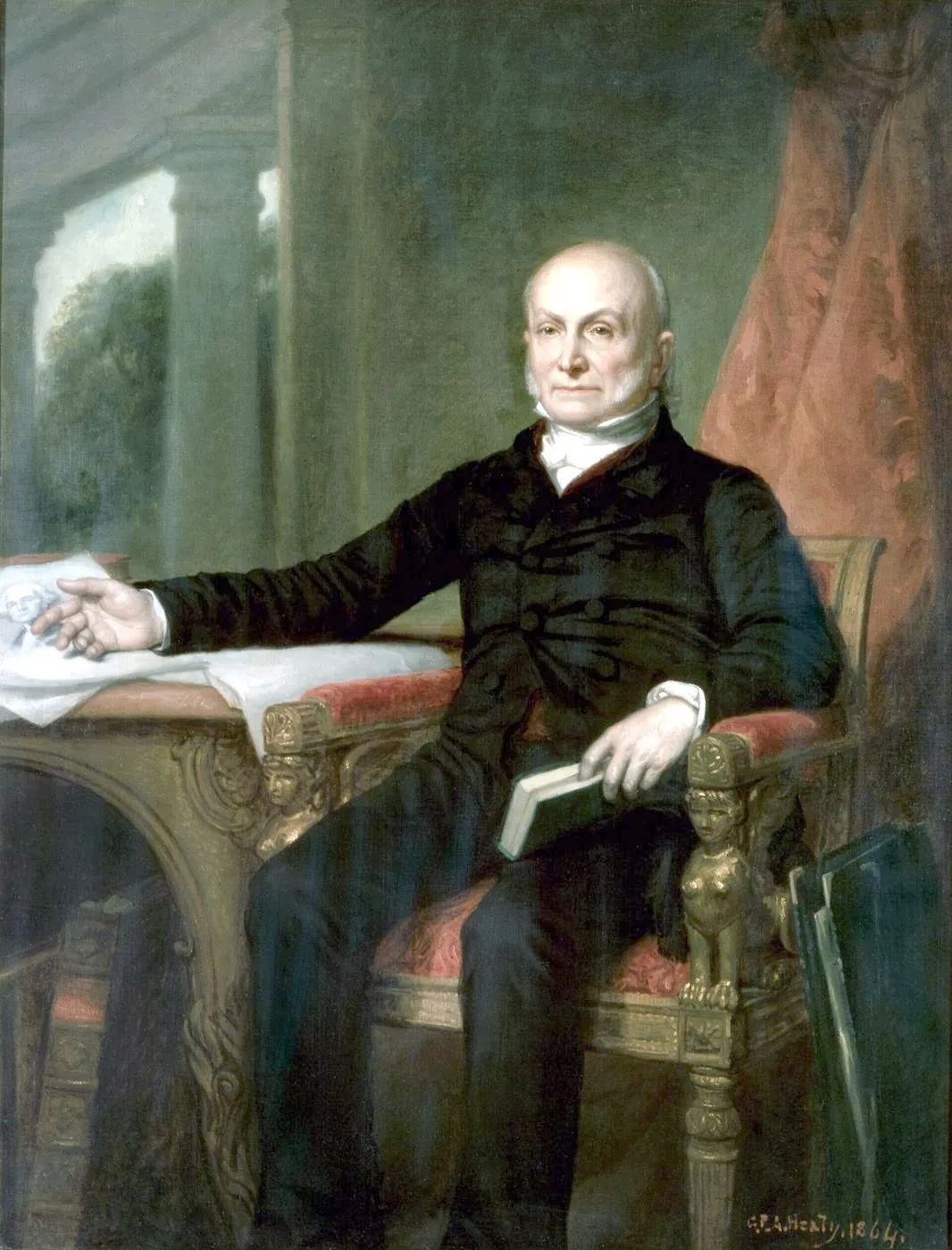
This John Quincy Adams timeline traces his path from a diplomat’s son to the presidency and then to an unprecedented second career in Congress, covering the Monroe Doctrine, a contested election, and his later anti-slavery advocacy.
A Diplomat’s Early Career
John Quincy Adams was born on July 11, 1767, in Braintree, Massachusetts, the eldest son of John and Abigail Adams, and spent part of his childhood in Europe while his father served as a revolutionary diplomat. He began his own diplomatic career early, serving as secretary to the American minister to Russia as a teenager and studying at universities in Europe along the way, and President Washington later appointed him minister to the Netherlands in 1794. Over the following decades Adams held diplomatic postings in Prussia, Russia, and Britain, building a reputation as one of the most experienced foreign-policy figures of his generation. His expertise culminated in his service as secretary of state under President Monroe from 1817 to 1825, during which he negotiated the Adams-Onís Treaty securing Florida from Spain and is widely credited by historians as the principal author of the 1823 Monroe Doctrine, even though it was announced under Monroe’s name.
A Contested Election and Difficult Presidency
The 1824 presidential election produced no electoral college majority among four candidates, throwing the decision to the House of Representatives under the Twelfth Amendment. Andrew Jackson had won the most popular and electoral votes, but the House selected Adams after Henry Clay, who had finished fourth, threw his support behind him; when Adams subsequently named Clay his secretary of state, Jackson’s supporters accused the two of striking a “corrupt bargain,” a charge that shadowed Adams’s presidency and helped fuel Jackson’s decisive victory over him in the 1828 rematch. As president from 1825 to 1829, Adams pursued an ambitious program of federally funded infrastructure and scientific institutions, but he struggled to build political support in a Congress increasingly dominated by Jackson’s allies, and few of his proposals were enacted during his single term, though some, such as federal support for scientific and educational institutions, anticipated policies that later administrations would eventually pursue.

An Unprecedented Second Act in Congress
After losing the 1828 election, Adams did something no other former president has done: he won election to the House of Representatives, where he served from 1831 until his death, representing a Massachusetts district for nine consecutive terms. In Congress, Adams became an outspoken opponent of the “gag rule,” which automatically tabled anti-slavery petitions without discussion, and he fought for years to have it repealed, eventually succeeding in 1844. In 1841, he argued before the U.S. Supreme Court on behalf of the African captives who had seized the slave ship Amistad, helping secure a ruling that affirmed their freedom and allowed most of the survivors to eventually return to West Africa. Adams collapsed at his desk on the House floor on February 21, 1848, and died two days later in the Capitol building, earning the nickname “Old Man Eloquent” for his decades of forceful oratory in defense of the causes he championed late in life.
Frequently Asked Questions
What does this John Quincy Adams timeline cover?
This timeline covers his 1767 birth in Massachusetts, his long diplomatic career, his service as secretary of state under Monroe, his contested 1824 election and presidency, and his later years representing Massachusetts in the House of Representatives.
What was the 'corrupt bargain' controversy?
After the 1824 election was decided in the House of Representatives, Adams's appointment of Henry Clay, who had helped secure his win, as secretary of state led Andrew Jackson's supporters to allege a corrupt political deal, a charge that damaged Adams's presidency though it was never proven.
What did John Quincy Adams do after his presidency?
He became the only former president to serve in the House of Representatives, holding a seat from 1831 until his death in 1848 and becoming a leading congressional opponent of slavery-related gag rules.