
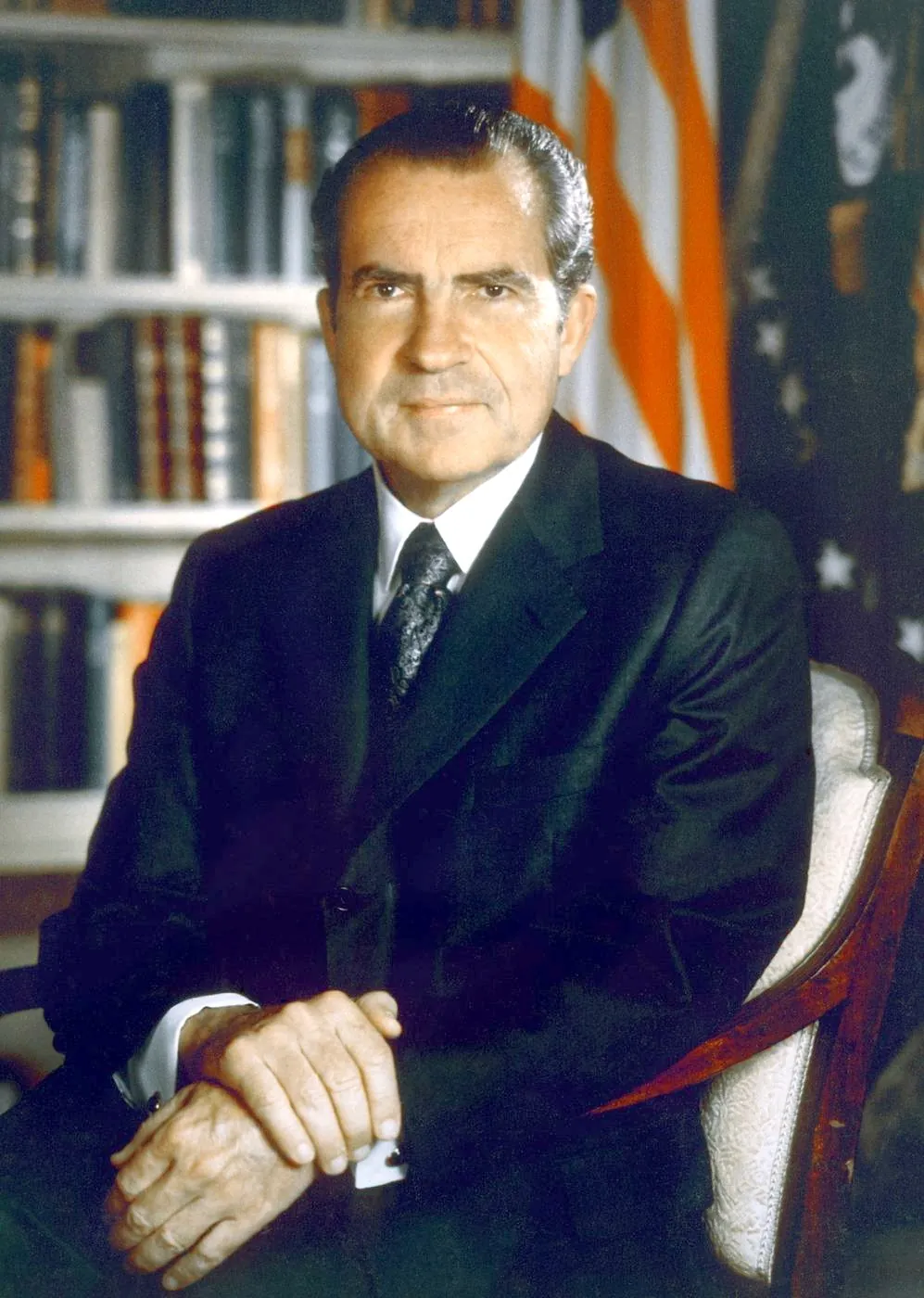

This Richard Nixon timeline traces his rise from a modest Southern California upbringing to the presidency, his consequential opening to China, and the Watergate scandal that made him the only U.S. president to resign from office.
Early Life and Political Rise
Richard Milhous Nixon was born on January 9, 1913, in Yorba Linda, California, into a family of modest means, and served as a U.S. Navy logistics officer in the Pacific during World War II. He entered politics in 1946, winning a California congressional seat by campaigning aggressively against his opponent’s alleged communist sympathies, and gained national prominence through his work on the House Un-American Activities Committee, particularly the Alger Hiss espionage case. Elected to the Senate in 1950, Nixon was chosen as Dwight Eisenhower’s running mate in 1952 and served two terms as vice president, narrowly surviving a corruption controversy over a personal expense fund with his televised “Checkers speech,” and gaining wider public attention for his impromptu 1959 “Kitchen Debate” with Soviet Premier Nikita Khrushchev over the merits of capitalism and communism. He lost the 1960 presidential election to John F. Kennedy by one of the smallest popular-vote margins in American history, then lost a subsequent bid for California governor in 1962, telling reporters at the time that they “won’t have Nixon to kick around anymore,” a remark widely read as the end of his political career.
Presidency: China, Détente, and Vietnam
Nixon completed a remarkable political comeback, winning the presidency in 1968 amid deep divisions over the Vietnam War and domestic unrest. In foreign policy, his administration pursued a strategy of “Vietnamization,” shifting combat responsibility to South Vietnamese forces while gradually withdrawing American troops, a process that also included a controversial 1970 incursion into Cambodia; American involvement formally ended with the Paris Peace Accords of January 1973. Nixon’s most consequential foreign-policy achievement came in February 1972, when he traveled to Beijing and met Chinese leader Mao Zedong, opening formal relations between the United States and the People’s Republic of China after more than two decades of Cold War estrangement. He pursued a parallel policy of détente with the Soviet Union, signing the SALT I arms-limitation treaty later that year, and his domestic record included the creation of the Environmental Protection Agency in 1970 and the imposition of wage-and-price controls in 1971 to combat inflation. He won re-election in 1972 by a landslide over Democrat George McGovern, carrying nearly every state in the country.

Watergate and Resignation
In June 1972, five men connected to Nixon’s re-election campaign were arrested breaking into Democratic National Committee offices at Washington’s Watergate complex. Nixon was not shown to have ordered the break-in itself, but he directed and participated in a sustained cover-up to obstruct the subsequent federal investigation, a fact confirmed by secret White House tape recordings he had made of his own conversations. Senate hearings through 1973 and 1974 exposed widening abuses of power, and the release of a June 1972 recording, the so-called “smoking gun” tape showing Nixon approving a plan to use the CIA to obstruct the FBI’s inquiry, destroyed his remaining political support. Facing near-certain impeachment by the House and conviction in the Senate, Nixon resigned the presidency on August 9, 1974, the only U.S. president ever to do so, and was succeeded by Vice President Gerald Ford, who issued him a full pardon the following month. Nixon spent his later years writing books on foreign policy and gradually rehabilitating his public standing as an elder statesman, though Watergate remained the defining event of his career; he died in New York on April 22, 1994, following a stroke.
Frequently Asked Questions
What does this Richard Nixon timeline cover?
This timeline covers Nixon's biography from his 1913 birth in California through his vice presidency, his 1968 election, the 1972 opening to China, the Watergate scandal, his 1974 resignation, and his 1994 death.
Why is Nixon's 1972 visit to China considered significant?
Nixon's February 1972 visit to Beijing began the normalization of relations between the United States and the People's Republic of China after more than two decades without formal diplomatic ties, reshaping Cold War-era geopolitics.
Why did Richard Nixon resign the presidency?
Nixon resigned on August 9, 1974, after evidence, including his own secret White House tape recordings, confirmed his involvement in obstructing the federal investigation into the June 1972 Watergate break-in, making impeachment and conviction all but certain.
Is Nixon the only U.S. president to resign from office?
Yes. Richard Nixon remains the only president in American history to resign the office, doing so in 1974 rather than face near-certain impeachment and removal over the Watergate scandal.