
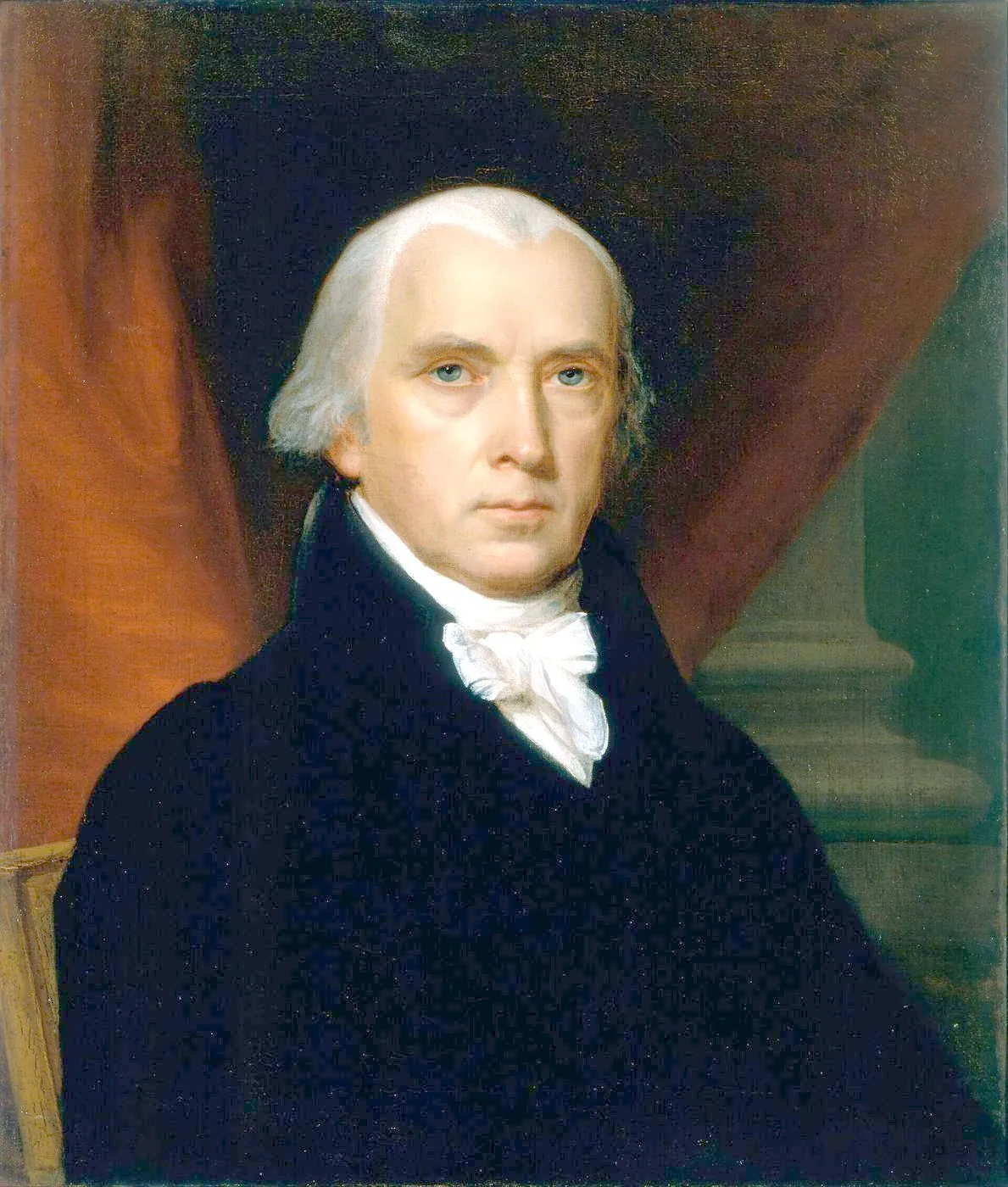
This James Madison timeline traces his path from constitutional theorist to fourth president, covering his role in drafting the Constitution, the Bill of Rights, and his leadership during the War of 1812.
Architect of the Constitution
James Madison was born on March 16, 1751, in Port Conway, Virginia, and grew up at Montpelier, his family’s plantation. A meticulous student of political history and comparative government, Madison arrived at the 1787 Constitutional Convention in Philadelphia having already researched the failures of earlier confederations, and his Virginia Plan helped shape the structure of the debate itself. His detailed notes on the convention’s proceedings remain one of the most important primary sources for understanding how the Constitution took shape, and his central role in drafting and advocating for it later earned him the popular title “Father of the Constitution,” though Madison himself reportedly considered the document the product of many hands rather than his alone. Alongside Alexander Hamilton and John Jay, he co-wrote the Federalist Papers, a series of essays published under the pseudonym Publius that argued for ratification and remain a foundational text of American political thought. As a member of the first Congress, Madison then drafted the amendments that became the Bill of Rights, having campaigned for a seat by promising constituents he would pursue such protections.
Secretary of State and Path to the Presidency
Madison served as secretary of state under his close ally Thomas Jefferson from 1801 to 1809, a period that included the diplomatic groundwork accompanying the Louisiana Purchase and Jefferson’s efforts to keep the United States out of the wars then consuming Europe. He was elected president in 1808 as Jefferson’s chosen successor and took office in March 1809, inheriting escalating tensions with Great Britain over trade restrictions and the impressment of American sailors into the British navy, along with ongoing disputes over British support for Native American resistance along the western frontier.

The War of 1812 and Later Life
Those tensions erupted into the War of 1812, a conflict fought against Britain over maritime rights, trade, and territorial pressures along the frontier. The war went poorly for the United States in several respects, culminating in August 1814 when British troops captured Washington, D.C., and burned the White House, the Capitol, and other public buildings; Madison and the government were forced to flee the city, and First Lady Dolley Madison became known for helping save a full-length portrait of George Washington before the building was set ablaze. The war ultimately ended in a stalemate with the Treaty of Ghent, signed in December 1814, which restored prewar boundaries without resolving the maritime disputes that had triggered the conflict; the war nonetheless produced a surge of postwar nationalism sometimes called the Era of Good Feelings under Madison’s successor. Madison left office in 1817 and retired to Montpelier, where he remained active in public affairs, later serving as a delegate to Virginia’s 1829 constitutional convention, helping Jefferson establish the University of Virginia, and eventually succeeding Jefferson as the university’s rector. He died on June 28, 1836, the last of the Constitution’s framers to survive, having outlived every other Founding Father present at the 1787 convention.
Frequently Asked Questions
What does this James Madison timeline cover?
This timeline covers Madison's 1751 birth in Virginia, his central role in drafting the Constitution and Bill of Rights, his service as secretary of state, and his presidency from 1809 to 1817, including the War of 1812.
Why is James Madison called the 'Father of the Constitution'?
Madison earned the title for his extensive preparatory research, his Virginia Plan, and his influential role in the debates and drafting at the 1787 Constitutional Convention, though he himself credited the document to the collective work of the convention.
What happened to Washington, D.C. during the War of 1812?
In August 1814, British forces captured the capital and burned several public buildings, including the White House and the Capitol, forcing Madison and the government to evacuate temporarily.