
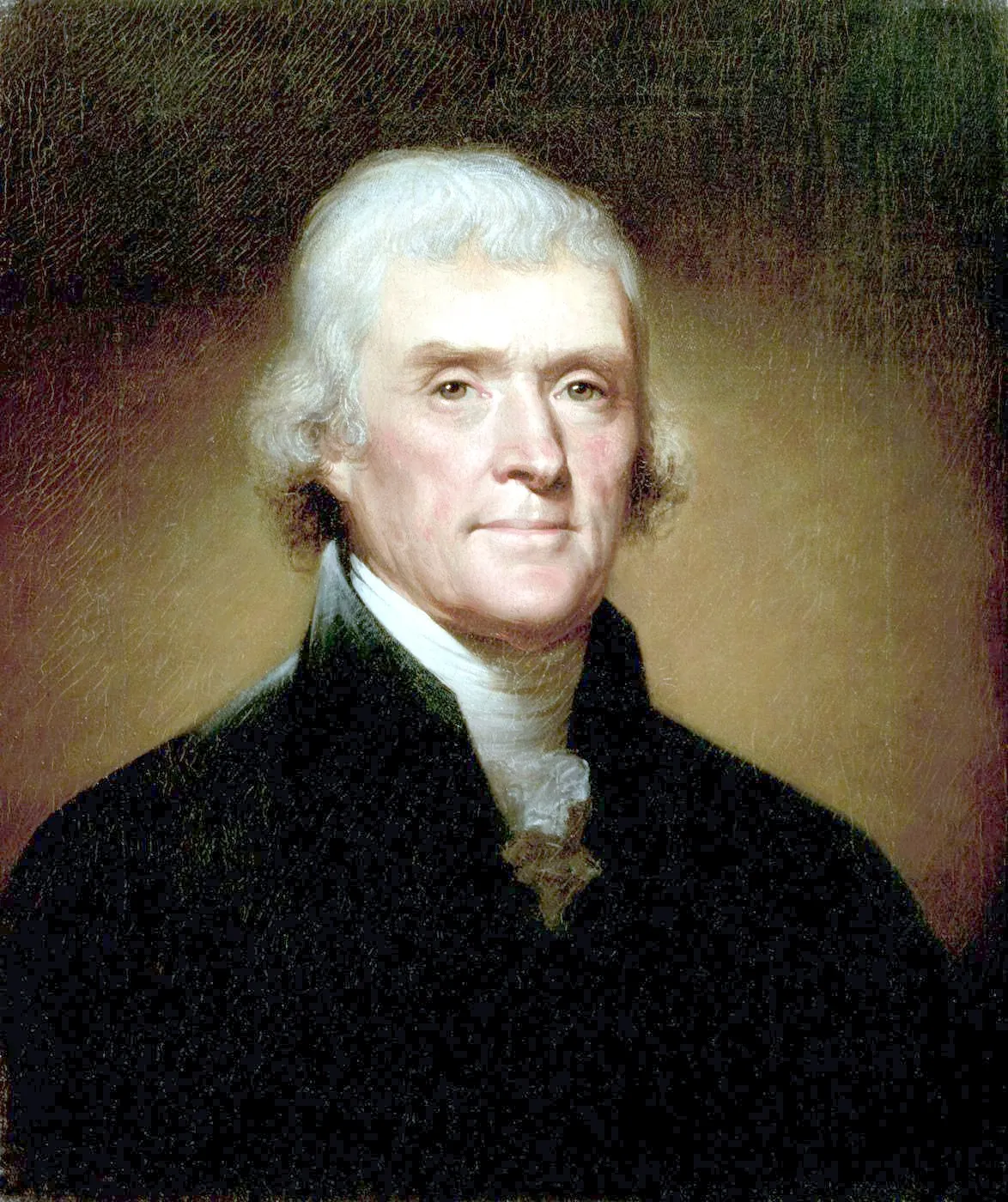
This Thomas Jefferson timeline follows his path from Virginia planter and revolutionary writer to the presidency, covering the Declaration of Independence, the Louisiana Purchase, and the legacy he left behind.
Revolutionary Writer and Diplomat
Thomas Jefferson was born on April 13, 1743, at Shadwell in colonial Virginia, and trained as a lawyer before entering colonial and revolutionary politics. In 1776, the Continental Congress selected him as the principal drafter of the Declaration of Independence, and his language, asserting that all men are created equal and possess unalienable rights, became the founding statement of American political identity, even as Jefferson himself owned enslaved people throughout his life, a contradiction historians continue to examine closely. After serving as governor of Virginia during the Revolutionary War, Jefferson spent several years in France as the American minister, observing the early stages of the French Revolution before returning home to serve as the nation’s first secretary of state under President Washington, where his disputes with Treasury Secretary Alexander Hamilton over federal power helped crystallize the young republic’s first political parties.

Election and the Louisiana Purchase
Jefferson ran for president in 1796, losing narrowly to John Adams and serving as vice president under the rules of the time, then ran again in 1800 against Adams. That election produced a tie in the electoral college between Jefferson and his own running mate, Aaron Burr, throwing the decision to the House of Representatives, which chose Jefferson after dozens of ballots. His inauguration in March 1801 is generally regarded as the first peaceful transfer of power between opposing political parties in the young nation’s history. The defining achievement of Jefferson’s presidency came in 1803, when his administration negotiated the purchase of the vast Louisiana Territory from Napoleonic France for approximately $15 million, roughly doubling the territorial size of the United States even though Jefferson himself had constitutional doubts about the president’s authority to make such an acquisition. The following year, he commissioned Meriwether Lewis and William Clark to lead an expedition across the new territory to the Pacific coast, a journey that produced detailed records of the land, its peoples, and its resources.
Second Term and Later Legacy
Jefferson won reelection in 1804 by a wide margin, reflecting the popularity his first term had built, but his second term proved more difficult, dominated by efforts to keep the United States out of the Napoleonic Wars raging in Europe. His 1807 Embargo Act, intended to pressure Britain and France by cutting off American trade, instead devastated the American shipping economy and proved deeply unpopular, and it was repealed shortly before he left office in 1809. After retiring to his Monticello estate, Jefferson founded the University of Virginia in 1819, designing much of its campus himself and viewing the project as one of his most significant accomplishments alongside the Declaration of Independence and his advocacy for religious freedom. Jefferson died on July 4, 1826, the fiftieth anniversary of the Declaration’s adoption, on the same day as his one-time rival and later friend John Adams. Historical and DNA evidence has established that Jefferson fathered children with Sally Hemings, an enslaved woman at Monticello, a fact now generally accepted by mainstream historians and the Thomas Jefferson Foundation itself.
Frequently Asked Questions
What does this Thomas Jefferson timeline cover?
This timeline covers Jefferson's 1743 birth in Virginia, his authorship of the Declaration of Independence, his service as secretary of state and vice president, his presidency from 1801 to 1809 including the Louisiana Purchase, and his later founding of the University of Virginia.
How did the Louisiana Purchase happen?
In 1803, Jefferson's administration negotiated the purchase of the Louisiana Territory from France for roughly $15 million, acquiring land that would eventually form all or part of more than a dozen future states.
Why was the 1800 election decided in the House of Representatives?
Under the electoral rules in place at the time, Jefferson and his running mate Aaron Burr received an equal number of electoral votes, and the tie was broken by the House of Representatives, which selected Jefferson after an extended series of ballots.