
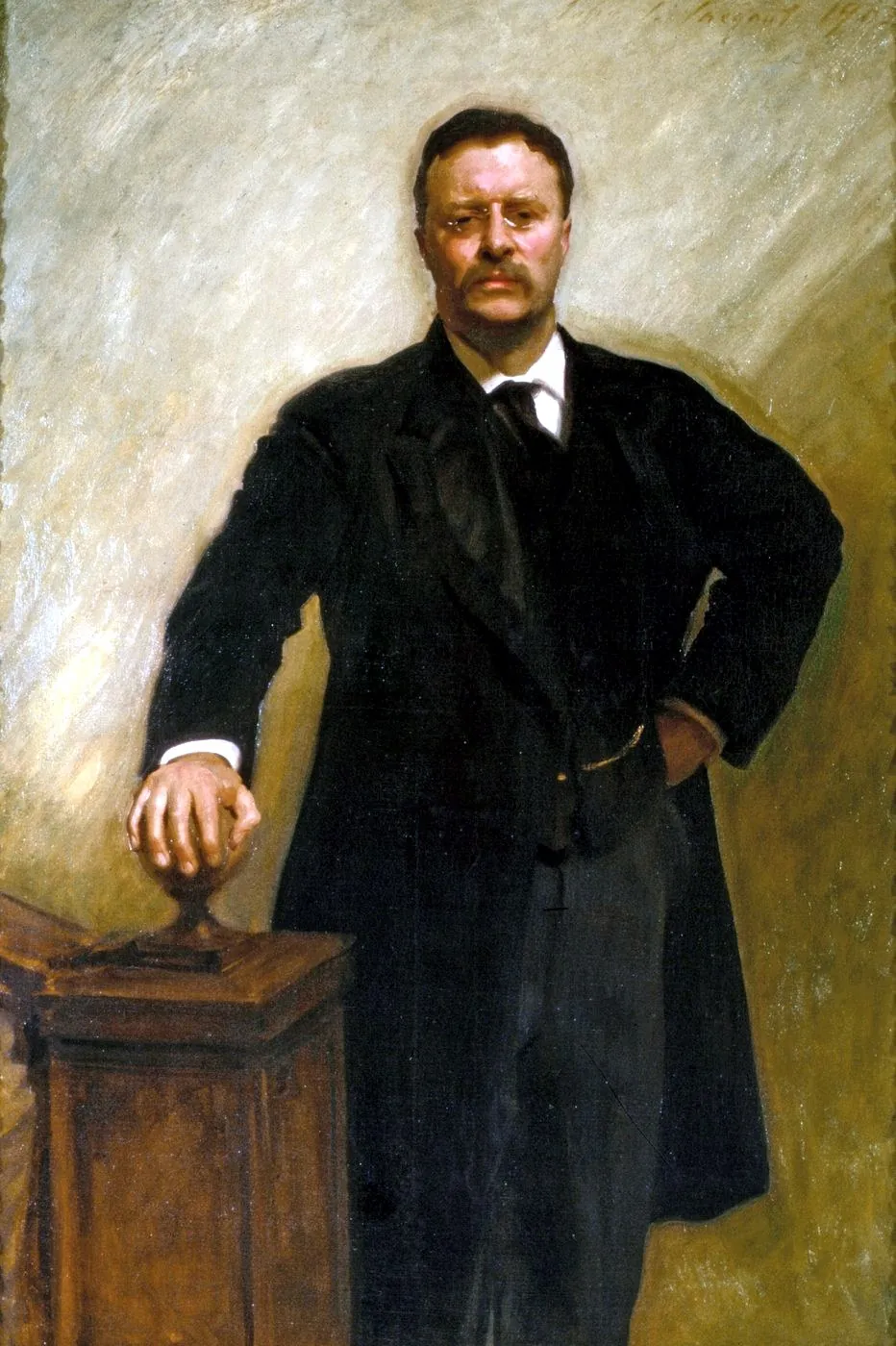
This Theodore Roosevelt timeline traces his path from a frail New York childhood to Rough Rider fame, an accidental presidency forged by assassination, and a legacy built on trust-busting, conservation, and a more assertive American role in the world.
Early Life and the Rise of a Rough Rider
Theodore Roosevelt was born on October 27, 1858, in New York City to a wealthy and prominent family, and spent much of his childhood battling severe asthma and poor health, which he addressed through what he later called “the strenuous life,” a self-imposed regimen of boxing, horseback riding, and vigorous outdoor exercise. He graduated from Harvard, entered New York politics as a reform-minded state assemblyman, and cycled through an unusually varied early career that included ranching in the Dakota Badlands after the deaths of his first wife and mother on the same day in 1884, serving as a New York City police commissioner known for aggressive anti-corruption enforcement, and running the U.S. Civil Service Commission in Washington. As Assistant Secretary of the Navy under President McKinley, he pushed for a stronger fleet, then resigned the post in 1898 to help organize the First U.S. Volunteer Cavalry, popularly known as the Rough Riders. His leadership during the Spanish-American War’s fighting near Santiago, Cuba, made him a national celebrity, propelling him to the New York governorship in 1898 and, two years later, onto McKinley’s reelection ticket as vice president.
Presidency: Trust-Busting, Conservation, and the Panama Canal
Roosevelt became the 26th president in September 1901, at age 42 the youngest man to hold the office, after an anarchist assassinated McKinley in Buffalo. He quickly set his own course, pursuing what he called a “Square Deal” for ordinary Americans: his administration brought the landmark antitrust case that broke up the Northern Securities railroad trust in 1904, and he intervened directly in a major coal strike that year on terms more favorable to labor than prior administrations had typically offered. In foreign affairs, Roosevelt backed Panama’s 1903 secession from Colombia and quickly secured a treaty granting the United States rights to build the Panama Canal, framing American power abroad through what he termed “Big Stick” diplomacy and an expanded Roosevelt Corollary to the Monroe Doctrine.

Conservation became one of his most enduring legacies: using the 1906 Antiquities Act and his executive authority over forest reserves, Roosevelt protected an estimated 230 million acres of public land, including new national forests, game reserves, and monuments such as the Grand Canyon. His administration also pushed through consumer-protection measures such as the 1906 Pure Food and Drug Act and Meat Inspection Act, responding to public alarm over unsanitary industrial practices exposed by investigative journalists of the era. That same year, he became the first American awarded the Nobel Peace Prize, for mediating an end to the Russo-Japanese War at the 1905 Portsmouth peace talks. He had already won a full term in his own right in 1904, defeating Democrat Alton Parker decisively, and his combination of regulatory activism and personal popularity redefined what an assertive American presidency could look like.
The Bull Moose Campaign and Final Years
Roosevelt declined to seek a third term in 1908, throwing his support behind his chosen successor, William Howard Taft. He soon grew disillusioned with what he saw as Taft’s overly cautious conservatism, and in 1912 he challenged Taft for the Republican nomination; when the party establishment held firm for Taft, Roosevelt ran instead as the candidate of the new Progressive Party, nicknamed the “Bull Moose” ticket after his remark that he felt “fit as a bull moose.” He survived an assassination attempt in Milwaukee during the campaign, reportedly finishing a scheduled speech with the bullet still lodged in his chest, but the split Republican vote handed the election to Democrat Woodrow Wilson, with Roosevelt finishing second ahead of Taft. He spent his later years writing and exploring, including a punishing 1913–14 expedition into the Brazilian Amazon that permanently damaged his health, and died at his Long Island home, Sagamore Hill, on January 6, 1919.
Frequently Asked Questions
What does this Theodore Roosevelt timeline cover?
This timeline covers Roosevelt's biography from his 1858 birth in New York City through his Rough Rider fame, his 1901 accession to the presidency, his trust-busting and conservation record, the securing of the Panama Canal, his 1912 Bull Moose campaign, and his 1919 death.
How did Theodore Roosevelt become president?
Roosevelt became president in September 1901 after Vice President succession following the assassination of President William McKinley, and was later elected to a full term in his own right in 1904.
What was Theodore Roosevelt's conservation legacy?
Roosevelt used his executive authority and the 1906 Antiquities Act to protect an estimated 230 million acres of public land, establishing national forests, monuments, and wildlife refuges that laid the groundwork for the modern national park system.
Why did Roosevelt run for president again in 1912?
Roosevelt broke with his chosen successor, William Taft, over the direction of the Republican Party, and ran as the Progressive "Bull Moose" candidate, splitting the Republican vote and losing the election to Woodrow Wilson.