
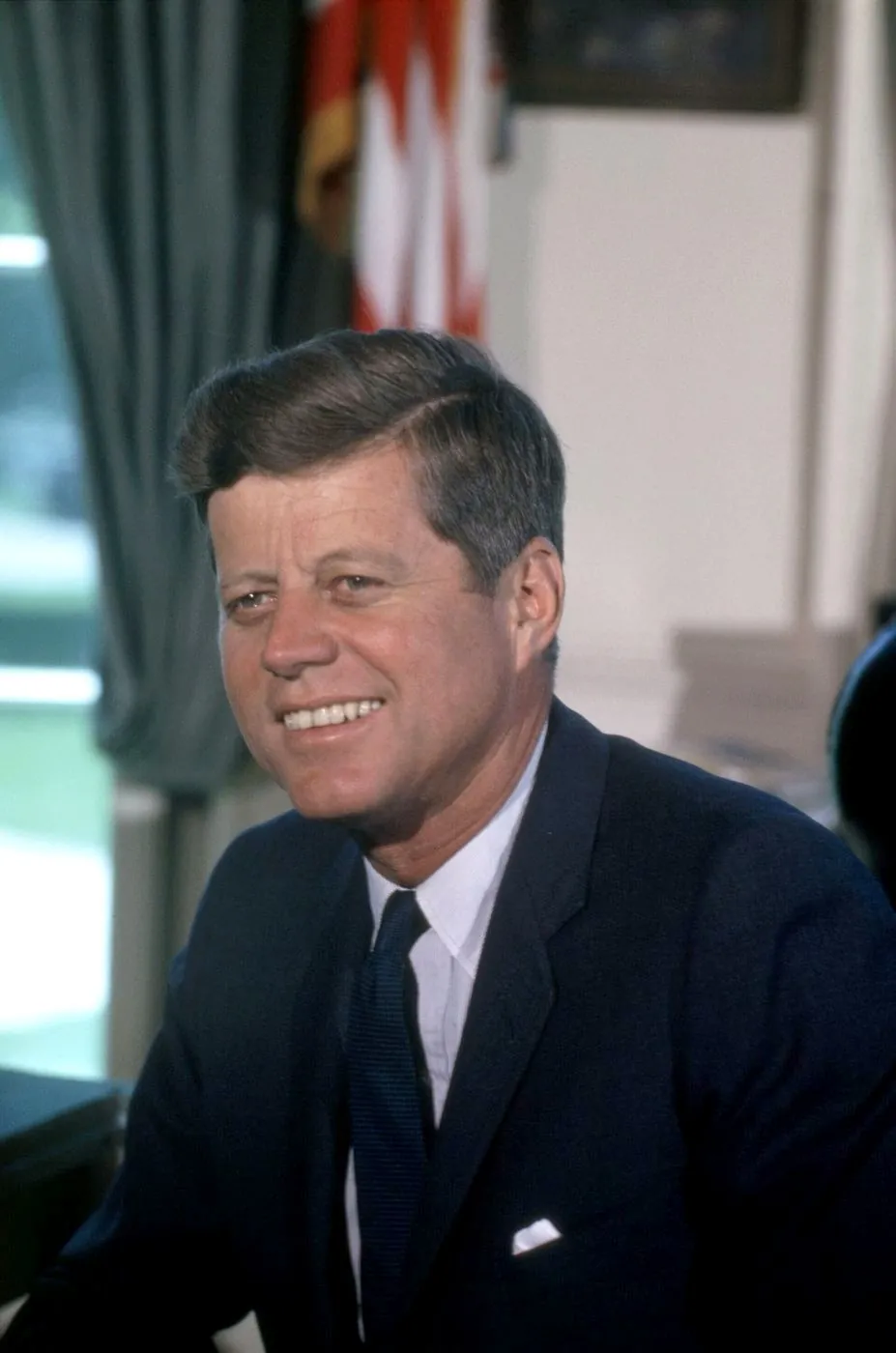
This John F. Kennedy timeline traces his path from a decorated wartime naval officer to the presidency, and the Cold War crises and ambitions that defined his brief time in office.
Early Life and Path to the Presidency
John Fitzgerald Kennedy was born on May 29, 1917, in Brookline, Massachusetts, into a wealthy and politically ambitious Irish-American family. He graduated from Harvard University in 1940 and served in the U.S. Navy during the Second World War, where he commanded the patrol torpedo boat PT-109 in the Pacific; after it was rammed and sunk by a Japanese destroyer in 1943, Kennedy helped lead surviving crew members to safety, an episode that later became central to his public image. After the war, he entered politics, representing Massachusetts in the U.S. House of Representatives from 1947 and the U.S. Senate from 1953. In 1960, he narrowly won the Democratic presidential nomination and went on to defeat Republican Vice President Richard Nixon in one of the closest popular-vote margins in American history, becoming, at 43, the youngest person ever elected president and the first Roman Catholic to hold the office. His campaign benefited from a series of televised debates with Nixon, widely credited as an early demonstration of television’s growing influence on American politics, and his inaugural address, with its call to “ask not what your country can do for you,” became one of the most quoted speeches in presidential history.
Presidency: Cold War Crises and a New Frontier
Kennedy’s presidency, beginning in January 1961, was quickly tested by Cold War confrontations. In April 1961, a CIA-backed invasion of Cuba by anti-Castro exiles failed disastrously at the Bay of Pigs, an early setback for the new administration. Kennedy also established the Peace Corps in 1961, sending American volunteers abroad on development and educational assignments, and created the Alliance for Progress, an economic cooperation program aimed at Latin America. In October 1962, American reconnaissance revealed Soviet nuclear missiles being installed in Cuba, precipitating the Cuban Missile Crisis: a tense thirteen-day standoff, covered in greater depth elsewhere on this site, that brought the world close to nuclear war before a negotiated resolution saw the missiles withdrawn. Kennedy also pursued an ambitious space program, telling Congress in 1961 that the United States should land a man on the Moon before the decade was out, and used a 1962 speech at Rice University to frame the effort as a defining national challenge, a goal realized after his death, in 1969. At home, his administration moved cautiously but increasingly toward supporting civil rights legislation as the movement’s momentum grew, proposing the bill that would become the Civil Rights Act of 1964, having watched the escalating confrontations over segregation, including the 1963 events in Birmingham, Alabama, unfold on national television.

Assassination and Legacy
On November 22, 1963, Kennedy was assassinated while riding in a presidential motorcade through Dallas, Texas. The Warren Commission, a federal panel appointed to investigate, concluded that Lee Harvey Oswald acted alone in the shooting, though the assassination has remained the subject of enduring public debate and competing theories in the decades since. Kennedy’s death, less than three years into his term, shocked the nation and elevated him into a lasting symbol of youthful promise cut short; his successor, Vice President Lyndon B. Johnson, moved quickly to advance much of Kennedy’s stalled legislative agenda, including the civil rights bill. Historians continue to debate Kennedy’s substantive record given the brevity of his presidency, but his handling of the Cuban Missile Crisis and his articulation of the space program are widely regarded as his most consequential legacies.
Frequently Asked Questions
What does this John F. Kennedy timeline cover?
This timeline covers Kennedy's biography from his 1917 birth in Brookline, Massachusetts, through his wartime Navy service, his 1960 election, the Bay of Pigs and Cuban Missile Crisis, and his 1963 assassination.
What happened during the Cuban Missile Crisis?
In October 1962, Kennedy confronted a Soviet attempt to install nuclear missiles in Cuba, a standoff resolved through negotiation. It is covered in greater depth in a dedicated article on this site.
Who assassinated John F. Kennedy?
Kennedy was assassinated on November 22, 1963, in Dallas, Texas. The Warren Commission concluded that Lee Harvey Oswald acted alone, though the event has remained the subject of enduring debate.
Why is Kennedy associated with the Moon landing?
Kennedy publicly committed the United States to landing a man on the Moon before the end of the 1960s, a goal achieved in 1969, six years after his death.