
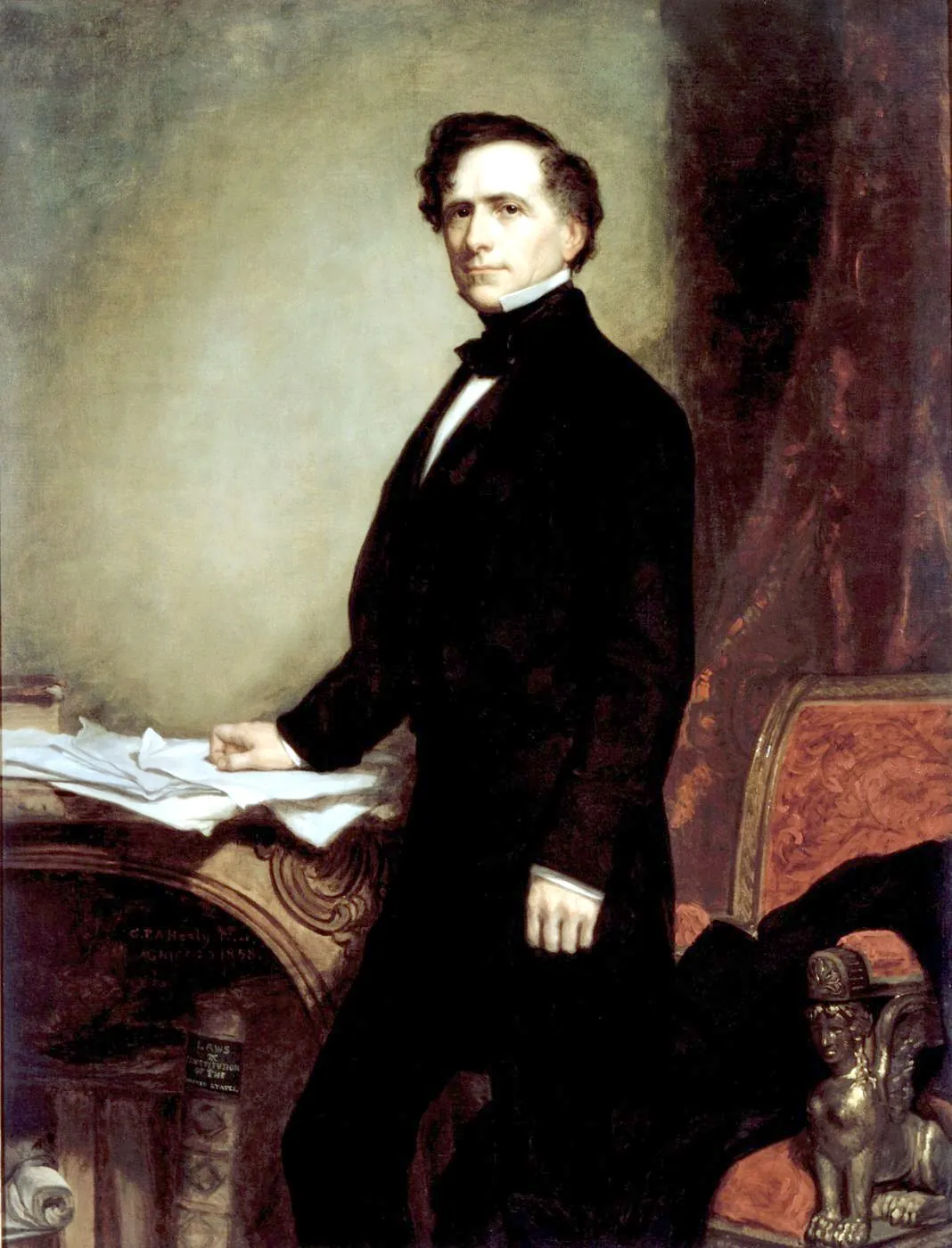
This Franklin Pierce timeline traces his path from a New Hampshire legal and military career to a single presidential term whose legislation on slavery in the territories helped push the country toward civil war.
Early Life and Pre-Presidential Career
Franklin Pierce was born on November 23, 1804, in Hillsborough, New Hampshire, the son of a Revolutionary War veteran and two-term New Hampshire governor. He graduated from Bowdoin College in 1824, studied law, and quickly rose through New Hampshire’s Democratic Party, serving in the state legislature before winning election to the U.S. House of Representatives and later the U.S. Senate. He resigned from the Senate in 1842 to return to private legal practice in Concord, New Hampshire, partly at the urging of his wife, Jane Means Appleton Pierce, who disliked Washington life and suffered from poor health and depression throughout their marriage. When the Mexican-American War began, Pierce enlisted as a private and was quickly commissioned a brigadier general of volunteers, serving under General Winfield Scott in the campaign for Mexico City, where he was injured after his horse fell during battle; the experience gave him a military profile he later used to build national political support.
The Presidency: The Kansas-Nebraska Act and Sectional Crisis
Pierce emerged as a compromise “dark horse” candidate at the 1852 Democratic National Convention and won the presidency in a landslide over Winfield Scott, though his term began in tragedy when his young son Benjamin was killed in a train accident shortly before the inauguration. As president, Pierce’s administration completed the Gadsden Purchase in 1853, acquiring a strip of land from Mexico intended to support a southern transcontinental railroad route. His most consequential act, however, was signing the Kansas-Nebraska Act in 1854, which organized the Kansas and Nebraska territories and allowed settlers there to decide the question of slavery through popular sovereignty, effectively repealing the Missouri Compromise’s slavery line. The law triggered a wave of pro- and anti-slavery settlers into Kansas Territory and the violent sectional conflict that became known as “Bleeding Kansas,” severely damaging Pierce’s standing and deepening the national rift over slavery that would culminate in the Civil War. His administration’s expansionist ambitions, including support for schemes to acquire Cuba from Spain and the controversial Ostend Manifesto episode, drew further controversy amid the sectional tensions of the period, feeding Northern suspicions that Pierce’s foreign policy was designed chiefly to extend the reach of slaveholding territory.

Later Years and Legacy
The turmoil surrounding Kansas-Nebraska cost Pierce the support of his own party, and in 1856 the Democrats denied him renomination, making him the only elected president to seek and be refused his party’s nomination for a second term. He returned to New Hampshire, and his final years were marked by personal grief over the deaths of all three of his sons in childhood or youth, and by increasing reliance on alcohol; he publicly opposed the Lincoln administration’s conduct of the Civil War, a stance that further eroded his public standing in the North. Franklin Pierce died in Concord, New Hampshire, on October 8, 1869, having outlived his wife by several years and all three of his children. Historians have generally ranked his presidency among the least effective in American history, largely because of the Kansas-Nebraska Act’s role in accelerating the sectional breakdown that led to civil war just a few years after he left office.