
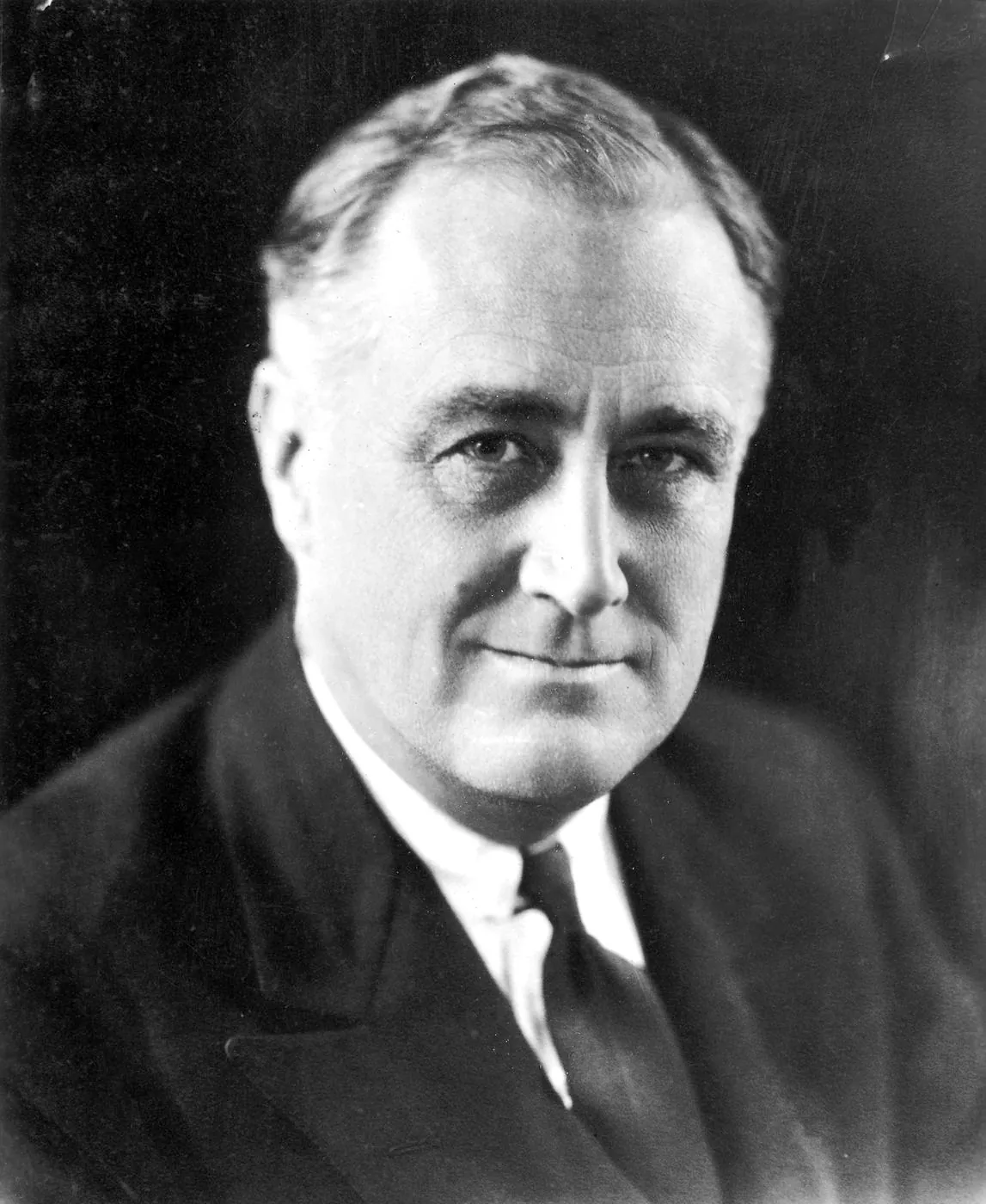
This Franklin D. Roosevelt timeline traces his path from a privileged Hyde Park childhood through paralysis, the New Deal, and leadership of the United States through most of the Second World War.
Early Life and Rise to the Presidency
Franklin Delano Roosevelt was born on January 30, 1882, at his family’s estate in Hyde Park, New York, into a prosperous and politically connected family distantly related to former president Theodore Roosevelt. He was educated at Groton School, Harvard College, and Columbia Law School before entering New York state politics as a Democratic state senator in 1910. President Woodrow Wilson appointed him Assistant Secretary of the Navy in 1913, a post he held throughout the First World War. In 1920, he ran unsuccessfully for vice president on the Democratic ticket, and the following year, at age 39, he was stricken with a paralytic illness, generally diagnosed at the time as polio, that left him unable to walk unaided for the rest of his life. Roosevelt continued in politics despite this, largely concealing the extent of his paralysis from the public, and was elected Governor of New York in 1928. As governor, he introduced relief measures in response to the deepening economic crisis that followed the 1929 stock market crash, building a reputation that carried him to the Democratic presidential nomination in 1932. In 1905, he had married Eleanor Roosevelt, a distant cousin who became an influential political partner throughout his career and, after his death, a prominent public figure in her own right. Seeking relief for his paralysis, Roosevelt also spent time at Warm Springs, Georgia, and helped establish a rehabilitation foundation there for other polio patients.
The New Deal and the Road to War
Roosevelt was elected the 32nd President of the United States in 1932, defeating incumbent Herbert Hoover amid the depths of the Great Depression, a crisis covered in more detail elsewhere on this site. In office, he launched a sweeping program of relief, recovery, and reform known as the New Deal, creating federal agencies aimed at unemployment, banking reform, and public works, and reshaping the federal government’s role in American economic life. Signature measures included the Works Progress Administration, which employed millions on public projects, the Federal Deposit Insurance Corporation, which restored confidence in the banking system, and the Social Security Act of 1935, which established a national system of old-age pensions still in operation today. Voters returned him to office in 1936, 1940, and again in 1944, making him the only president elected to four terms, a run that prompted the later ratification of the Twenty-Second Amendment limiting future presidents to two. As war spread across Europe and Asia in the late 1930s, Roosevelt moved the officially neutral United States toward supporting Britain and its allies through measures such as Lend-Lease, before the Japanese attack on Pearl Harbor on December 7, 1941, brought the country fully into the Second World War.

Wartime Leadership and Death in Office
As commander-in-chief, Roosevelt led the United States through most of its involvement in the Second World War, coordinating military strategy with Allied leaders including Winston Churchill and Joseph Stalin at conferences in Casablanca, Tehran, and Yalta, and overseeing the massive mobilization of American industry and manpower that helped tip the war toward the Allies, including the June 1944 Normandy landings. He also authorized the secret Manhattan Project to develop an atomic weapon, a program whose results would be put to use only months after his death. By early 1945, Roosevelt’s health had visibly declined after more than twelve years in office. He died of a cerebral hemorrhage on April 12, 1945, at Warm Springs, Georgia, less than a month before Germany’s surrender and about four months before Japan’s, leaving Vice President Harry S. Truman to complete the war and begin shaping the postwar world. Roosevelt is widely ranked by historians among the most consequential American presidents, credited with reshaping the federal government’s economic role and steering the nation through depression and global war.
Frequently Asked Questions
What does this Franklin D. Roosevelt timeline cover?
This timeline covers Roosevelt's biography from his 1882 birth in Hyde Park, New York, through his 1921 illness, his 1932 election, the launch of the New Deal, his leadership during the Second World War, and his death in office in 1945.
How many terms did Franklin D. Roosevelt serve as president?
Roosevelt was elected to four terms (1932, 1936, 1940, and 1944), the only president in American history to serve more than two terms. His example led to the Twenty-Second Amendment limiting future presidents to two terms.
What was the New Deal?
The New Deal was Roosevelt's program of federal relief, recovery, and reform measures launched in 1933 in response to the Great Depression, which is covered in greater depth in a dedicated article on this site.
When did Franklin D. Roosevelt die?
Roosevelt died on April 12, 1945, at Warm Springs, Georgia, of a cerebral hemorrhage, just weeks before Germany's surrender ended the war in Europe.