

This Georgia history timeline traces the state’s arc from the Mississippian mound-building societies and their Muscogee and Cherokee descendants, through James Oglethorpe’s 1733 founding of Savannah, to the Civil War, the Civil Rights Movement, and Atlanta’s rise as a modern metropolis, sourced and dated so it can be cited with confidence.
Georgia History Timeline: Indigenous Georgia and the Founding of the Colony
Long before European contact, the region that became Georgia was home to sophisticated Mississippian societies, whose mound-building chiefdoms flourished from roughly 800 to 1600 CE, constructing large earthworks such as those at Etowah as ceremonial and political centers. As these chiefdoms declined following European contact and disease, their descendant communities coalesced into the Muscogee (Creek) and Cherokee peoples who inhabited Georgia when English colonization began. In 1732, King George II granted a charter to the Trustees for Establishing the Colony of Georgia, the last of the thirteen original English colonies, conceived partly as a defensive buffer protecting South Carolina from Spanish Florida and partly, in James Oglethorpe’s vision, as a fresh start for England’s indebted and poor. Oglethorpe personally led about 114 colonists across the Atlantic, landing on a bluff above the Savannah River on February 1, 1733, where he laid out the town of Savannah in a distinctive grid of open public squares that still defines the city today. The original charter uniquely banned slavery and guaranteed religious freedom, drawing early settlers including a Jewish community that became one of the oldest in the American colonies, though the ban on enslaved labor was repealed within two decades under pressure from planters.
Georgia History Timeline: Statehood, Removal, and the Civil War
Georgia ratified the US Constitution on January 2, 1788, becoming the fourth state admitted to the Union after a unanimous vote at a special convention in Augusta. Over the following decades, the state’s cotton economy expanded rapidly, and Georgia authorities pressed for the removal of the Cherokee Nation from its northern territory. Following the disputed Treaty of New Echota, the US Army forcibly removed the Cherokee from Georgia in 1838 and 1839, marching them west on the journey remembered as the Trail of Tears, on which historians estimate roughly 4,000 people died from cold, disease, and exhaustion. By 1861, Georgia’s economy was deeply tied to plantation slavery, and delegates at a state convention in Milledgeville voted to secede from the Union, with the ordinance formally signed on January 21, 1861. Georgia became a major theater of the Civil War, and in 1864 Union General William T. Sherman captured Atlanta before launching his “March to the Sea,” a campaign of deliberate destruction across roughly 200 miles of the state that ended with the fall of Savannah on December 21, 1864, and hastened the Confederacy’s collapse the following spring.
Georgia History Timeline: Reconstruction to the Civil Rights Movement and Today
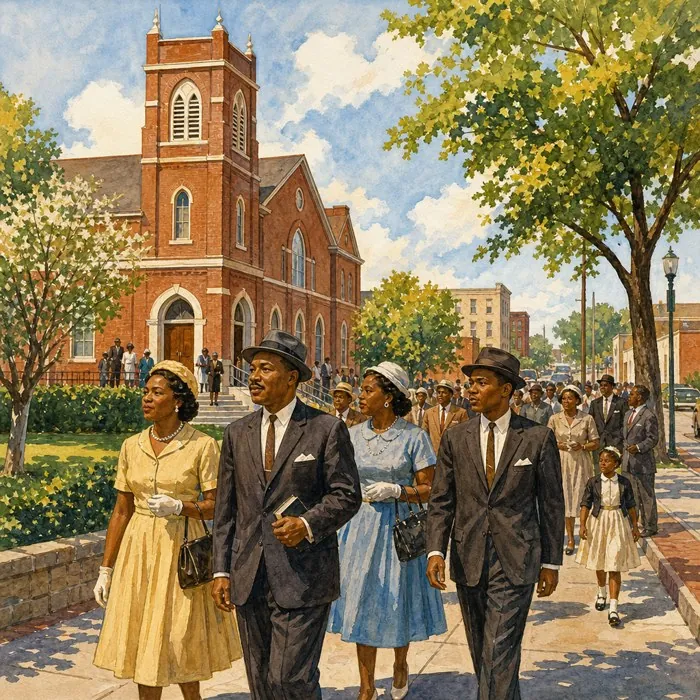
Reconstruction brought Georgia back into the Union, followed by decades of Jim Crow segregation that shaped Black life across the state well into the 20th century. Atlanta became a center of Black education, business, and, later, activism, anchored by institutions along Auburn Avenue and historically Black colleges including Morehouse and Spelman. Martin Luther King Jr. was born in Atlanta on January 15, 1929, and after rising to national prominence in Montgomery, Alabama, he returned to serve as co-pastor of Ebenezer Baptist Church, leading the Southern Christian Leadership Conference from its Atlanta headquarters and helping coordinate the Civil Rights Movement across the South, including the student-led sit-ins that desegregated Atlanta businesses in the early 1960s. In the decades since, Atlanta has grown into one of the largest and fastest-growing metropolitan economies in the United States, a transformation symbolized by its hosting of the 1996 Summer Olympic Games and its rise as a major hub for logistics, finance, film, and technology.
Frequently Asked Questions
What does this Georgia history timeline cover?
This Georgia history timeline covers the state from Mississippian mound-building societies through James Oglethorpe's 1733 founding of Savannah, the Cherokee removal, the Civil War, and into the Civil Rights Movement and Atlanta's growth as a modern metropolis.
Why did James Oglethorpe found the Georgia colony?
Oglethorpe envisioned Georgia as both a defensive buffer protecting South Carolina from Spanish Florida and a fresh start for England's poor and indebted, and he personally led the first colonists ashore at Savannah on February 1, 1733.
What was the Trail of Tears in Georgia?
The Trail of Tears refers to the forced removal of the Cherokee Nation from Georgia and neighboring states in 1838 and 1839, following pressure from state officials and the disputed Treaty of New Echota; historians estimate roughly 4,000 Cherokee died on the journey west.
Why is Atlanta significant to the Civil Rights Movement?
Atlanta was the birthplace and adult base of Martin Luther King Jr., who led the Southern Christian Leadership Conference from the city and preached at Ebenezer Baptist Church, making Atlanta a headquarters for organizing the broader Civil Rights Movement.