
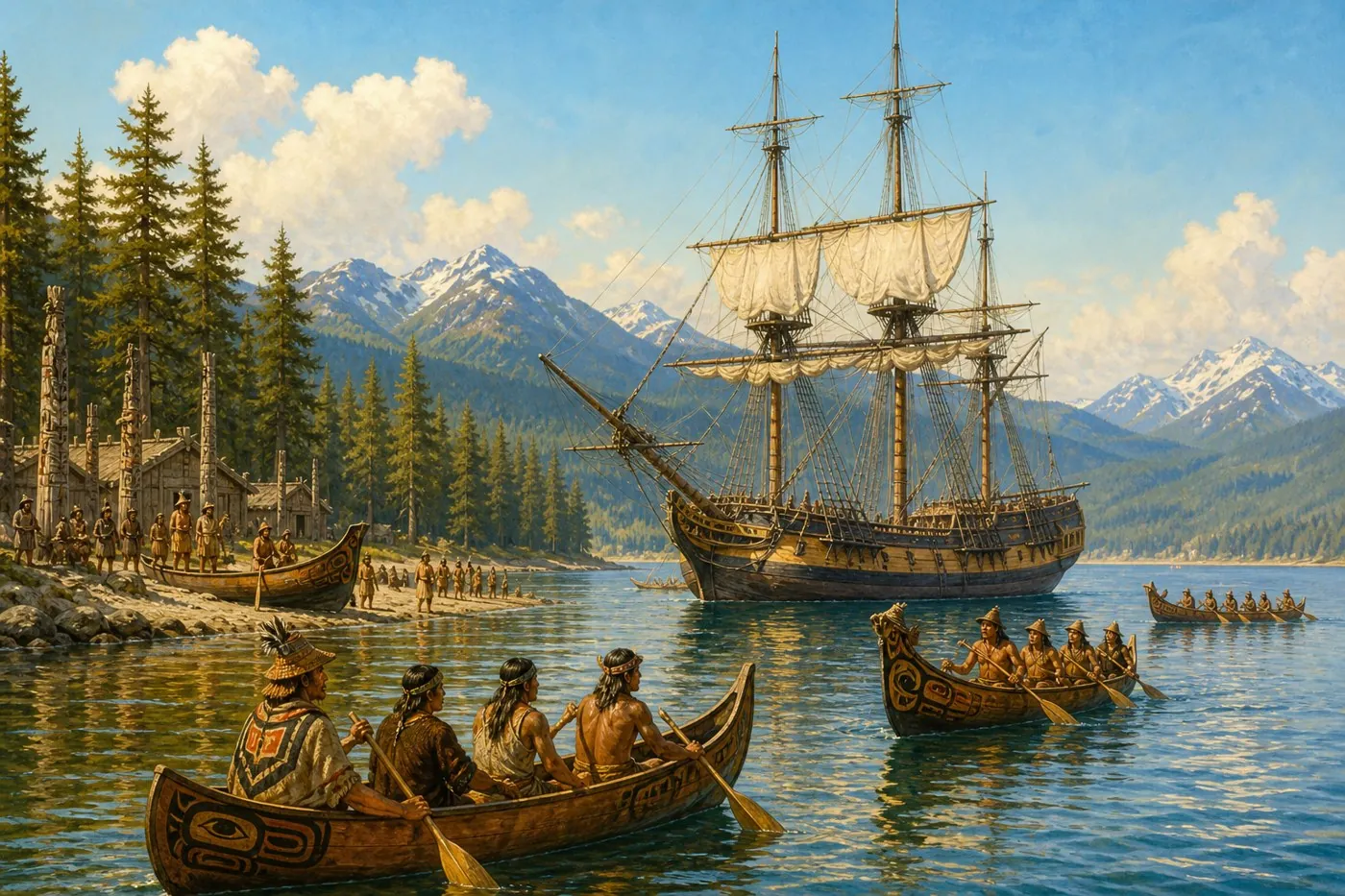
This Washington history timeline traces the state’s story from the Indigenous nations of the Puget Sound region and the era of Spanish, British, and American exploration, through the Hudson’s Bay Company fur trade and the settlers who founded Seattle, to Washington’s 1889 statehood and its 20th-century transformation into a global center of aerospace and technology. Each entry below is dated and sourced so the sequence can be verified and cited with confidence.
Washington History Timeline: Indigenous Nations and European Exploration
For thousands of years before European contact, present-day Washington was home to dense, sophisticated Indigenous societies. Coast Salish-speaking peoples of the Puget Sound lowlands — along with the Nez Perce, Yakama, Chinook, and many other nations across the interior and coast — built large permanent villages supported by abundant salmon runs, shellfish, and cedar forests, developing extensive trade networks and elaborate ceremonial and political systems. Europeans did not reach the region in force until the late 18th century. Spanish explorer Salvador Fidalgo established a short-lived outpost at Neah Bay in 1792, one of the first European settlements in what is now Washington. That same spring, American fur trader Robert Gray and British naval officer George Vancouver both explored the coast within weeks of one another: Gray entered and named the Columbia River in May 1792, strengthening the young United States’ claim to the region, while Vancouver charted and named dozens of features across Puget Sound. Their overlapping voyages set the stage for decades of rival American and British claims to the Pacific Northwest, a dispute that would not be resolved for another half-century.
Washington History Timeline: Fur Trade to Territory and Statehood
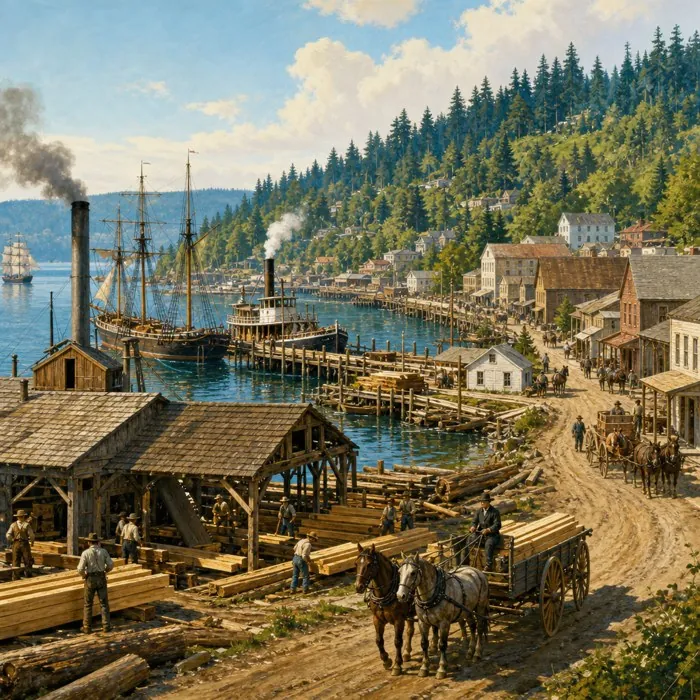
British interests dominated the region through the fur trade era. The Hudson’s Bay Company built Fort Vancouver on the Columbia River in the mid-1820s, making it the commercial and administrative hub of the Pacific Northwest and the center of British influence in the disputed “Oregon Country.” American settlement accelerated in the following decades, and in 1846 the United States and Britain signed the Oregon Treaty, fixing the boundary between their territories at the 49th parallel and placing the future state of Washington under undisputed American claim. Settlers soon followed: on November 13, 1851, a party of pioneers led by Arthur Denny landed at Alki Point on Puget Sound, relocating the following year to a site across Elliott Bay that grew into the city of Seattle. As population grew, Congress organized Washington Territory in 1853, separating it from Oregon Territory. Statehood followed after decades of petitioning: delegates drafted a constitution in Olympia in the summer of 1889, voters ratified it that October, and on November 11, 1889, President Benjamin Harrison proclaimed Washington the 42nd state of the Union.
Washington History Timeline: Industry, War, and the Rise of Seattle Tech
Statehood ushered in an era of rapid industrial growth built on timber, fishing, shipping, and mining. The most consequential new industry arrived in 1916, when William Boeing incorporated Pacific Aero Products Company in Seattle; renamed Boeing Airplane Company the following year, it grew into a dominant force in American aviation, and wartime aircraft production during the Second World War cemented Boeing’s role as one of the state’s largest employers. Seattle’s port and shipyards likewise expanded through both world wars, drawing new residents and diversifying the regional economy. In the second half of the 20th century, Washington’s economy diversified again as software and technology firms took root alongside aerospace: Microsoft, founded in 1975, relocated its headquarters to the Seattle area in 1979, and Amazon, founded in Seattle in 1994, grew from an online bookseller into one of the world’s largest companies. Together with Boeing’s continued aerospace operations, these firms transformed the Puget Sound region into one of the country’s leading technology and innovation hubs, a role that continues to define Washington’s economy into the 21st century.
Frequently Asked Questions
What does this Washington history timeline cover?
This Washington history timeline covers the Indigenous nations of the Puget Sound region, Spanish, British, and American exploration in 1792, the Hudson's Bay Company fur trade, Washington's 1889 statehood, and its growth through Boeing and Seattle's later technology industry.
When did Washington become a state?
Washington became the 42nd state on November 11, 1889, when President Benjamin Harrison proclaimed its admission after delegates drafted a constitution in Olympia and voters ratified it that October.
Why is 1792 significant in Washington's history?
In 1792, American captain Robert Gray entered and named the Columbia River and British captain George Vancouver charted much of Puget Sound, marking the first substantial European exploration of the region and setting up decades of rival American and British claims.
What role did Boeing play in Washington's development?
Founded in Seattle in 1916 by William Boeing, the Boeing Company grew into one of Washington's largest employers and a defining force in American aviation, anchoring an aerospace industry central to the state's modern economy.