
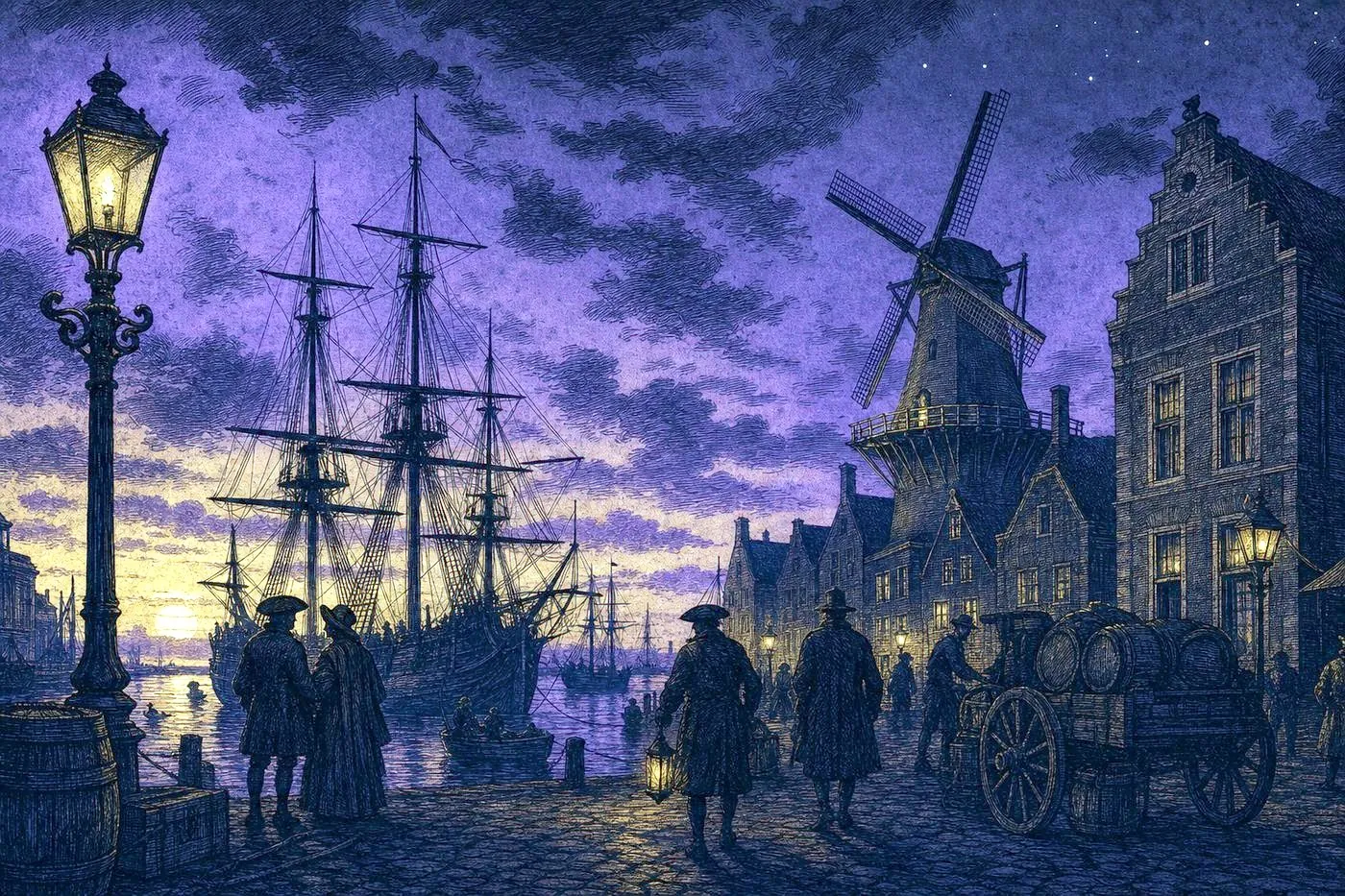
This New York history timeline of events traces the state’s development from Dutch colonial New Amsterdam through one of the original thirteen colonies to the Erie Canal era and the nation’s central gateway for immigration, sourced and dated so it can be cited with confidence.
From Dutch New Amsterdam to English New York
Before European settlement, the region around New York Harbor and the Hudson Valley was home to Algonquian-speaking peoples, including the Lenape, and to the Haudenosaunee (Iroquois) Confederacy further north and west, whose political structures European observers found remarkable. European exploration began with Henry Hudson’s 1609 voyage up the river that would later bear his name, sailing on behalf of the Dutch East India Company. Dutch colonization followed, and in 1624 the Dutch West India Company established the colony of New Netherland, with New Amsterdam founded soon after on the southern tip of Manhattan Island as its capital and principal trading post. According to a widely repeated, though imperfectly documented, colonial account, Dutch official Peter Minuit acquired Manhattan from local Lenape people in 1626 in exchange for trade goods. Dutch rule proved short-lived: in 1664, an English fleet seized New Amsterdam without a fight, and the colony was renamed New York in honor of James, Duke of York. Aside from a brief Dutch reconquest in 1673–74, New York remained an English colony from that point on, though Dutch language, place names, and cultural influence persisted for generations.
Revolution, Ratification, and One of the Original Thirteen Colonies
As one of the thirteen colonies that declared independence in 1776, New York occupied an unusually central and contested position in the Revolutionary War. Following the Battle of Long Island that same year, British forces captured New York City and held it as their principal base of operations for most of the conflict, while campaigns through the Hudson Valley and upstate New York, including the pivotal 1777 victory at Saratoga, helped secure the crucial French alliance that turned the war in the Americans’ favor. After independence was won, New York’s role in shaping the new republic proved just as significant: ratification of the proposed US Constitution faced fierce opposition in the state, and the debate over ratification produced most of the essays later collected as The Federalist Papers, written by Alexander Hamilton, James Madison, and John Jay to build support for the new framework of government. New York ratified the Constitution on July 26, 1788, becoming the 11th state to do so, and New York City briefly served as the young nation’s first capital, hosting George Washington’s 1789 inauguration.

The Erie Canal and the Nation’s Gateway for Immigration
New York’s 19th-century transformation into the country’s commercial and cultural center was driven substantially by a single engineering project: the Erie Canal. Completed in 1825, the 363-mile canal connected the Hudson River at Albany to Lake Erie, opening a direct water route between New York City and the interior of the growing nation. The canal dramatically cut the cost and time of shipping goods, cemented New York City’s position as the country’s leading port, and helped earn the state its nickname, the Empire State. That same commercial dominance made New York Harbor the natural gateway for the waves of immigration that reshaped the United States from the mid-19th century onward. An earlier processing center at Castle Garden gave way in 1892 to Ellis Island, the federal immigration station that would process more than 12 million immigrants before its closure in 1954, with the Statue of Liberty, dedicated in the harbor in 1886, standing as the first sight of the country for many arriving by sea. Together, the canal and the harbor made New York, and above all New York City, the primary point of entry through which generations of immigrants entered American life, a legacy still visible in the state’s exceptional cultural and demographic diversity today.
Frequently Asked Questions
What does this New York history timeline cover?
This New York history timeline of events covers the state from Dutch colonial New Amsterdam through English New York, its role as one of the original thirteen colonies and in ratifying the Constitution, the 1825 opening of the Erie Canal, and its history as the nation's principal gateway for immigration through Ellis Island.
When did New York ratify the US Constitution?
New York ratified the Constitution on July 26, 1788, becoming the 11th state to do so, after a debate that helped produce most of The Federalist Papers.
Why was the Erie Canal so important to New York's history?
Completed in 1825, the Erie Canal connected the Hudson River to Lake Erie, giving New York City a direct water route to the country's interior. It dramatically boosted trade, cemented the city's status as the leading US port, and helped earn the state its nickname, the Empire State.
How many immigrants passed through Ellis Island?
Ellis Island, which opened in New York Harbor in January 1892, processed more than 12 million immigrants before it closed in 1954, making it the busiest US immigration inspection station of its era.