
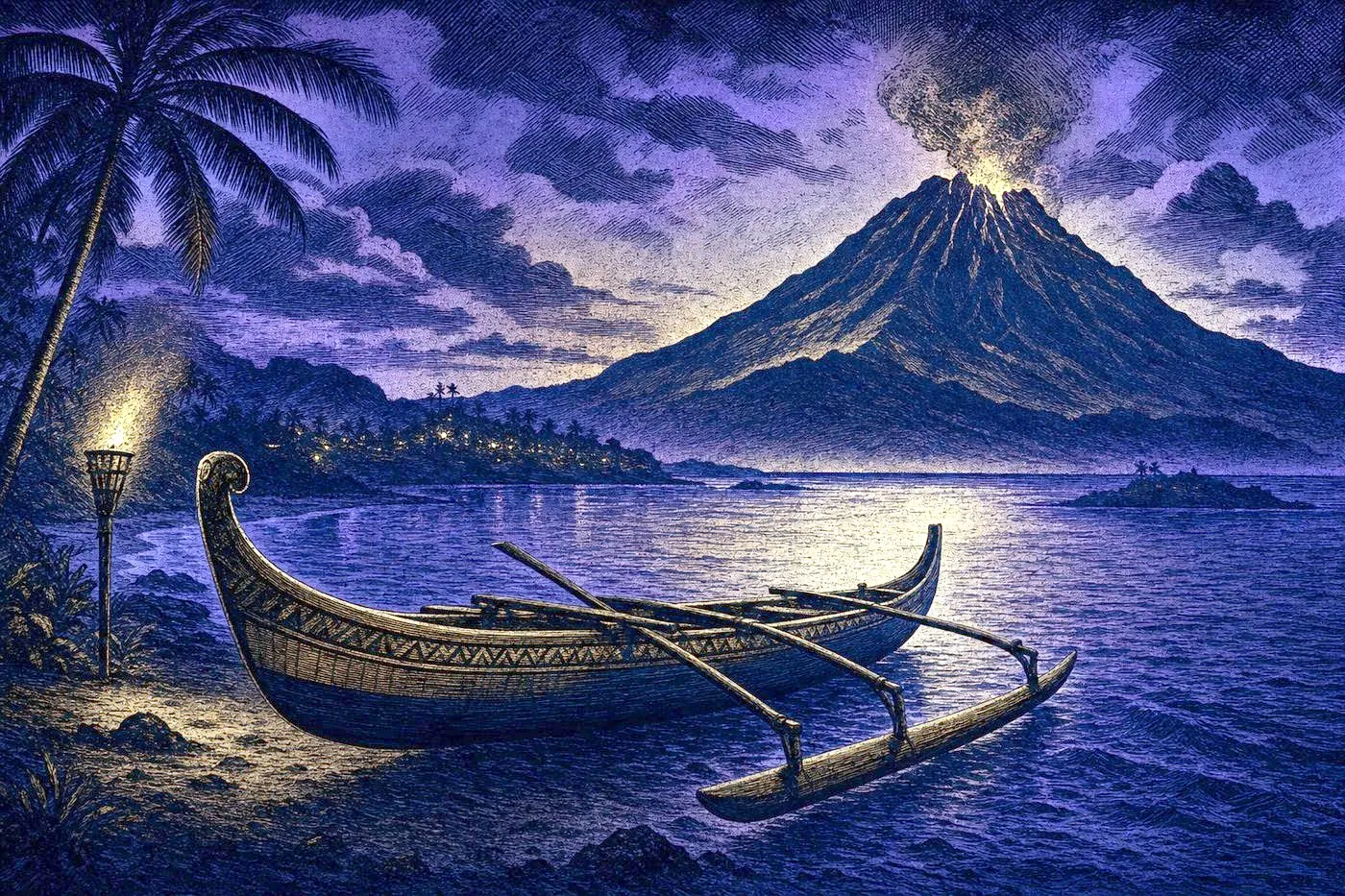
This Hawaii history timeline traces the islands from ancient Polynesian settlement through the Kingdom of Hawaii, the controversial 1893 overthrow and American annexation, territorial status, and statehood in 1959.
Ancient Hawaii and the Kingdom of Hawaii
The Hawaiian Islands were settled by Polynesian voyagers between roughly 300 and 1200 CE, who voyaged across the Pacific Ocean in double-hulled canoes, navigating by stars and ocean swells. These early inhabitants established a sophisticated agricultural society, developing distinctive Hawaiian culture, language, and governance systems. For centuries, the islands were divided among independent chiefdoms and kingdoms, each controlling particular islands. In 1810, Chief Kamehameha I, armed with firearms acquired through foreign trade, systematically conquered and unified all the Hawaiian islands under his rule, establishing the Kingdom of Hawaii. The kingdom maintained its independence and issued its own constitution (1840), conducted diplomacy with foreign powers, and developed a recognized Hawaiian monarchy. For much of the 19th century, Hawaii remained sovereign, though Western commercial interests, particularly sugar plantations, grew increasingly influential in the islands’ economy and politics.

The Overthrow and American Annexation, 1893–1898
In 1893, American businessmen and military personnel, supported by U.S. Marines, engineered the overthrow of Hawaii’s monarchy, deposing Queen Liliuokalani and ending Hawaiian independence. The overthrow, carried out without authorization from the U.S. government, was subsequently legitimized through American annexation. In 1898, during the Spanish-American War, the United States formally annexed Hawaii as part of its Pacific expansion strategy. The event remains historically controversial; the overthrow was primarily motivated by economic interests of sugar planters and American strategic goals, and it violated Hawaiian sovereignty. In 1993, the U.S. Congress formally apologized for the overthrow of the Hawaiian Kingdom, recognizing it as a wrongful act. Hawaiians have since worked to preserve and revitalize their cultural heritage, language, and sovereignty within the American political system.
Territorial Status and Statehood, 1900–1959
Following annexation, Hawaii was organized as a U.S. territory in 1900 under the Organic Act. For nearly 60 years, Hawaii remained a territory rather than a state, governed by a presidential appointee and Congress. During this period, the islands’ economy was dominated by the sugar and pineapple industries, and Hawaii became an increasingly important strategic military location, particularly after the attack on Pearl Harbor in 1941. The islands served as a major base for U.S. operations throughout the Pacific War. By the 1950s, Hawaii’s growing population and economic importance made statehood a realistic prospect. On August 21, 1959, Hawaii was admitted as the 50th state, making it the most recent state to join the Union (alongside Alaska that same year). Today, Hawaii remains unique among American states for its distinct Indigenous culture, island geography, and multicultural society shaped by centuries of Hawaiian heritage combined with immigration waves from Asia, Europe, and the mainland United States.
Frequently Asked Questions
How did Kamehameha I unify the Hawaiian Islands?
Kamehameha I used firearms acquired through foreign trade to wage a series of military campaigns against rival chiefs throughout the islands. By 1810, he had conquered and unified all the Hawaiian islands under his rule, establishing the Kingdom of Hawaii and ending centuries of inter-island warfare.
What was the overthrow of the Hawaiian Kingdom?
In 1893, American businessmen and military personnel orchestrated the overthrow of Hawaii's monarchy, deposing Queen Liliuokalani. The U.S. Congress formally apologized for the overthrow in 1993, recognizing it as a wrongful act that violated Hawaiian sovereignty.
Why did the United States annex Hawaii?
The United States annexed Hawaii in 1898 primarily for strategic and economic reasons: sugar plantation interests sought American protection, and the U.S. government saw the islands as strategically important for Pacific naval operations and trade.
When did Hawaii become a state, and why did it take so long?
Hawaii was admitted as the 50th state on August 21, 1959. It remained a territory for 60 years after annexation because of various political and demographic factors, but statehood was finally granted after World War II when Hawaii's strategic importance and economic development made the case compelling.