
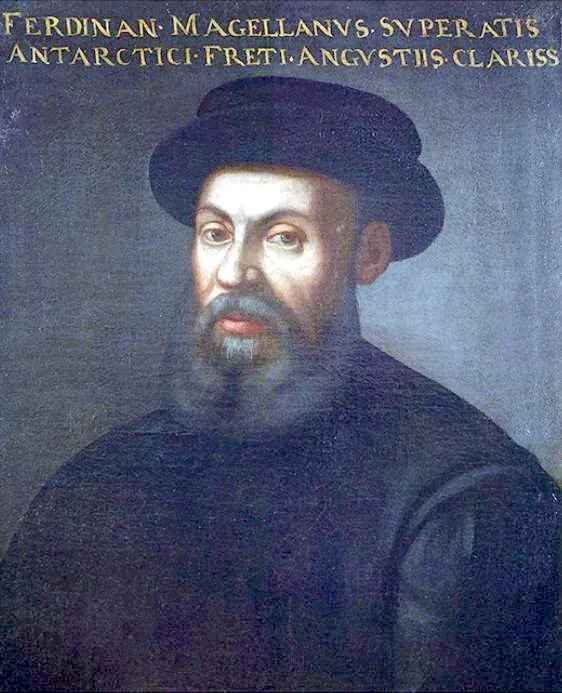
This Ferdinand Magellan timeline follows his career from Portuguese royal service through the Spanish-funded voyage that achieved the first circumnavigation of the globe, a milestone he did not live to see completed.
Early Service and the Turn to Spain
Ferdinand Magellan was born around 1480 in northern Portugal, and as a young man he served the Portuguese crown on voyages to India and the Malay Peninsula, gaining direct experience of the lucrative spice trade routes that connected Europe to South and Southeast Asia, and reportedly taking part in military engagements in the region as well. Details of his early life are sparse, and some biographical particulars, including his exact birthplace, are inferred rather than fully documented. After a dispute over pay and status, and after a request for an increase in his royal stipend was refused, Magellan fell out of favour with the Portuguese king and turned to Spain, proposing to the young King Charles I that a westward route around South America could reach the Spice Islands (the Moluccas) without infringing on Portugal’s eastern routes, which had been established under the Treaty of Tordesillas dividing newly discovered lands between the two crowns. Spain agreed to fund the venture, appointing Magellan captain-general of the fleet, and in September 1519 he departed Sanlúcar de Barrameda with five ships (the Trinidad, San Antonio, Concepción, Victoria, and Santiago) and a crew of roughly 270 men drawn from several nations.

The Voyage and the Strait
The expedition faced mutiny, desertion, and severe hardship as it worked its way down the coast of South America through 1519 and 1520; one ship, the Santiago, was wrecked in a scouting mission, and a serious mutiny among the Spanish captains, who resented serving under a Portuguese commander, was suppressed by Magellan during a long winter stopover on the Patagonian coast. The fleet eventually located the narrow, treacherous passage near the continent’s southern tip that has since borne Magellan’s name: the Strait of Magellan, discovered in late 1520 after weeks of searching its maze of channels. Emerging into the ocean beyond, Magellan named it the Pacific for its apparent calm relative to the strait’s violent currents. The crossing of the Pacific proved far longer than anticipated: the fleet sighted almost no land for months, and the crew suffered severe food shortages, scurvy, and considerable loss of life before reaching Guam and then the Philippines in 1521. There, Magellan became involved in a local political and religious dispute, allying with one regional leader, Rajah Humabon of Cebu, against a rival chief, and was killed in the resulting Battle of Mactan in April 1521.
Legacy of a Voyage Completed by Others
Magellan’s death left the expedition’s survivors to continue without him, and command eventually fell to the Basque navigator Juan Sebastián Elcano. Of the original five ships and roughly 270 men, only one vessel, the Victoria, returned to Spain in September 1522, completing the first known circumnavigation of the Earth with a small fraction, often cited as around 18, of the original crew still aboard, along with a cargo of spices valuable enough to cover much of the expedition’s cost. Because Magellan died partway through the voyage, historians generally credit the expedition as a whole, rather than Magellan personally, with achieving the circumnavigation, though his navigational leadership and the strait he found remain central to the achievement. The voyage transformed European understanding of the planet’s true scale, provided the first practical proof of the Earth’s circumference through direct experience, and confirmed the feasibility, if not the commercial practicality, of a westward route to Asia, cementing Magellan’s place as one of the pivotal figures of the Age of Exploration.
Frequently Asked Questions
What does this Ferdinand Magellan timeline cover?
This timeline covers his Portuguese naval service, his 1519 departure from Spain, his discovery of the strait bearing his name, and his death in the Philippines in 1521 before the voyage's completion.
Did Ferdinand Magellan circumnavigate the globe himself?
Not personally: he was killed in the Philippines in 1521, roughly midway through the voyage. The expedition he led completed the circumnavigation under Juan Sebastián Elcano in 1522.
How did Ferdinand Magellan die?
He was killed in April 1521 during the Battle of Mactan, a conflict with local forces on an island in the present-day Philippines, after becoming involved in a local political dispute.
Why is the Strait of Magellan significant?
It provided the fleet's passage from the Atlantic to the Pacific around the southern tip of South America, and its discovery was essential to the voyage reaching Asia and, eventually, achieving the first circumnavigation of the globe.