
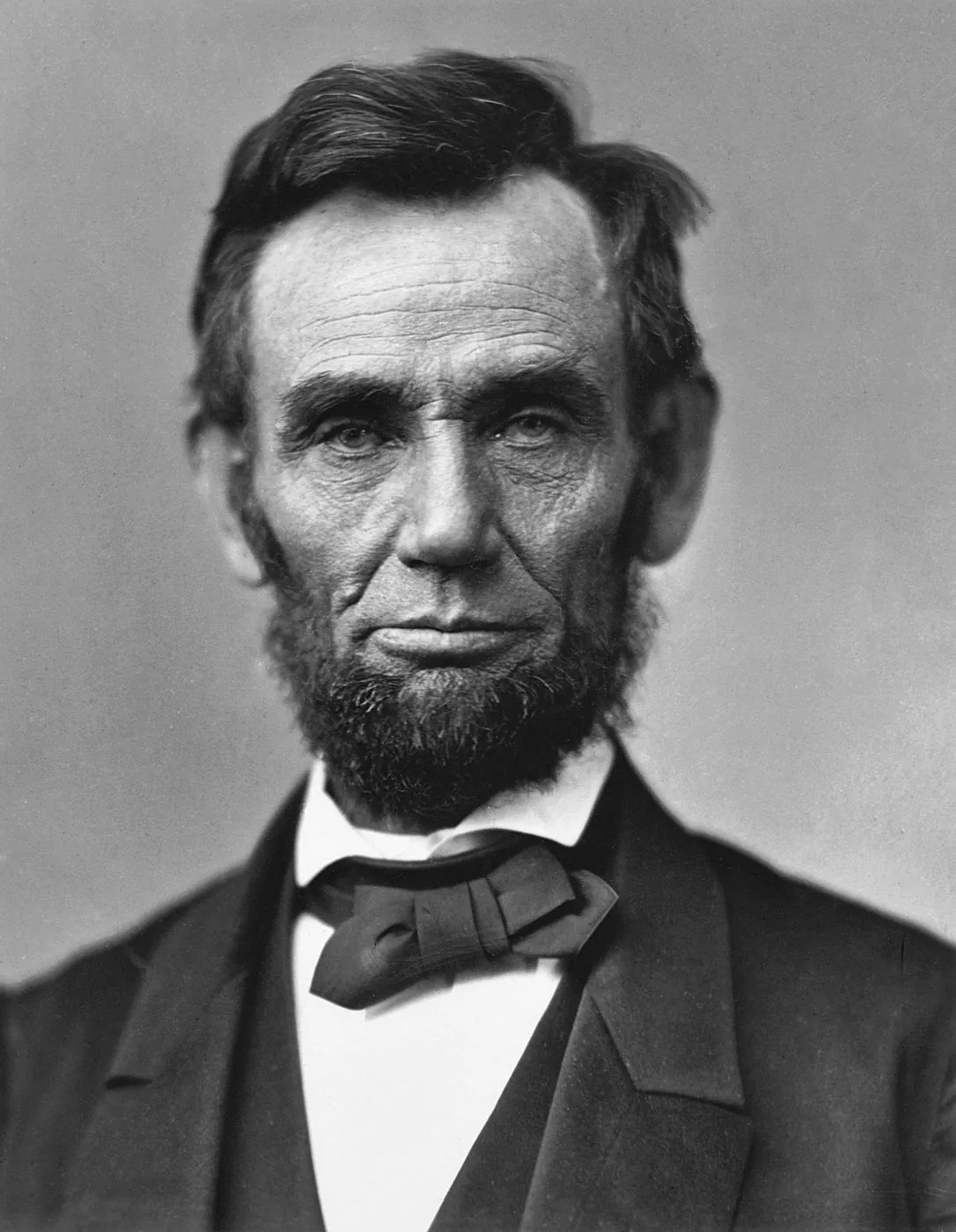
Early Life and Rise in Illinois Politics
Abraham Lincoln was born on February 12, 1809, in a one-room log cabin near Hodgenville, Kentucky, into a farming family with little access to formal education. His family later moved to Indiana and then to Illinois, and Lincoln himself received less than a year of schooling in total, teaching himself law and rhetoric largely through independent reading. He worked as a store clerk, postmaster, and surveyor before turning to law and politics in New Salem and later Springfield, Illinois. In 1834, he won election to the Illinois state legislature as a member of the Whig Party, serving four terms and building the legal practice that supported the family he began with Mary Todd, whom he married in 1842. In 1846, Lincoln was elected to a single term in the U.S. House of Representatives, where he opposed the Mexican-American War, before returning to a successful Illinois law practice for most of the 1850s.
The Road to the Presidency
Lincoln returned to national prominence through the growing debate over slavery’s expansion into new territories, joining the newly formed Republican Party. In 1858, he challenged incumbent Senator Stephen Douglas in an Illinois Senate race built around a series of widely publicized debates on slavery and the future of the Union. Lincoln lost that race, but the debates established him as a leading voice against the spread of slavery, carrying him to the Republican presidential nomination in 1860. That November, he was elected the 16th President of the United States without winning a single electoral vote from the Southern states. His election prompted South Carolina, and soon several other Southern states, to declare secession from the Union, and by the time Lincoln took office in March 1861 the Confederacy had already formed. The American Civil War began weeks later with the Confederate attack on Fort Sumter.
Civil War, the Emancipation Proclamation, and Assassination
As president, Lincoln led the Union through four years of civil war, working to preserve the country while gradually redefining the conflict’s purpose. On January 1, 1863, he issued the Emancipation Proclamation, declaring enslaved people in Confederate-held territory free and recasting the war as a fight against slavery itself, though full abolition nationwide awaited the Thirteenth Amendment, which Lincoln championed and Congress passed in early 1865. Later in 1863, he delivered the Gettysburg Address at the dedication of a Union cemetery, a brief speech that has since become one of the most quoted statements of American political ideals.
Lincoln won re-election in 1864 as the war turned in the Union’s favor, and General Robert E. Lee’s surrender at Appomattox in April 1865 effectively ended the conflict. Days later, on April 14, 1865, Lincoln was shot by John Wilkes Booth while attending a play at Ford’s Theatre in Washington, D.C., and died the following morning. His assassination, coming so soon after the war’s end, left the difficult work of postwar Reconstruction to his successor, Vice President Andrew Johnson, whose approach to that task differed sharply from what Lincoln had outlined in his conciliatory second inaugural address of March 1865. He is widely regarded by historians as one of the most consequential presidents in American history, credited with preserving the Union and setting in motion the legal end of slavery in the United States.