
This Titanic timeline of events traces RMS Titanic from her construction at the Harland & Wolff shipyard in Belfast through her fatal 1912 maiden voyage, tracking the key dates behind one of the most studied maritime disasters in history. As a titanic sinking timeline, it follows the White Star Line’s reputation for an “unsinkable” ship into the North Atlantic ice field where that reputation was tested and failed. Read as history of the titanic timeline, it also covers the inquiries and regulatory changes the disaster forced onto the shipping industry.
Titanic Timeline: Construction and the Sinking of RMS Titanic
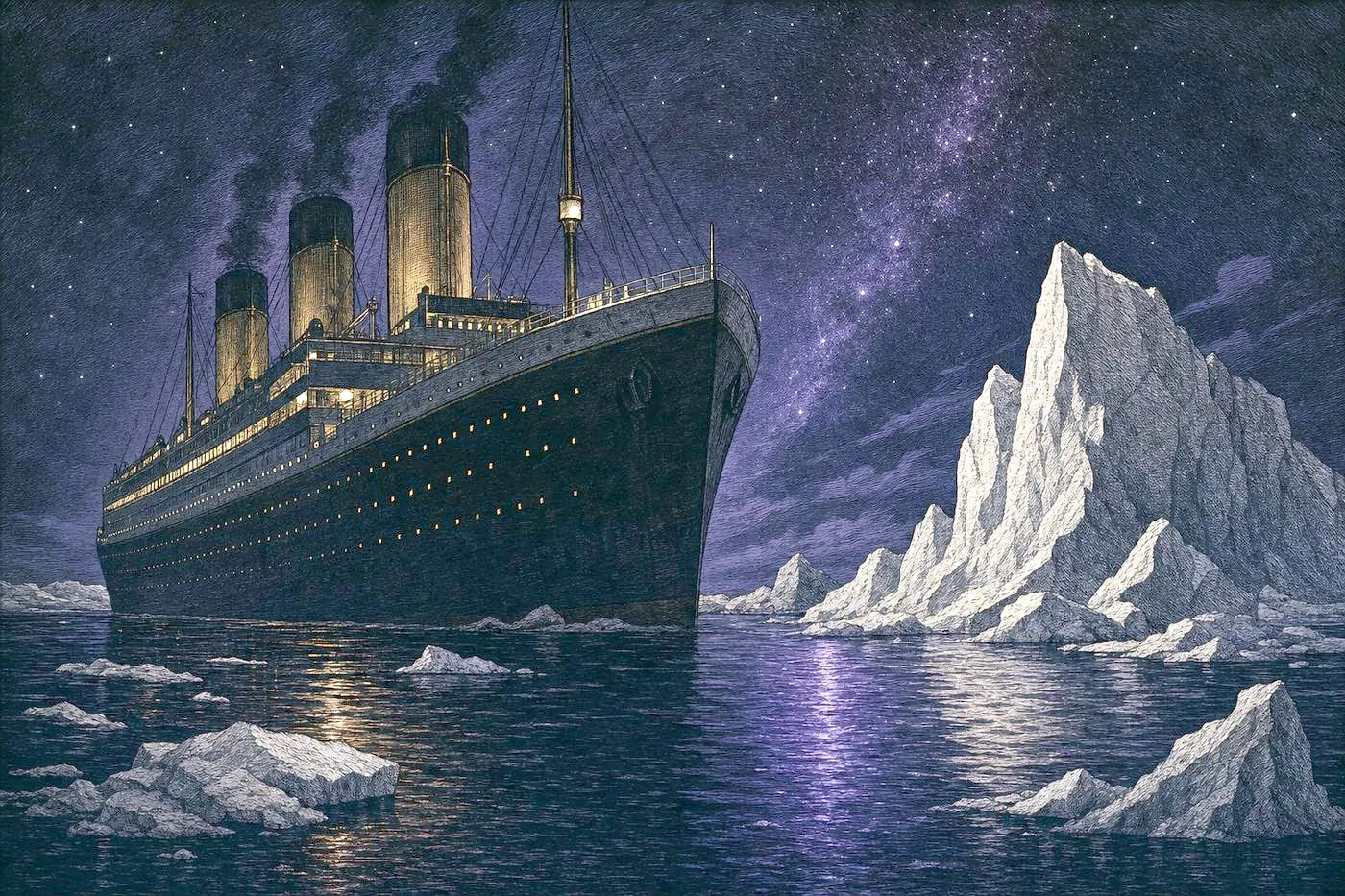
RMS Titanic was built by Harland & Wolff in Belfast for the White Star Line, laid down in 1909 and launched on May 31, 1911. At roughly 46,000 gross tons, she was the largest passenger steamship in the world at the time, and her sixteen watertight compartments led to a popular, though never formally guaranteed, reputation as practically unsinkable. Titanic departed Southampton on her maiden voyage on April 10, 1912, bound for New York with stops at Cherbourg and Queenstown. Despite receiving multiple iceberg warnings from other ships in the days before, Titanic was travelling at close to full speed through the North Atlantic ice field on the night of April 14. At 11:40 p.m., lookouts spotted an iceberg too late to avoid a glancing collision along the starboard side, buckling hull plates and opening several compartments to the sea, more than the ship’s watertight design could survive. Any titanic sinking timeline has to note that the ship carried lifeboats for barely half of those aboard, a shortfall that met outdated Board of Trade regulations tied to a vessel’s tonnage rather than the number of passengers it carried.
The Collision and the Ship’s Final Hours
Titanic’s wireless operators sent distress calls as the crew began loading lifeboats, but confusion, a shortage of trained crew, and the ship’s list slowed the process, and several boats left the davits far from full. The ship broke apart and sank at approximately 2:20 a.m. on April 15, 1912, roughly two hours and forty minutes after the sinking began with the iceberg strike. Widely cited estimates put the death toll at more than 1,500 of the roughly 2,200 people aboard, making it one of the deadliest peacetime sinkings in maritime history. The Cunard liner Carpathia, responding to distress signals, arrived a little over an hour after Titanic went down and rescued the roughly 700 survivors from the ship’s lifeboats.
Inquiry, Regulation, and Titanic’s Place in History
Both the British Wreck Commissioner’s inquiry, led by Lord Mersey, and a United States Senate inquiry chaired by Senator William Alden Smith opened within weeks of the sinking, taking testimony on the ship’s speed, its unheeded ice warnings, and its inadequate lifeboat capacity. Their findings fed directly into the first International Convention for the Safety of Life at Sea (SOLAS), adopted in 1914, which mandated lifeboat space for every person aboard, continuous wireless watch, and the international ice patrol that still monitors North Atlantic icebergs today. Any complete history of the titanic timeline has to credit this regulatory legacy: SOLAS, revised many times since, remains the foundation of international maritime safety law. More than a century later, the Titanic timeline of events is still taught as the moment ocean travel was forced to reckon with the gap between its confidence and its safety record, a turning point that reshaped maritime history.
Frequently Asked Questions
What does this Titanic timeline cover?
This Titanic timeline of events covers the ship's construction, its April 1912 maiden voyage, the sinking after striking an iceberg, and the inquiries and safety reforms that followed.
Why was the Titanic called unsinkable?
Titanic's sixteen watertight compartments gave it a reputation, widely repeated in the press at the time, for being effectively unsinkable, though White Star Line never issued that as a formal guarantee.
How many people died when the Titanic sank?
Widely cited estimates put the death toll at more than 1,500 of the roughly 2,200 passengers and crew aboard, making the sinking one of the deadliest peacetime maritime disasters on record.
What changed after the Titanic disaster?
The sinking led directly to the first SOLAS convention in 1914, which required lifeboat space for everyone aboard a ship, continuous wireless radio watch, and the International Ice Patrol that still tracks North Atlantic icebergs.