
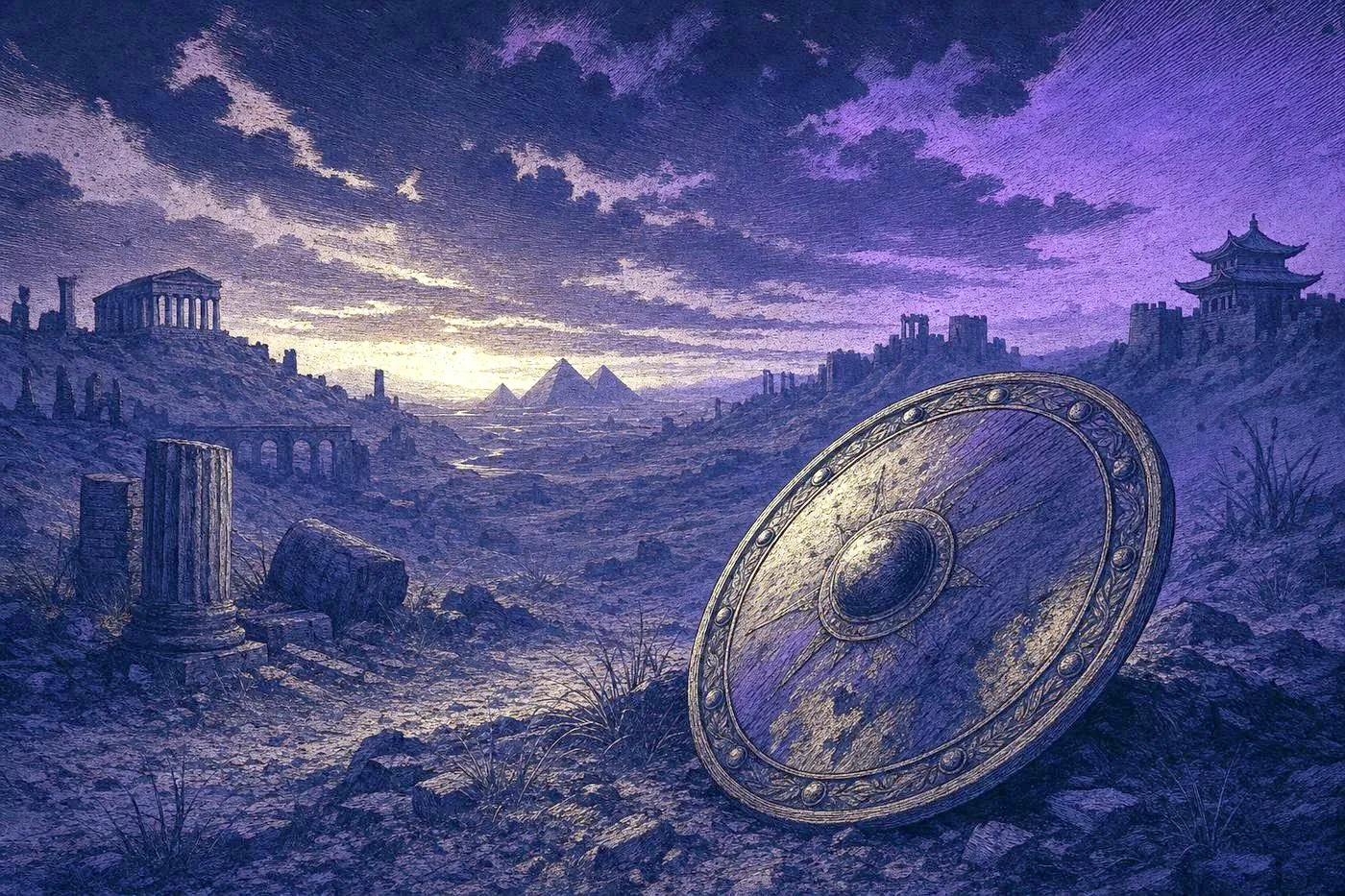
This timeline of war offers a broad, high-level sweep across major conflicts in human history, from an ancient battle recorded on Egyptian temple walls to the industrialized global wars of the twentieth century, rather than tracing any single conflict in depth.
Ancient and Classical Warfare
Organized warfare stretches back further than any detailed written record, but among the earliest large-scale battles documented with reasonable historical confidence is the Battle of Kadesh, fought around 1274 BCE between the forces of Egyptian Pharaoh Ramesses II and the Hittite Empire near the Orontes River in modern Syria. Both sides claimed victory in their own inscriptions, and the conflict is notable less for its outcome than for what followed roughly 15 years later: a peace treaty between Egypt and the Hittites that is among the oldest surviving international agreements of its kind. Centuries later, the Greek world was reshaped by the Peloponnesian War (431–404 BCE), a prolonged struggle between Athens and Sparta and their respective alliances of city-states. Athens, despite its naval strength and cultural prominence, was ultimately defeated, and the war is widely seen by historians as marking the decline of the classical Greek city-state system’s golden age. Much of what is known about the conflict comes from the historian Thucydides, whose contemporary account remains a foundational text in the study of both military history and political strategy.
Medieval and Early Modern Conflict
The medieval and early modern periods produced wars fought over dynastic claims, territory, and religion, often stretching across generations. The Hundred Years’ War (1337–1453) was in fact a series of related conflicts between England and France over succession to the French crown, punctuated by famous battles such as Agincourt in 1415 and by the emergence of Joan of Arc as a rallying figure for French forces; by its end, England had lost nearly all its continental territory. Warfare’s character shifted further with the spread of gunpowder weapons and religious conflict in the Thirty Years’ War (1618–1648), which began as a struggle between Protestant and Catholic states within the Holy Roman Empire before drawing in most major European powers. Estimates of the war’s toll vary, but it is consistently ranked among the most destructive conflicts in European history relative to the populations involved, and it ended with the Peace of Westphalia, an agreement often cited as an early foundation of the modern system of sovereign states. Gunpowder weapons, increasingly professional standing armies, and more systematic military logistics all became standard features of European warfare over this same period, gradually displacing the smaller feudal levies and knightly forces that had characterized medieval battles.
Industrialized and Global Warfare in the Twentieth Century
The twentieth century brought a scale and mechanization of warfare without earlier precedent. World War I (1914–1918), triggered by the assassination of Archduke Franz Ferdinand of Austria-Hungary, drew in empires across Europe and their colonial territories, introducing trench warfare, machine guns, tanks, and chemical weapons, and is generally estimated to have caused millions of military and civilian deaths. Barely two decades later, World War II (1939–1945) became the deadliest conflict in recorded history, fought across Europe, North Africa, the Pacific, and beyond, and involving the majority of the world’s nations in some capacity. It ended in 1945 following the atomic bombings of Hiroshima and Nagasaki, the first and only use of nuclear weapons in warfare, ushering in a nuclear age that reshaped the strategic calculations behind every major conflict since. Viewed together across more than three thousand years, this broad timeline of war traces a shift from localized battles fought with bronze-age weapons to conflicts capable of touching nearly every part of the globe at once, a pattern that later conflicts of the Cold War era and beyond, documented in more detail elsewhere on this site, continued to build upon.