
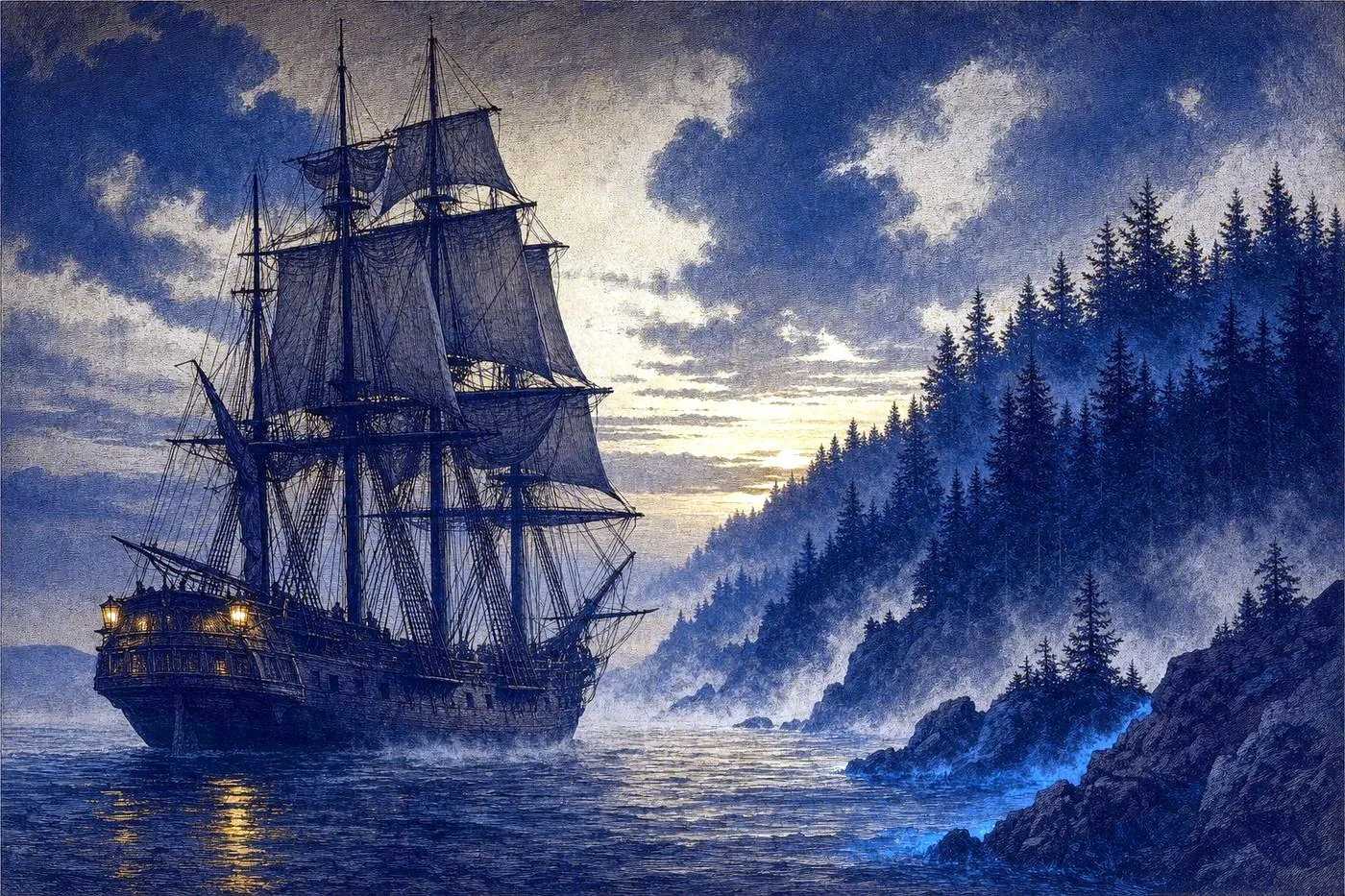
Colonization and the Founding of a Nation
European colonization of the land that became the United States began in earnest in 1607, when English settlers established Jamestown in Virginia, the first permanent English colony in North America. In 1620, a second group of colonists crossed the Atlantic on the Mayflower and landed near present-day Plymouth, Massachusetts, drafting the Mayflower Compact as an early framework for self-government. Over the following century and a half, English, and to a lesser extent Dutch, Swedish, French, and Spanish colonization spread along the Atlantic seaboard and beyond. This growth came at direct cost to the Indigenous nations who already inhabited the continent, who faced displacement, disease, and recurring conflict with colonial settlements. The colonial economy, particularly in the South, also became increasingly dependent on enslaved African labor, a system that would shape American life for centuries. By the mid-1700s, thirteen British colonies had developed distinct identities and growing friction with the Crown over taxation and self-rule, culminating in the Revolutionary War and the Second Continental Congress’s adoption of the Declaration of Independence in 1776. The war ended in 1783, and the new nation drafted the Constitution in 1787, ratifying it in 1788 and adding the Bill of Rights in 1791 to establish the federal system of government still in use today.
Expansion and a Nation Divided
The early republic expanded rapidly. The 1803 Louisiana Purchase from France roughly doubled the country’s size, and over the following decades settlers pushed steadily westward, often under the banner of “manifest destiny.” This expansion accelerated the forced removal of Indigenous nations from their homelands, including the 1830s Indian Removal Act and the Trail of Tears, and it drew the country into further territorial conflict, notably the Mexican–American War of the 1840s, which added much of the present-day Southwest. Meanwhile, slavery remained entrenched in the Southern states even as free states multiplied in the North, and the question of whether new territories would permit slavery grew increasingly volatile. That division erupted into the Civil War in 1861, a conflict between the Union and the Confederate states that lasted until 1865 and remains the deadliest war in American history. President Abraham Lincoln’s 1863 Emancipation Proclamation moved the war’s aims toward ending slavery, and the war’s conclusion was followed by the 13th Amendment’s abolition of slavery nationwide.

Reconstruction, Industry, and a Changing Century
The Reconstruction era that followed the Civil War, roughly 1865 to 1877, attempted to rebuild the South and extend civil rights to formerly enslaved people, though many of those gains were rolled back by discriminatory state laws in the decades that followed. At the same time, the country entered a period of rapid industrialization: railroads, including the transcontinental line completed in 1869, knit the continent together; factories and cities grew quickly; and waves of immigration from Europe and elsewhere reshaped the population, particularly in growing urban centers. By the turn of the 20th century, the United States had become a major industrial power, and the Progressive Era brought efforts to address the social strains of that rapid growth. That trajectory reached a landmark in 1920, when the 19th Amendment guaranteed women the right to vote nationwide, closing out this broad sweep of American history at the threshold of the modern era.