
Mechanical Beginnings
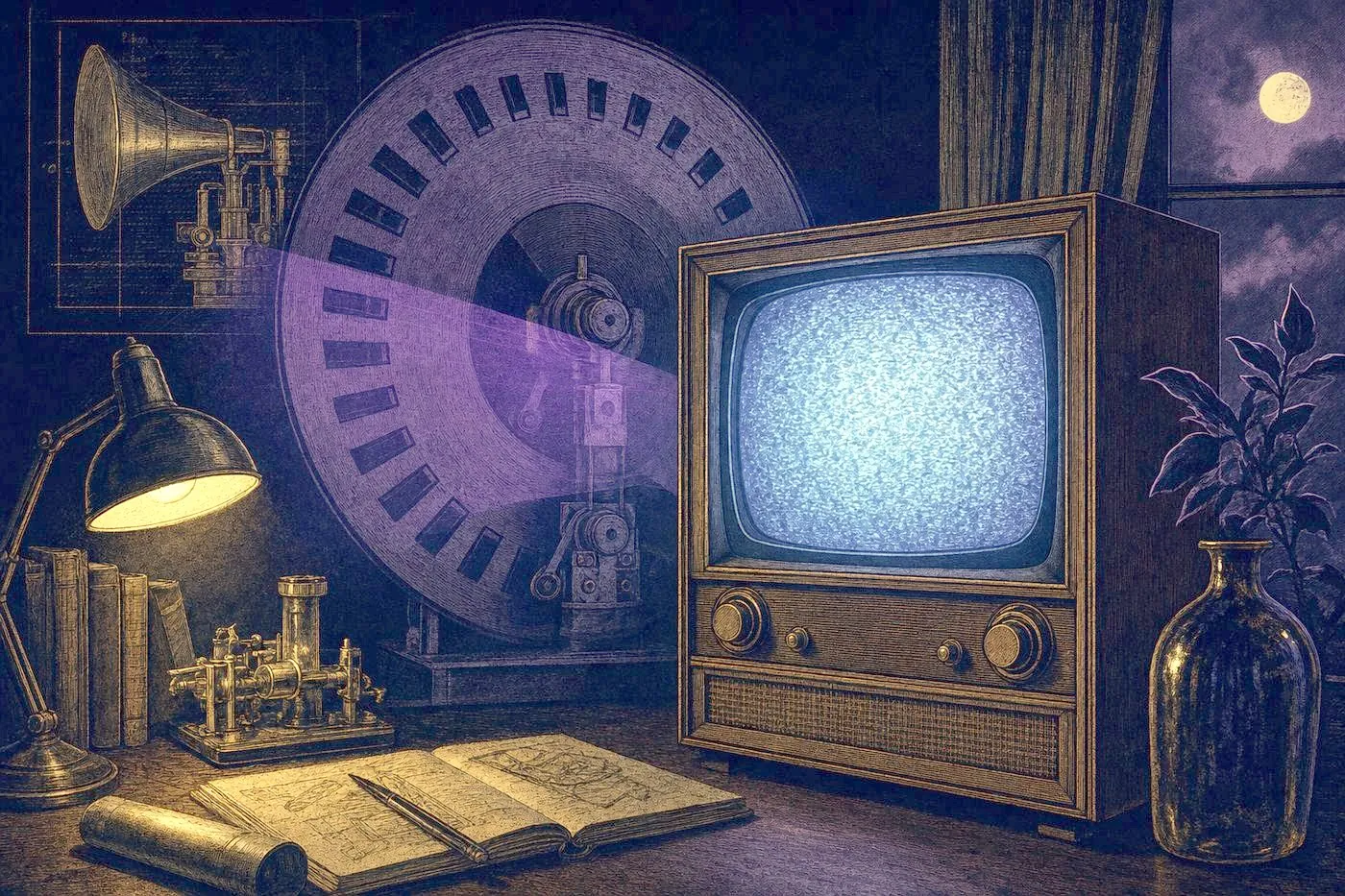
Television did not arrive as a single invention but as the slow convergence of several independent lines of research stretching back to the nineteenth century, when scientists first discovered that the element selenium changed its electrical resistance in response to light. That property suggested, in principle, that images might be converted into electrical signals and sent over a distance. The first person to build a working system around this idea was John Logie Baird, a Scottish engineer who, in 1925, demonstrated a mechanical television that used a rapidly spinning disc perforated with a spiral of holes to scan an image line by line. Baird’s system, crude by later standards, could only reproduce simple silhouettes at first, but by 1926 he had improved it enough to transmit recognisable human faces, and by the early 1930s versions of mechanical television were being trialled by broadcasters in Britain, Germany, and the United States. Mechanical systems shared a fundamental limitation, however: because they relied on physically moving parts to scan an image, they could never produce a picture sharp or fast enough to satisfy audiences used to cinema.
“The spinning disc proved that television was possible; the vacuum tube proved that it could actually work.”
The Shift to Electronic Television
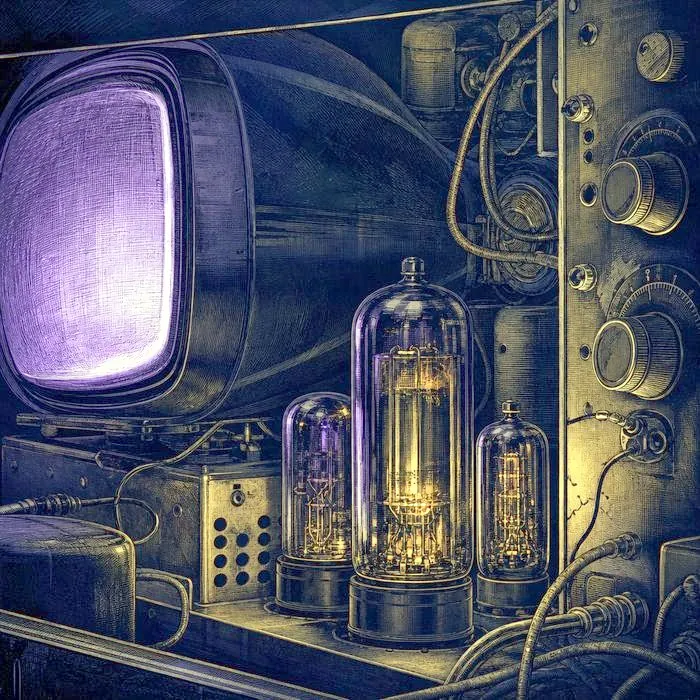
The decisive breakthrough came from an entirely different approach: replacing mechanical scanning with a beam of electrons inside a vacuum tube. In 1927, American inventor Philo Farnsworth, still in his early twenties and working largely on his own funding, successfully transmitted an image using a device he called the “image dissector,” an early form of electronic camera tube that scanned a scene using electrons rather than spinning parts. At almost the same time, Russian-American engineer Vladimir Zworykin, working first at Westinghouse and later at RCA, was developing a rival electronic camera tube known as the iconoscope. The two men’s overlapping patents led to years of legal disputes over who deserved credit for electronic television, a rivalry that historians still debate. What is clear is that by the mid-1930s, electronic systems had decisively outperformed mechanical ones, offering sharper images and far greater flexibility, and broadcasters began shifting their engineering efforts accordingly. The BBC captured this transition directly in 1936, when it launched the world’s first regular high-definition television service from Alexandra Palace in London, initially alternating broadcasts between Baird’s mechanical system and a competing electronic system before dropping the mechanical approach entirely within a year.
From Demonstration to Household Fixture
Television’s introduction to a mass audience is often dated to 1939, when RCA used the New York World’s Fair to showcase electronic television to the American public, with NBC broadcasting the fair’s opening ceremonies, including an address by President Franklin D. Roosevelt, to the small number of receivers then in operation. Commercial development slowed considerably during the Second World War, as manufacturing capacity and engineering talent were redirected toward the war effort, but growth resumed quickly afterward. Through the late 1940s, the number of television sets in American homes rose sharply as broadcast networks expanded their programming and prices for receivers gradually fell. Color television followed a similarly gradual path: after competing technical proposals from RCA and CBS, the Federal Communications Commission approved a color standard in 1953 that was compatible with existing black-and-white sets, meaning older receivers could still display color broadcasts in monochrome. Color adoption remained slow for years afterward, since color sets were expensive and few programs were broadcast in color, but the standard set in 1953 established the technical foundation that television broadcasting would build on for decades to come.